
Research Signal – Source date 2022-07-01
In a review of 30 clinical studies involving 12,921 people with advanced liver cancer, immune checkpoint inhibitors were linked to a lower pooled proportion of serious adverse events than targeted drugs. Yet the estimates for liver-related toxicity did not show the same pattern. For a treatment considered before an operation, those are different questions: how often did serious complications occur overall, and how often did treatment affect the liver?
The review, published July 1, 2022, brought together clinical trials identified through a literature search. Its findings offer context for planning preoperative research. They do not establish that one drug class is safer for every patient, or that either approach reliably gets someone to surgery.
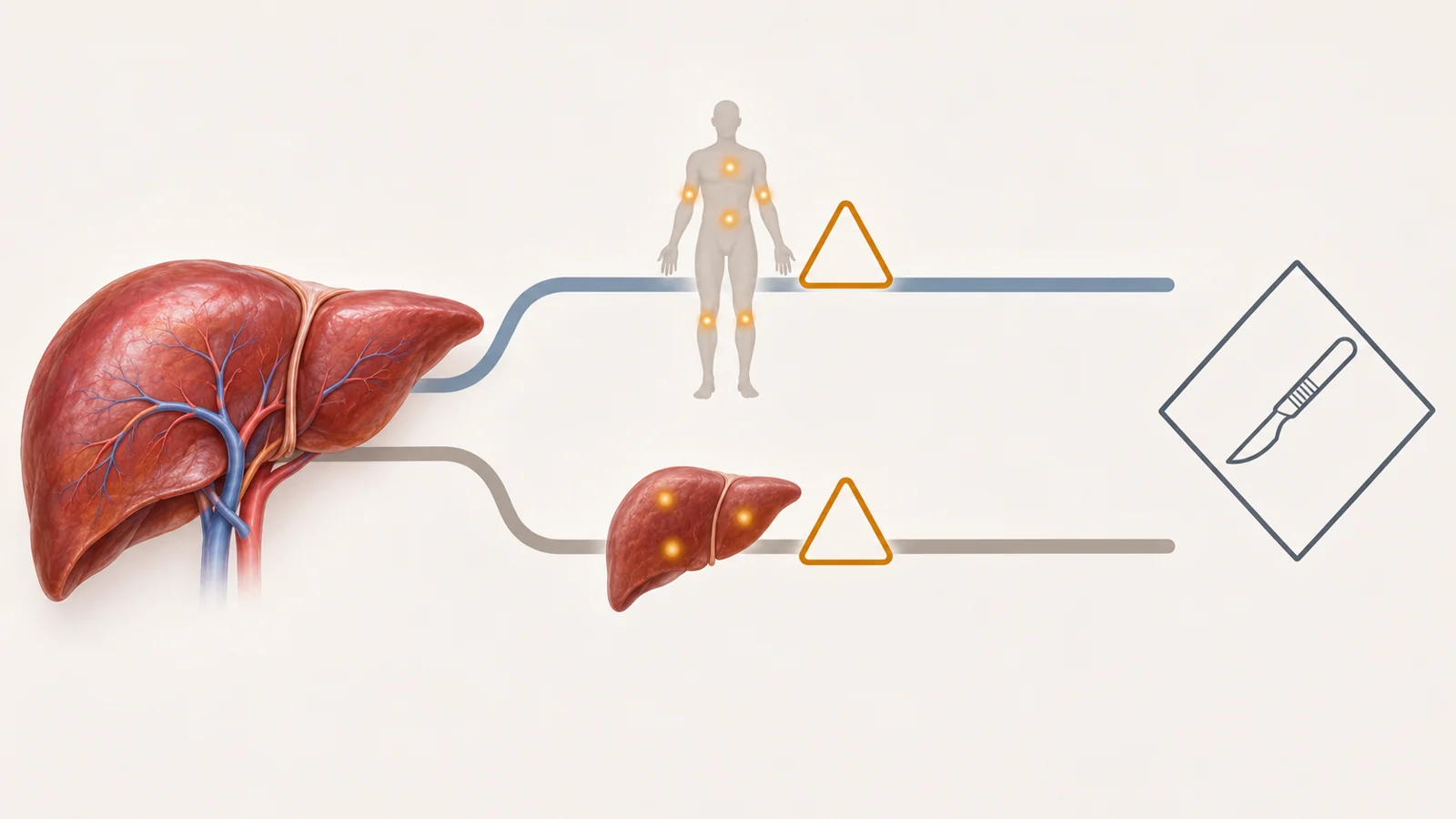
Two treatment approaches, two safety questions
The review focused on hepatocellular carcinoma (HCC), a form of liver cancer. The studies in this review mostly involved advanced disease: on average, 82% of participants had stage C HCC, and 97% had Child-Pugh A cirrhosis, a classification indicating relatively well-preserved liver function. Most participants were not considered eligible for surgery when they entered the studies.
The review grouped systemic treatments into tyrosine kinase inhibitors (TKIs) and immune checkpoint inhibitors (ICIs). TKIs are targeted drugs that interfere with signals involved in tumor growth. ICIs work by releasing restraints on immune cells, helping them respond to cancer. The review also included some combinations of these treatments.
Immune checkpoint drugs can cause inflammation in organs, including the liver. That makes liver-related toxicity a separate concern from the total burden of serious complications. An adverse event can be serious because it is life-threatening, requires hospitalization, or causes prolonged disability; it need not be a liver injury. Conversely, a liver-related event and a serious event are not interchangeable categories.
The pooled totals separate overall harm from liver effects
Across the studies, the pooled proportion of patients with serious adverse events was 46% (95% confidence interval, 40% to 51%) among people receiving a TKI, compared with 24% (13% to 35%) among those receiving an ICI. For patients receiving both classes, the estimate was 36% (27% to 45%). Across treatment groups overall, the pooled estimate was 41% (34% to 48%).
The liver-related estimates pointed in a different direction. Such events were reported for 21% (16% to 26%) of TKI recipients and 28% (21% to 35%) of ICI recipients. These are pooled proportions from the groups studied, not a randomized comparison of the two classes across a single shared population. The figures do not show a clear liver-safety advantage for immune checkpoint inhibitors.
A third measure helps explain why the outcomes cannot be collapsed into one safety score. Grade 3 or higher events—events classified as severe under trial grading criteria—were estimated at 69% (56% to 81%) with TKIs, 35% (22% to 49%) with ICIs, and 67% (58% to 76%) with combination treatment. This grade-based category is distinct from the review’s serious-adverse-event definition. The two measures can therefore produce different totals, even though both describe clinically important harms.
Sorafenib comparisons sharpen the estimate, not the class-wide verdict
Some trials directly compared another treatment with sorafenib, a TKI. In those shared-comparator analyses, other TKIs had a higher estimated risk of serious adverse events: risk ratio 1.24, with a 95% confidence interval from 1.07 to 1.44. A risk ratio compares event rates between two groups; a value above 1 indicates a higher rate in the first group. Here, the interval did not include 1, supporting a higher estimate for other TKIs in those comparisons.
For ICIs compared with sorafenib, the serious-event risk ratio was 1.19 (95% CI, 0.95 to 1.50). The interval includes 1, so this analysis did not establish a clear difference. The same was true for liver-related events: the ICI-versus-sorafenib risk ratio was 1.10 (0.86 to 1.40), while other TKIs versus sorafenib had a ratio of 1.06 (0.92 to 1.24). Those intervals leave room for differences in either direction.
These direct comparisons add useful context because each compares treatments within trials that included the same comparator. They still cover specific drugs, participants, and trial conditions. They cannot turn the separate pooled proportions into a head-to-head verdict that applies to every TKI and ICI.
Before surgery, toxicity is only one part of the path
A preoperative treatment has to be evaluated partly by whether a patient can proceed to the planned operation. Complications may affect that path, while a response that makes surgery possible could matter too. But this review mainly assembled safety data from advanced-disease trials, not evidence designed to determine whether preoperative treatment prevents surgical delays or cancellations.
The paper describes two small preoperative examples. In a small trial of nivolumab, with or without ipilimumab, 21 patients reached surgery. In a separate single-arm phase 2 study of cemiplimab in resectable HCC, 20 of 21 patients underwent resection. These examples show that surgery after immune-based treatment was feasible for many patients in those small studies. They do not demonstrate reliable conversion of initially inoperable cancer to operable disease, or establish that a treatment avoids complications that delay or cancel surgery.
The review also discussed why preoperative trials were an open question in 2022. Earlier studies of advanced HCC had suggested that some treatments could shrink tumors, while the available evidence about toxicity came largely from patients who were not surgical candidates. Together, those observations made it reasonable to study treatment before surgery, but did not settle how well the approach would work or for whom.
The patients and trials limit individual predictions
The large combined sample gives a broad view of reported adverse events across HCC trials, but it does not match every person being considered for surgery. Most participants had advanced disease and relatively well-preserved liver function. A surgical candidate may differ in disease stage, liver reserve, prior treatments, or the specific regimen under consideration.
The trials also varied in what they reported. Some supplied liver-toxicity data, while others did not; some reported serious adverse events and others emphasized grade 3 or higher events. Prior treatment varied as well, including whether patients had already received local treatments or systemic therapy. Because prior treatment and trial eligibility differed, event proportions across separate groups may reflect more than the drug class alone.
Most studies were randomized, but some were open-label, and two were single-group trials. Those design differences add to the uncertainty in applying the pooled estimates to an individual facing a particular operation and regimen.
Where this research could lead
If future preoperative studies confirm that selected systemic treatments can control HCC without closing the route to surgery, clinicians could gain a way to treat cancer before an operation while learning which patients remain suitable for it. That could make treatment decisions more responsive to both tumor behavior and a patient’s ability to undergo surgery. Reaching that point depends on evidence from studies designed around the preoperative setting, including whether patients complete treatment and proceed to surgery. The 2022 review helps frame that question; its pooled safety estimates alone cannot answer it.
Key Sources
- Primary source: Toxicity Profiles of Systemic Therapies for Advanced Hepatocellular Carcinoma: A Systematic Review and Meta-analysis.
DOI or Journal Page · Review or Meta-Analysis · 2022-07-01
Keep exploring