
Research Signal – Source date 2023-07-06
A treatment can be powerful in a dish and still fail to help a patient if too little of it reaches the cells that matter. Brain tumors make that delivery problem especially difficult. The brain is protected by a tightly regulated blood-brain barrier, while infiltrating tumor cells can be spread through tissue rather than gathered in one easily reached mass.
A review published on July 6, 2023, examines whether lipid-based nanoplatforms could improve that situation. The review focuses heavily on gliomas and discusses drug delivery, gene-directed approaches, imaging, and immunotherapy. Its central subject is not a single finished treatment. It is the design problem of getting different payloads to different biological destinations while limiting unwanted exposure elsewhere.
The delivery problem starts before the drug acts
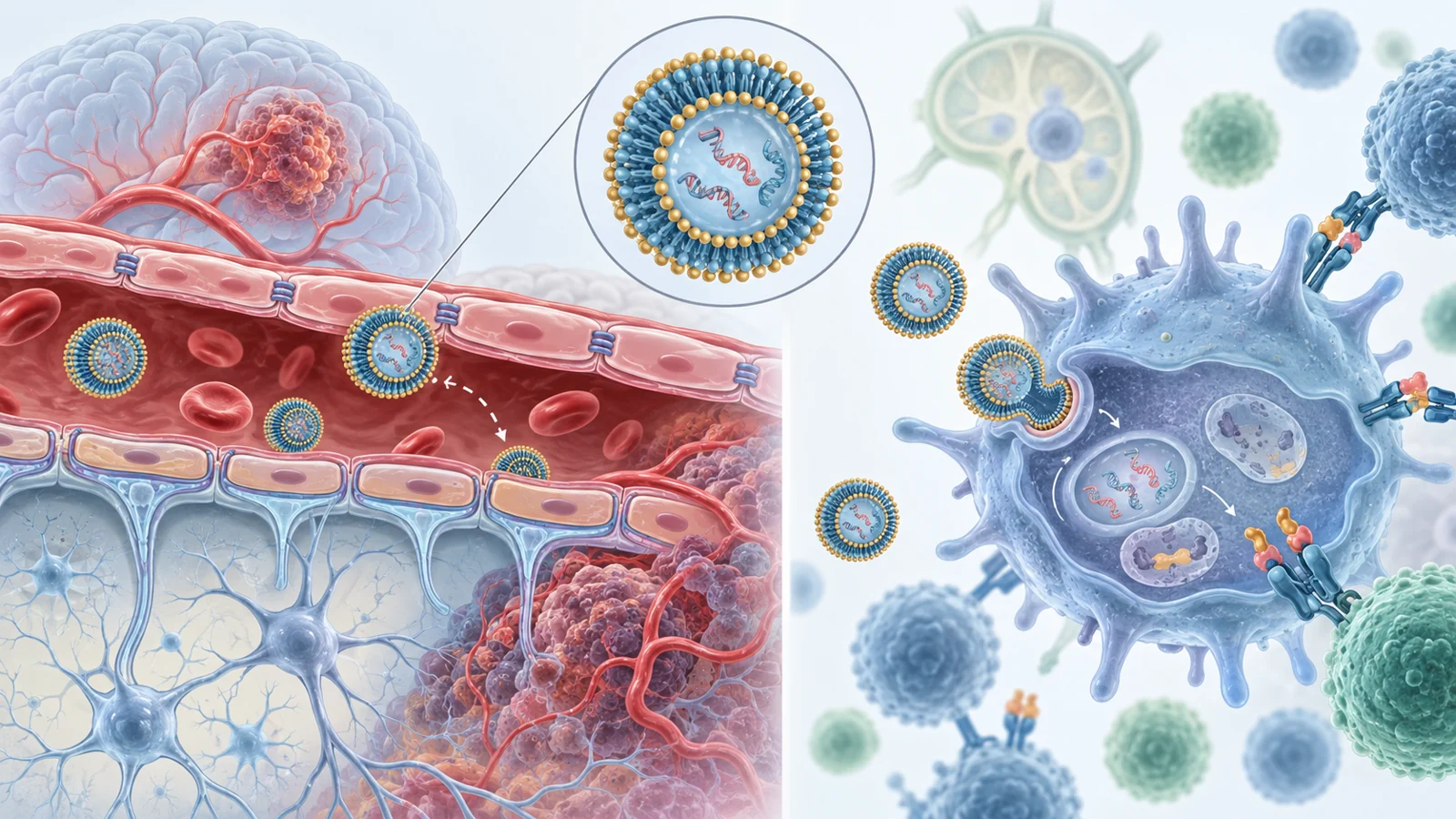
The blood-brain barrier is formed by specialized blood-vessel cells, tight connections between them, supporting basement membrane, astrocyte end-feet, and pericytes. Together, these structures help protect the central nervous system and maintain its internal environment. They also restrict the movement of many medicines from the bloodstream into the brain.
Brain tumors introduce another layer of complexity. The blood-brain tumor barrier between tumor-associated blood vessels and cancer cells can be more permeable in some areas, but it is not a universal open door. Tumor cells may also migrate into regions where delivery is less favorable. A drug that circulates through the body therefore still needs to reach the relevant tumor cells at a useful concentration, remain available long enough to act, and avoid causing disproportionate harm in healthy organs.
Lipid carriers are designed to alter that journey. A liposome, one important example, is a small vesicle enclosed by a lipid bilayer. Other lipid-based systems include particles with solid or partly liquid lipid cores, as well as vesicles made with non-ionic surfactants. These structures can hold a payload, protect it from premature degradation, and influence how quickly it is released.
Those properties can change a drug’s exposure without guaranteeing that the carrier reaches every infiltrating cell. A carrier may improve solubility or circulation time, accumulate differently from a free drug, or release its contents under particular conditions. Each change can be useful, but each also creates a formulation that must be tested in its own right.
A lipid carrier can protect a payload without solving every barrier
For a treatment given through the bloodstream, the carrier and its payload still face the blood-brain barrier. The review describes several ways researchers have tried to address that challenge. Nanoparticles can be modified with ligands or protein-recognizing features that engage transport mechanisms at the barrier. Their physical properties can also affect how they circulate and interact with cells.
Targeting and triggered release are related but different design functions. Targeting concerns where a carrier goes or which cells are more likely to take it up. Triggered release concerns when the payload leaves the carrier. A tumor-associated environment may provide an internal cue such as a particular pH, redox state, or enzyme activity. Heat or light can provide an external cue in approaches designed around that stimulus.
Neither strategy turns a complex biological route into a simple one. A targeting feature may alter circulation, immune recognition, or manufacturing requirements. A release mechanism may work differently in an animal model and in a human tumor. The value of a design depends on the complete chain from injection or implantation to tissue exposure, cellular uptake, payload release, and biological effect.
The route does not always have to begin in the bloodstream. The review also discusses local delivery, including administration near or into a tumor, as a way to bypass the blood-brain barrier and raise local exposure while reducing some systemic distribution. Local delivery can solve one problem while introducing others, such as the need to place the treatment accurately and distribute it through a tumor with irregular boundaries.
RNA can travel toward tumor cells or immune cells
RNA payloads make the destination question even more important. One use is gene silencing: a short RNA molecule can be delivered to tumor cells with the aim of reducing production of a selected protein. Another use is immune instruction: RNA can be taken up by antigen-presenting cells, which process its message and help prime T cells against a tumor-associated target.
The second strategy does not require every carrier to cross into the brain. The review describes lipid nanocarriers being taken up by immune-related organs such as the liver and spleen, where antigen-presenting cells can process RNA and participate in immune activation. In that setting, the carrier’s destination is part of the immune system outside the brain, even though the intended response concerns a tumor in the central nervous system.
The review also summarizes a 2022 example of gene silencing in glioblastoma models. Researchers used a cholesterol and DOPE lipid nanoparticle formulation with an ionizable amine-containing lipid to deliver small interfering RNA. The RNA was designed to reduce CD47 and PD-L1, two signals associated with tumor-driven immune suppression. CD47 can help tumor cells avoid being engulfed by immune cells, while PD-L1 can restrain immune attack through an inhibitory signal.
In mice bearing gliomas in the brain, the combined approach was associated with stronger innate and adaptive anti-glioma immune responses. The findings are preclinical. They show how a carrier can be used to alter gene expression and immune behavior in a model, not that the same formulation has established a clinical benefit for people.
Other work summarized by the review used brain-targeting peptides attached to liposomal particles for small-RNA delivery against dysregulated messenger RNA in glioblastoma models. These examples illustrate the range of possible destinations: a carrier may be designed to reach tumor cells, immune cells, or both through different routes and biological mechanisms. Evidence for one destination or payload does not validate every other lipid formulation.
Early clinical experience measures more than one kind of progress
The review’s clinical examples mainly concern liposomal chemotherapy, while its RNA examples include preclinical studies and a separately listed early-phase trial. Keeping those categories apart matters because a patient result from one formulation cannot establish the efficacy of another formulation carrying a different payload.
One example is 2B3-101, a glutathione-modified, PEGylated liposomal doxorubicin formulation intended to improve delivery toward the brain. The review describes phase I and II evaluation in patients with high-grade gliomas and reports that, among 24 patients, 54% had stable disease and the three-month progression-free rate was 33%.
Stable disease means that the disease was reported as neither clearly shrinking nor clearly progressing during the relevant assessment. It is not the same measurement as tumor shrinkage. A three-month progression-free rate describes how many patients remained without documented progression at that time point; it is not overall survival. These measures can indicate what happened during a study period, but they do not by themselves show that a lipid carrier as a class improves survival or outperforms standard treatment.
The review also discusses liposomal irinotecan in recurrent high-grade gliomas and in a study involving diffuse intrinsic pontine glioma, including intravenous and local delivery approaches. These examples show that both the payload and the route can vary substantially. A formulation administered directly into a tumor is addressing a different delivery problem from one expected to circulate through the body and reach the brain.
For RNA, the review lists NCT04573140 as a phase I trial involving RNA-lipid particles loaded with tumor-related messenger RNA and pp65 full-length LAMP messenger RNA in pediatric high-grade gliomas and adult glioblastoma. The review describes the trial as recruiting. That listing establishes the trial’s place in the review’s account, not a treatment result, a demonstrated clinical response, or independently verified current registry status.
The hardest step may be making the formulation repeatably
A carrier can change where a treatment goes, but the same features that make it biologically interesting can make it difficult to manufacture and evaluate. After intravenous administration, conventional liposomes may be cleared through interactions with plasma proteins and uptake by the liver, spleen, and other reticuloendothelial organs. That clearance affects how much payload remains in circulation and how much reaches the intended tissue.
Added targeting groups, responsive release components, or multiple payloads can further change circulation, tissue accumulation, immune recognition, and toxicity. The formulation must be characterized consistently, and its behavior must be assessed beyond the first visible treatment response. The review identifies manufacturing cost, demanding quality assurance, formulation-specific pharmacokinetic and pharmacodynamic evaluation, and biosafety testing as obstacles to translation.
The materials and production process matter too. The review notes concerns about toxic organic solvents used in some chemical synthesis routes, the need for longer-term safety assessment for materials that may be metabolized slowly, and possible problems involving surface polymers such as PEG. Particle size, surface chemistry, payload retention, release behavior, and interactions with cells can all affect whether an apparently promising design remains practical at larger scale.
This creates a difficult tradeoff. A simpler carrier may be easier to produce but offer less control over where or when a payload is released. A more elaborate carrier may provide additional biological functions while increasing cost, quality-control demands, and the amount of formulation-specific evidence needed before clinical use. Results from animal models can guide that process, but human benefit still has to be shown for the particular product and route.
What more selective delivery could mean for brain-tumor care
More selective delivery could eventually make it possible to concentrate a drug at relevant tumor cells, deliver gene-silencing RNA to a chosen cellular target, or activate an immune response through antigen-presenting cells without requiring every therapeutic carrier to enter the brain. That could support combinations of chemotherapy, gene-directed treatment, and immunotherapy while reducing unnecessary exposure of healthy tissue.
The possibility visible from the July 2023 review is conditional. A useful clinical advance would require formulation-specific human benefit, acceptable toxicity, reliable delivery to the intended biological destination, and reproducible production. The review does not establish improved survival or promise that any particular lipid platform will become available. It shows why changing the delivery system may be important, while leaving the hardest question open: whether a better route for a payload becomes a better outcome for patients.
Key Sources
- Primary source: Insight into lipid-based nanoplatform-mediated drug and gene delivery in neuro-oncology and their clinical prospects.
DOI or Journal Page · Review or Meta-Analysis · 2023-07-06
Keep exploring