
Research Signal – Source date 2025-07-12
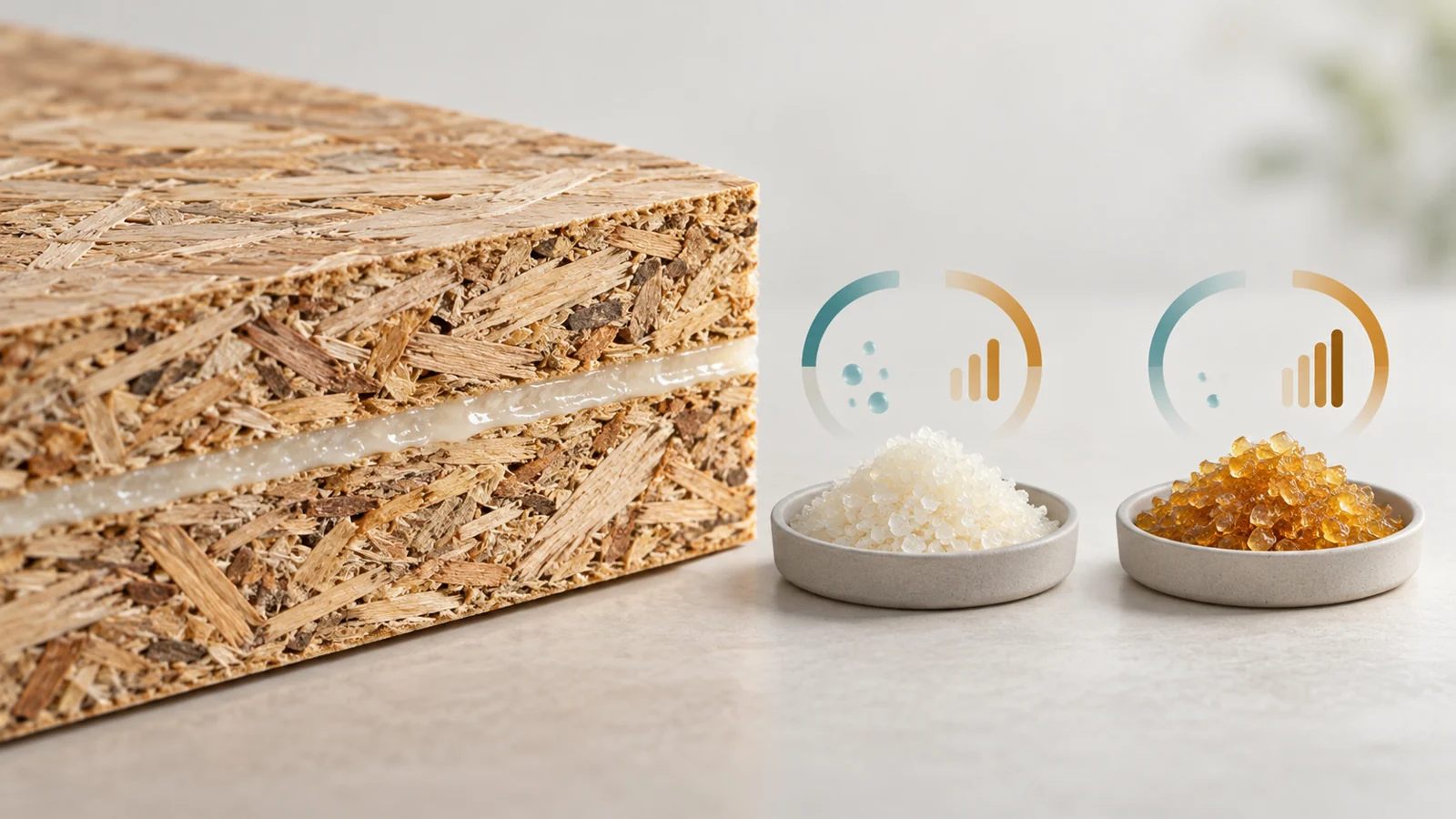
One lignin-containing particleboard recipe released less formaldehyde without a significant difference in internal bond strength. In a different plywood recipe, adding lignin slightly increased release. A third recipe lowered release but also had weaker shear strength. These results, gathered in a review published July 12, 2025, point to a practical puzzle: lignin can change both emissions and bonding, but the outcome depends on the material and how it is used.
The examples come from different formulations and panel types, so they are not a controlled contest with one clear winner. They do show why adding a plant-derived ingredient is not, by itself, a guarantee of lower emissions or preserved strength.
Why UF glue is hard to replace
Urea-formaldehyde, or UF, adhesive is widely used to make interior wood panels such as particleboard and medium-density fiberboard. It cures quickly, is practical to process, costs relatively little, and bonds well. Those qualities help explain its popularity. Its drawback is that panels made with UF can release formaldehyde, a gas that can contribute to indoor air pollution.
A substitute or modifier has to meet two needs at once. It should reduce formaldehyde release while still helping a panel hold together. That balance matters because a lower release measurement alone says little about whether a panel has adequate bonding, and a strong bond alone does not resolve emissions concerns.
Lignin is a structural polymer found in plant cell walls, alongside cellulose and hemicellulose. Plants make it from several related building blocks, joined in varied arrangements. Its structure differs with plant species and tissue, and the process used to extract it can change the material further. So “lignin” does not describe one uniform ingredient that will behave identically in every adhesive.
The ingredient depends on its history
Some lignin is recovered from paper and pulp production, while other sources come from biorefineries designed to separate useful materials from plant biomass. Extraction methods range from established industrial processes to approaches intended to preserve more of lignin’s structure. The result can vary in purity, composition, and reactivity.
That variation matters when lignin meets UF resin. Some of lignin’s chemical groups can react during resin making, but its structure can also make it hard to dissolve or slow to react. Treatments such as phenolation and glyoxalation change the groups available for reactions with formaldehyde or urea. That may help lignin become part of the adhesive, but it does not guarantee lower release and adequate strength in every panel.
Two routes into the resin
In the reviewed studies, lignin enters UF adhesives in two broad ways. It can replace part of the finished resin, or it can be introduced during resin synthesis, sometimes taking the place of some urea. Those routes change where lignin participates in making or modifying the adhesive, and the chosen lignin and treatment also differ among recipes.
The review reports that some formulations replaced up to 20–30% of UF resin without significantly compromising panel performance. That range describes particular reported formulations, not a universal recipe or a demonstrated limit across lignin sources and panel production.
The variation is visible in the panel results. A particleboard formulation using phenolated Kraft lignin reported formaldehyde release falling from 4.3 to 2.8 mg per 100 g, a reduction of about 34%. The study also reported no significant difference in internal bond strength compared with the neat UF resin. Internal bond strength measures how well the panel holds together through its thickness.
A separate plywood formulation used sodium lignosulfonate, a lignin-derived ingredient, without further chemical treatment. It reported a slight increase in formaldehyde release, although the result remained below the E0-grade plywood emission requirement cited in the review. Its shear strength, a measure of plywood bonding, was similar to that of the reference panel. Adding lignin therefore did not automatically lower measured release.
Another plywood recipe used glyoxalated bagasse lignin during UF synthesis. Its reported formaldehyde release fell from 4.3 to 3.2 mg per 100 g. But shear strength also fell, from 1.93 MPa to 1.22 MPa. In that formulation, the emissions improvement came with a bonding tradeoff. These figures should be read within each study’s recipe and panel test; they do not establish a ranking across particleboard and plywood.
The environmental case depends on the whole panel
Whether lignin makes an adhesive cheaper or environmentally preferable depends on more than the amount added. Some biorefinery lignins may be inexpensive because they are recovered as coproducts, and in some cases their value is shaped by the cost of disposal or burning. Other sources and extraction methods can require additional processing, changing both cost and environmental impact.
Life-cycle assessment tries to account for impacts across a product’s supply chain, but lignin production often yields more than one product. Analysts must decide how to allocate shared impacts among those coproducts, and different allocation choices can produce different comparisons. The review discusses estimates for lignin’s climate impact per kilogram, but those figures alone cannot establish the whole-life impact of a finished wood panel. The panel’s ingredients, processing, performance, and end of life all matter to that larger question.
The review identifies long-term performance, scale-up, cost, and life-cycle accounting as unresolved challenges. A promising laboratory or panel formulation still has to work through consistent manufacturing and service conditions before its broader value is clear.
What this could make possible
A homeowner or furniture buyer could one day choose commercially made wood panels whose producer documents both dependable bonding and lower formaldehyde release, with lignin replacing a meaningful share of conventional UF resin. The reviewed particleboard result offers one evidence bridge toward that possibility: in that particular recipe, release fell while internal bond strength showed no significant difference. The contrasting plywood results explain why the approach would need to be reliable across formulations and panel types before buyers could count on it.
A useful nearer milestone would be a pilot-scale, matched comparison of lignin-containing and conventional UF panels that reports emissions, bond strength, and water resistance side by side. Consistent results would help show whether a recipe can move from a promising panel test toward production. Long-term durability and a fair accounting of environmental impacts would still need their own evidence.
Key Sources
- Primary source: Advances in Lignin Chemistry, Bonding Performance, and Formaldehyde Emission Reduction in Lignin-Based Urea-Formaldehyde Adhesives: A Review.
DOI or Journal Page · Review or Meta-Analysis · 2025-07-12
Keep exploring