
Research Signal – Source date 2023-03-29
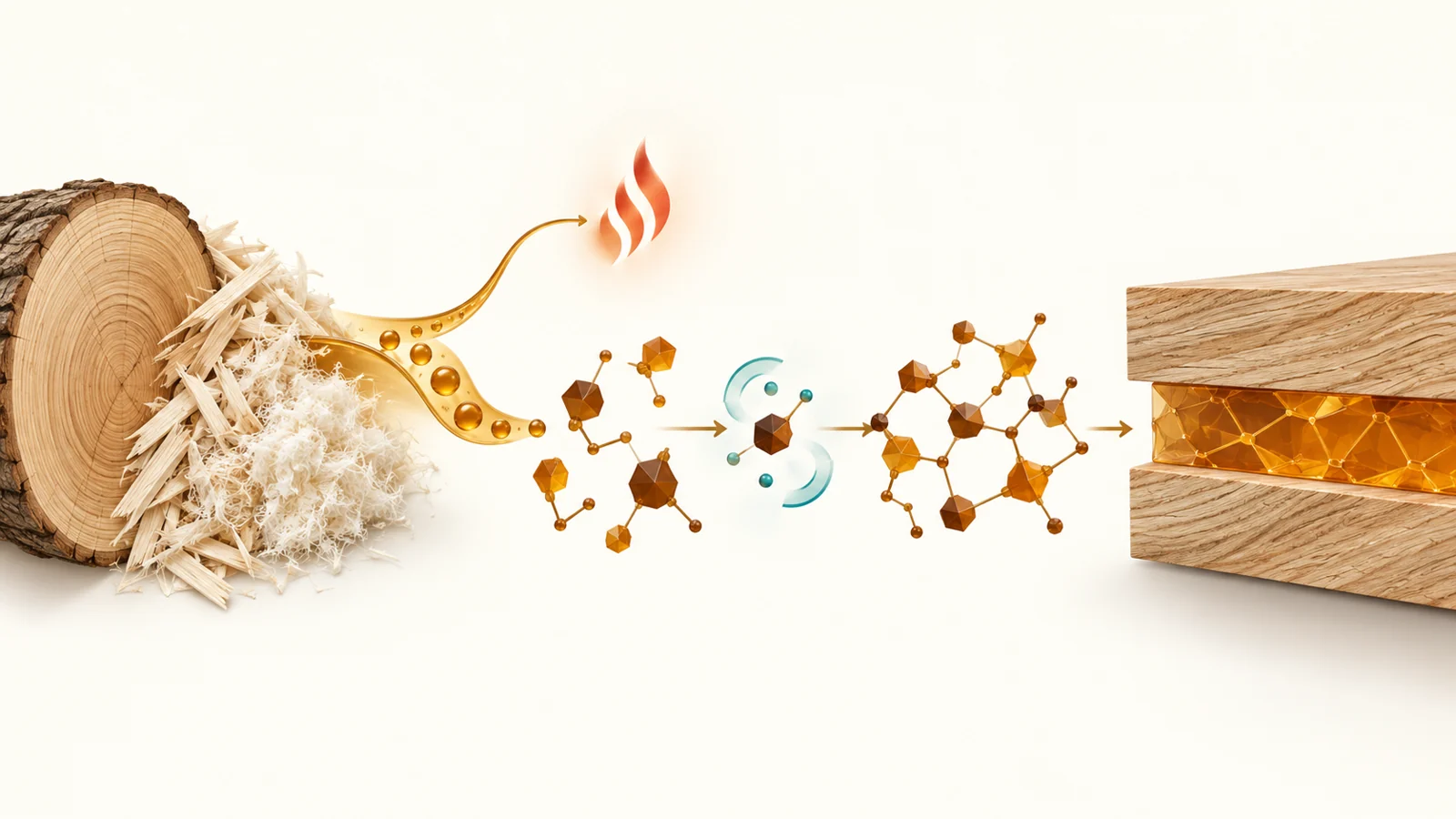
Paper mills separate wood into useful components, but those components take different paths. Cellulose becomes paper. Much of the lignin, a plant polymer separated during pulping, is burned to help supply the mill’s energy. Keeping some of that lignin for materials would change what the mill gets from the same raw resource.
A review published March 29, 2023, examines how enzymes can modify this industrial side stream for uses that include adhesives. Its contribution is to bring together existing research on the starting materials, the reactions available to change them, and the properties of the resulting products. Two adhesive examples make the possibility tangible: a starch-based paper glue with longer wet resistance, and a lignin-based wood glue compared with commercial white glues.
The practical question begins before either glue reaches a joint. Which lignin is available, how must it be treated, and what useful function can it perform in the finished mixture? Following those steps helps explain both the reported results and the choice between retaining lignin as a material and using it for energy.
The starting material carries its processing history
The lignin recovered from a mill is already chemically altered. Pulping separates the components of plant material under demanding conditions, and different processes leave different chemical groups and molecular structures behind. Researchers call these recovered materials technical lignins. The name covers a family of starting materials rather than one uniform ingredient.
The contrast between kraft lignin and lignosulfonates is particularly useful. Kraft lignin is readily available and inexpensive, making it an attractive candidate for further use. But it dissolves poorly in water, and changes introduced during pulping can make parts of its structure difficult to modify. Preparing it for an enzyme reaction may require substantial pretreatment or enzymes that remain effective at high temperatures or high pH.
Lignosulfonates come from sulfite pulping. That process introduces sulfonate groups that help the lignin dissolve in water. This matters because an enzyme and the material it acts on need suitable conditions in which to interact. Water-soluble lignosulfonates offer a different starting point from poorly soluble kraft lignin, even though both originated in plants.
Choosing a feedstock therefore helps determine the treatment process. Its solubility, accessible reactive groups, and range of molecular sizes affect what can happen next. The adhesive examples discussed here use lignosulfonates; their results cannot simply be assigned to an untreated kraft lignin stream by changing the ingredient name.
Enzymes can help build larger molecules
Using lignin in a new material does not always mean breaking it down. The review distinguishes three broad operations. One splits lignin into smaller molecules that can serve as starting points for other chemicals. Another changes its reactive groups or properties. A third joins lignin into larger polymers. Each operation pursues a different material behavior.
The enzyme families covered include laccases, peroxidases, and lipases. Laccases and peroxidases promote oxidation reactions that can alter lignin and enable further reactions. Lipases belong to a different enzyme family and have also been investigated for lignin modification. For the adhesive examples, the central operation is polymerization: joining lignin components into larger structures.
That distinction connects the chemistry to the glue. Enzymatically polymerized lignosulfonate can become an ingredient in a blend or the basis of a lignin-containing adhesive. The enzyme treatment changes the ingredient before its performance is assessed in the adhesive formulation. The meaningful test is then what the formulated glue does between the particular surfaces it is intended to join.
Two glue comparisons answer different questions
In the paper-adhesive example summarized by the review, researchers added enzymatically polymerized lignosulfonate to a starch-based adhesive. The reported wet-resistance duration increased from 150 minutes for the starch adhesive alone to 1,200 minutes with the polymerized lignin added. That is an eightfold increase in the reported duration, from two and a half hours to 20 hours.
This is a concrete improvement in one measured property of a blend. It suggests that treated lignosulfonate can contribute useful behavior alongside starch, with the comparison focused on resistance under wet conditions. It does not mean the glue became eight times stronger. Nor should those durations be read as a guarantee of how long a paper product will survive rain, washing, or any other everyday exposure. Such a translation depends on the test conditions and the intended use.
The wood-adhesive example asks a different question. Here, laccase-polymerized lignosulfonate-based adhesives were compared with commercial polyvinyl acetate white glues in the D3 class. The review reports no significant difference in tensile shear strength between the two adhesive types. In plain terms, this measurement concerns how much stress a bonded joint can withstand when the applied force tends to slide the joined surfaces past each other.
A comparison with an existing glue gives the result a practical reference point. It shows why the lignosulfonate formulation deserves attention for wood bonding. But a reported lack of a statistically significant difference does not, by itself, establish that the products are statistically equivalent. It also does not confer commercial certification on the lignin-based adhesive. Matching one strength measurement cannot establish matching performance across all moisture exposures, aging conditions, wood types, or handling requirements.
The two examples are therefore complementary. The paper study reports a change in wet resistance after adding a treated ingredient to starch glue. The wood study compares a joint-strength measurement against commercial glues. They involve different formulations, surfaces, and endpoints; they cannot be combined into a single score for how well lignin replaces fossil-derived adhesives. Read at their proper scale, they show two useful roles for enzymatically modified lignosulfonates in adhesive design.
The mill’s energy balance belongs in the comparison
A useful glue ingredient still has to be produced. Recovering and preparing lignin, carrying out the enzyme treatment, and incorporating the result into a formulation all belong in an assessment of the proposed benefit. Starting with a renewable side stream does not settle the environmental outcome of those steps.
The review identifies life-cycle assessment as a way to examine impacts across production, use, and disposal. Applied to these adhesive pathways, the relevant comparison would include the processing needed for a particular lignin stream and the function delivered by the final product. A process that works with a water-soluble feedstock may have different requirements from one that first has to make poorly soluble lignin accessible to enzymes.
There is also a consequence at the mill. Lignin being burned already supplies a service: energy for pulping. Diverting it into glue ingredients changes that energy supply, so a whole-system comparison must account for how the displaced service is provided. The review notes that high energy prices strengthen the competition between burning lignin and retaining it as a chemical or material resource. Treating the input as cost-free waste would miss this existing use.
The featured adhesive results consequently do not establish a net emissions saving, lower production cost, or readiness for broad industrial replacement. Those conclusions require evidence beyond the reported property comparisons. Disposal also depends on the finished formulation. The review’s broad discussion of biodegradability should not be treated as proof that every lignin-containing glue, or a wood product bonded with it, will compost or break down harmlessly in the environment.
What this could change
If suitable lignin streams can be processed consistently, retain useful adhesive performance, and deliver favorable impacts across the whole production system, paper and wood-product manufacturers could obtain more of their glue ingredients from pulping side streams. The paper-adhesive example points to an ingredient that improves a starch blend’s response to wet conditions. The wood-adhesive example points to a lignin-based formulation that could serve a bonding function now supplied by a conventional white glue.
That would give manufacturers an additional material supply option. Selected portions of a pulping stream could remain in useful products, while adhesive makers could reduce their reliance on fossil-derived inputs in formulations suited to the treated lignin. The potential benefit lies in connecting an existing source of plant material to a specific manufacturing need, with enough control over the chemistry to make the ingredient dependable.
Key Sources
- Primary source: The Biomodified Lignin Platform: A Review.
DOI or Journal Page · Peer-Reviewed Paper · 2023-03-29
Keep exploring