
Research Signal – Source date 2021-03-03
In one experiment summarized in a 2021 review, adding lignin made a biodegradable plastic stiffer while sharply reducing its strength under tension and how far it could stretch before breaking. At 20% lignin, the composite’s elastic modulus rose by 10.21%, while its tensile strength fell by 31.9% and its elongation at break fell by 74.5% compared with pure PLA.
PLA, or poly(lactic acid), is a workable, biodegradable plastic. The figures show why “stronger” is too simple a verdict for a blend: stiffness, tensile strength and stretch before breaking describe different behaviors. A material can resist changing shape more while also carrying less tension before failure and stretching less before it snaps. The review gathers experiments in which results varied with the plant ingredient, its amount and treatment, and how the material was prepared.
A blend depends on how its ingredients meet
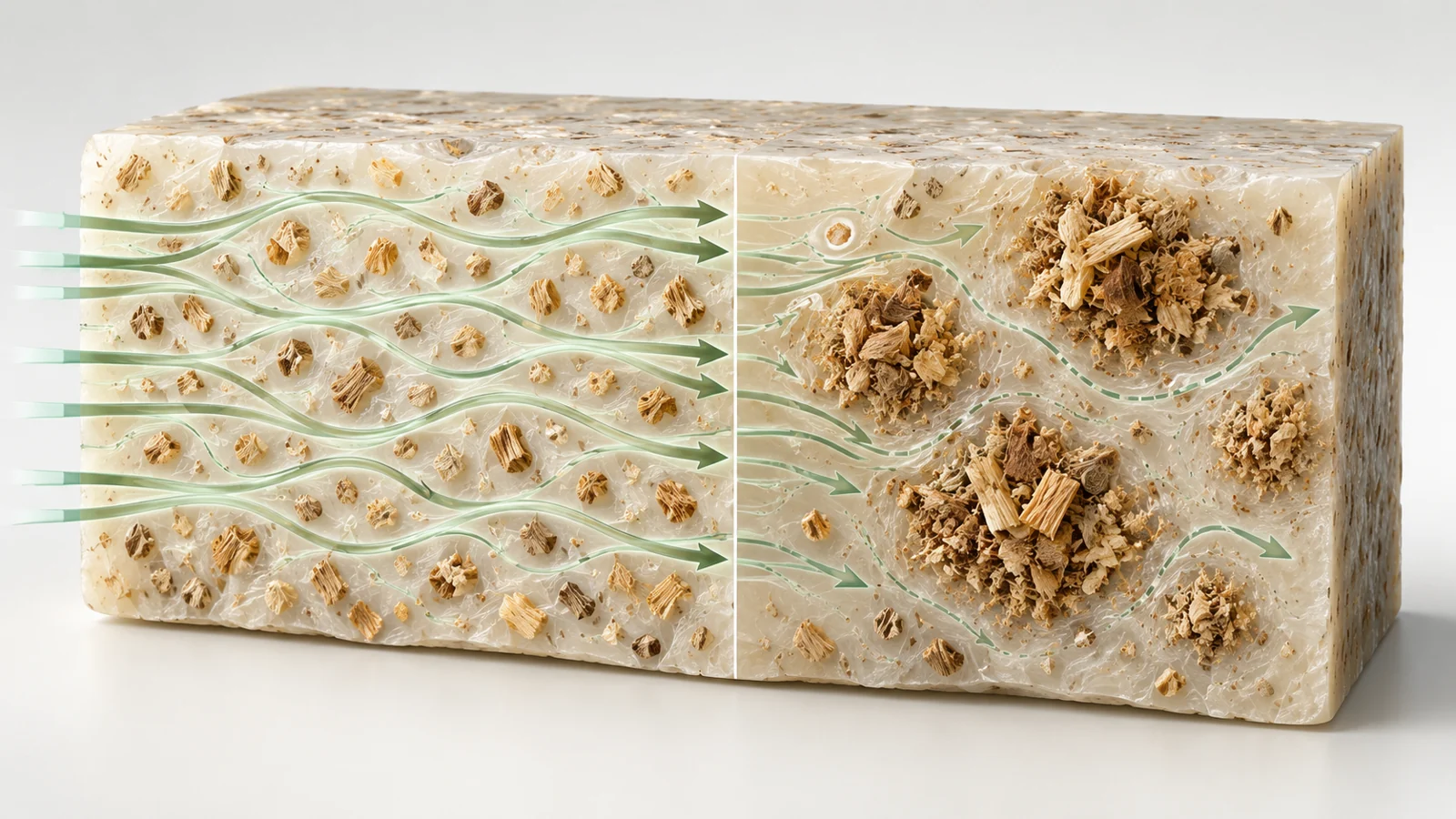
Lignin and cellulose have useful properties on their own, but combining either with PLA does not automatically transfer those properties to the finished material. Their surfaces must meet and interact within the blend. The review describes compatibility and interfacial adhesion—the bonding and contact between the plant component and the surrounding PLA—as important to how stress passes through a composite.
The review describes a surface mismatch: lignin and cellulose have many water-attracting groups, while PLA is more water-repelling. With poor compatibility, particles may not disperse evenly or adhere well to the PLA. Direct blending can therefore produce little improvement in crystallization or mechanical properties. In practice, the ingredient’s surface and distribution matter alongside its identity.
Lignin treatment changed flexibility in different ways
The 20% lignin example is a warning against treating all lignin blends as equivalent. Lignin from different sources can vary, and researchers have modified its surface to change how it interacts with PLA. One such treatment, esterification, changes chemical groups on lignin’s surface, altering how it interacts with PLA.
In one cited study, lignins treated with butyric anhydride and isobutyl butyric anhydride brought the composites’ stiffness close to that of pure PLA, while improving how far they stretched before breaking and how much they could deform permanently. Lignin treated with crotonic anhydride did not improve plasticity. The direction of the effect thus depended on the specific chemical treatment; “modified lignin” was not one interchangeable ingredient.
Cellulose gains depended on the amount added
A nanocellulose film experiment summarized in the review illustrates how dose can reverse a result. Adding less than 1.0% nanocellulose made tensile strength rise. Above 1.0%, the nanocellulose formed aggregates and dispersed poorly through the PLA, and tensile strength declined. At 1.0%, the researchers described PLA and nanocellulose chains forming a network that increased strength and stiffness; at 0.5%, the films were more flexible.
Another form, microcrystalline cellulose, had a different reported optimum. In one study, a 4% loading gave the highest tensile strength among the tested amounts: 73.01 MPa, 8.40% above pure PLA. The reported tensile modulus also rose, from 206 to 262.9 MPa. These are results for particular formulations and experiments, not a single recipe that can be assumed to work across materials or production conditions.
Crystallization is a separate measure
Crystallization describes PLA chains arranging into more ordered regions. It can affect a material’s properties, but it is not the same measurement as stretch before breaking or resistance to heat. The review’s examples show these outcomes can move in different directions.
In one study, acetate nanocellulose increased the extent and rate of PLA crystallization, but the films stretched less before breaking, even as they became more resistant to permanent deformation. The review suggests the acetate nanocellulose acted as a nucleating agent, helping PLA crystallize. It also notes that film preparation conditions affected the mechanical properties of pure PLA in that work. A crystallization gain alone, then, does not tell a reader whether the blend will be more flexible or perform better under heat.
Plain lignin points to a separate thermal tradeoff. Because lignin’s onset and maximum thermal degradation temperatures were lower than PLA’s, the review reports that adding lignin lowered those temperatures in the composites, with larger reductions at greater lignin additions. A plant-derived additive can therefore alter heat-related behavior without improving every other property.
Preparation costs are part of the question
Lignin, cellulose and hemicellulose occur together in plant material, and separating individual components requires pretreatment. The review identifies the cost of that preparation as a consideration for commercial use. Surface treatments may improve how an ingredient works with PLA, but the added processing has to be considered alongside the resulting properties.
The reported mechanical and thermal measurements are laboratory comparisons. They do not show that a particular blend meets all packaging requirements at manufacturing scale, or establish a finished product’s cost or environmental benefit. The review’s results make the formulation question concrete; they do not settle those broader product questions.
What better PLA blends could enable
If preparation can be made affordable and property gains prove reproducible in workable processing, PLA blends containing lignin or cellulose could support packaging materials that combine plant-derived ingredients with useful mechanical and thermal performance. That prospect depends on finding formulations that balance strength, flexibility, crystallization and heat behavior for the intended use, rather than relying on one ingredient or measurement as a guarantee.
Key Sources
- Primary source: A Review: Research Progress in Modification of Poly (Lactic Acid) by Lignin and Cellulose.
DOI or Journal Page · Review or Meta-Analysis · 2021-03-03
Keep exploring