
Research Signal – Source date 2022-10-28
A small crack deep inside concrete is difficult to reach with conventional repairs. Yet it can provide a route for water to enter, contributing to deterioration long before the damage becomes easy to see. Concrete’s limited ability to resist tension makes cracking a persistent problem, whether it starts with shrinkage, temperature changes, or an applied load.
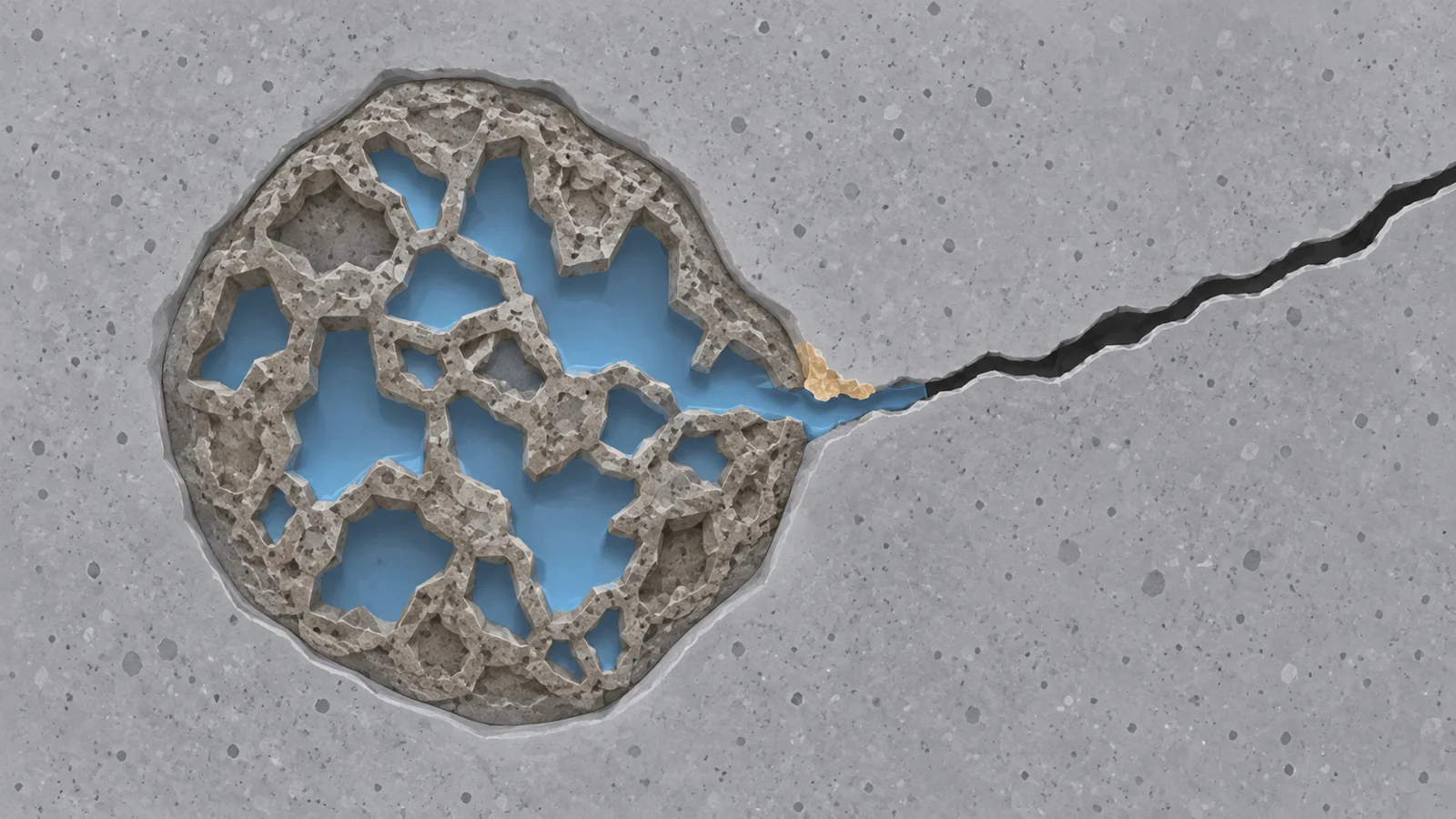
One approach puts repair ingredients inside the concrete before a crack appears. Porous, lightweight particles can hold water, chemicals, or biological components in their internal spaces. When a crack reaches a loaded particle, those stored ingredients can help form material that fills part of the opening. The same particles that reduce the concrete’s weight can therefore serve as small reservoirs for repair.
Published on October 28, 2022, A Review of Lightweight Self-Healing Concrete brings together research on this dual role. It describes several ways to prepare the particles and activate healing, alongside results from different concrete mixtures and testing conditions. The central engineering question is how to make useful storage space inside a material that must also carry loads.
What the particles hold determines how repair happens
The particles are called aggregate—the granular material held together by cement paste in concrete. Lightweight aggregates contain many pores, which reduce their density and can accommodate healing ingredients. Examples discussed in the review include expanded clay, expanded perlite, expanded vermiculite, and zeolite. Their internal structures differ, so they do not all store or release ingredients equally well.
The simplest reservoir contains water. Some cement remains unreacted after concrete hardens, and a renewed supply of water can allow further hydration, the reactions through which cement develops its binding material. Water also supports processes that deposit calcium carbonate in cracks. Pre-wetted aggregate can supply moisture from within the concrete, helping reactions occur beyond the outer surface.
This builds on concrete’s own capacity for limited healing. Adding a separate chemical agent offers another route. Sodium silicate stored in an aggregate particle can react with calcium hydroxide already present in the cement paste. The reaction forms calcium silicate hydrate, often shortened to C-S-H, a gel that provides much of cement paste’s binding action. Delivering that reactant near a crack can help produce new binding material where damage has occurred.
Biological systems use a different process. Microorganisms, supplied with suitable nutrients and conditions, can promote the precipitation of calcium carbonate. These mineral deposits can fill openings and obstruct water flow. Porous particles provide space for the organisms and their nutrients while helping protect them from the surrounding cement environment.
Self-healing concrete therefore does not necessarily contain living organisms. Water storage, added chemicals, and microbial mineral formation have different requirements. Their shared feature here is a lightweight particle that places useful ingredients inside the material, close to where a future crack might reach them.
A reservoir has to survive mixing and meet a crack
Pore volume alone does not determine whether a particle makes a good carrier. The pores must be accessible. The review describes expanded perlite as having an interconnected porous interior, while expanded vermiculite has spaces between its layers. By comparison, many pores in the gravelly ceramsite it discusses are closed off. An isolated cavity can reduce weight without providing useful space for an externally supplied healing agent.
Loading the accessible pores is a preparation step with consequences for later performance. In one example summarized by the review, vacuum immersion produced a reported sodium silicate absorption rate of 31% after 30 minutes, compared with 19% after three days of ordinary immersion. Removing trapped air helps the solution enter the pore network. Those figures describe uptake in the cited experiment, rather than a universal loading recipe.
Once loaded, the particle has to retain its contents while concrete is mixed and hardens. Premature leakage can spend the agent before there is a crack to repair. The review describes spraying impregnated particles with a polyvinyl alcohol coating to limit sodium silicate loss and early interaction with the surrounding cement paste. Preparation thus involves both getting the solution in and keeping it available for later use.
A developing crack must then intersect a loaded region so that the stored material can participate in healing. This introduces a mechanical complication. In conventional concrete with strong stone aggregate, cracks often travel along the boundary between stone and cement paste. Weaker lightweight particles can themselves fracture. That can expose their contents, but their weakness can also limit the strength of the concrete. Carrier strength remains part of the design alongside pore connectivity.
Water absorption creates another practical constraint before the concrete has even hardened. Porous particles can draw water out of the fresh mixture, reducing its workability—how readily it can be placed and handled. Pre-wetting and impregnation affect this exchange. Simply adding more water is not a neutral correction, because changing the water-to-cement ratio also changes the mixture’s behavior and strength.
Together, these steps explain why a promising healing ingredient is only part of the material. Its carrier must accept it, retain it, expose it at a useful location, and remain compatible with the concrete mixture.
Three different meanings of a successful repair
A photograph of a narrower crack answers a useful but limited question. Crack closure measures how much an opening shrinks. Mechanical tests ask how much load the damaged and healed material can carry. Permeability tests ask how easily water can still pass through it. These outcomes are related, but each tests a different function.
For crack closure, the review describes an experiment using expanded clay particles containing bacterial spores and calcium lactate. After specimens had been immersed in water for 100 days, reported healed crack widths reached 0.46 millimeters in the bacterial concrete, compared with 0.18 millimeters in controls. The researchers also used oxygen measurements to support the interpretation that bacterial activity contributed to the healing.
The timing and exposure are part of that result. It shows what this formulation achieved with prolonged access to water. It does not give every bacterial concrete a 0.46-millimeter repair capacity, or establish what the same mixture would do during a short wet period outdoors.
Mechanical recovery requires a separate test. The review defines a strength healing ratio by dividing the maximum stress sustained by a healed specimen by that of a virgin specimen. It reports an 80% value for a sodium silicate system. Under that definition, the healed specimen reached four-fifths of the comparison specimen’s measured strength; the figure is neither a percentage of crack closure nor a promise that a structure has recovered its original capacity.
Water permeability captures a different potential benefit. Mineral deposits may obstruct a connected route through the material and substantially reduce water passage. For example, the review reports reductions of 91–99% for a system combining Bacillus mucilaginous with ceramsite. Those measurements concern water transport in that particular system, not equivalent gains in strength or service life.
A visibly sealed opening may still have a weak bond across it, while a deposit that limits leakage may be useful without restoring the original load response. This is why photographs, loading tests, and water-flow measurements cannot substitute for one another when judging a repair.
Nor do the selected numbers form a performance leaderboard. They come from studies with different agents, aggregates, mixtures, damage, and exposure conditions. The review favors chemical agents on healing rate and stability, but that assessment should not be read as a controlled comparison establishing that chemicals always outperform biological systems. The examples demonstrate different capabilities and tradeoffs.
The environment has to support the reaction
Water is an active part of these processes. It supports continued cement hydration, enables relevant substances to dissolve and move, and supplies the moisture microorganisms need for mineral formation. A water-filled lightweight particle can maintain moisture locally as the surrounding paste dries, providing what concrete researchers call internal curing.
That reservoir changes access to water, but its usefulness depends on when and where the moisture becomes available. The review describes both immersion and wetting-and-drying conditions. Moving from an immersed specimen to exposed infrastructure means asking whether a particular crack will receive enough water, for long enough, to sustain the intended reaction.
Biological systems have additional requirements. Concrete presents a highly alkaline environment, and microorganisms can also face shortages of moisture and nutrients. Protecting cells and supplying what they need adds complexity to preparing, transporting, and incorporating the healing system. An aggregate that stores many cells is useful only if conditions later permit those cells to contribute to mineral formation.
Cold introduces another difficulty. The review identifies reduced microbial activity and changes in water availability at low temperatures, as well as potential damage to spores from freezing water. Resistance to low temperature alone does not ensure effective healing during cold exposure. For infrastructure subject to freezing and thawing, performance must encompass the conditions in which the concrete will actually operate.
Stored agents also raise a question about repeated damage. Initial loading and a successful healing episode do not establish an indefinitely renewable repair supply. Predictable service-life extension depends on how long ingredients remain usable, how much is consumed, and what happens when cracks recur. Inspection and conventional repair would still have a role.
What this could change
If strong lightweight particles can retain healing ingredients and release them under actual service conditions, they could give designers two useful capabilities in one concrete mixture. Lower material weight could reduce the dead load carried by high-rise buildings or long-span structures, while repair reactions inside otherwise inaccessible microcracks could help limit water entry and the deterioration that follows.
For infrastructure owners, successful internal repair could reduce some maintenance demands and help keep structures in service longer. Building occupants and bridge users could benefit from fewer repair-related disruptions. Those gains depend on maintaining adequate strength and reliable healing through the exposures the structure encounters; they remain prospective benefits of the systems discussed in this 2022 review.
The practical opportunity is to build a limited capacity for intervention into the material itself. A crack reaching a prepared particle could encounter ingredients for repair already in place, allowing a response deep inside concrete where direct access is difficult.
Key Sources
- Primary source: A Review of Lightweight Self-Healing Concrete.
DOI or Journal Page · Review or Meta-Analysis · 2022-10-28
Keep exploring