
Research Signal – Source date 2021-04-22
Two carbon-fiber hoods built for a small electric vehicle weighed 3,407 grams and 2,690 grams. The authors describe the second as 22% lighter; the listed masses work out to about 21%. The lighter hood also performed strongly in the study’s static stiffness comparisons. Its redesigned interior helps explain how the researchers removed material while retaining key attachment areas.
The study, published on April 22, 2021, compared two manufactured hood prototypes. It tested their response to bending and twisting and compared the composite results with a steel hood represented in a computer model. These tests address how much the hoods deflected under specified loads. They do not answer every question a production car hood would need to meet.
The redesign changed the hood’s interior
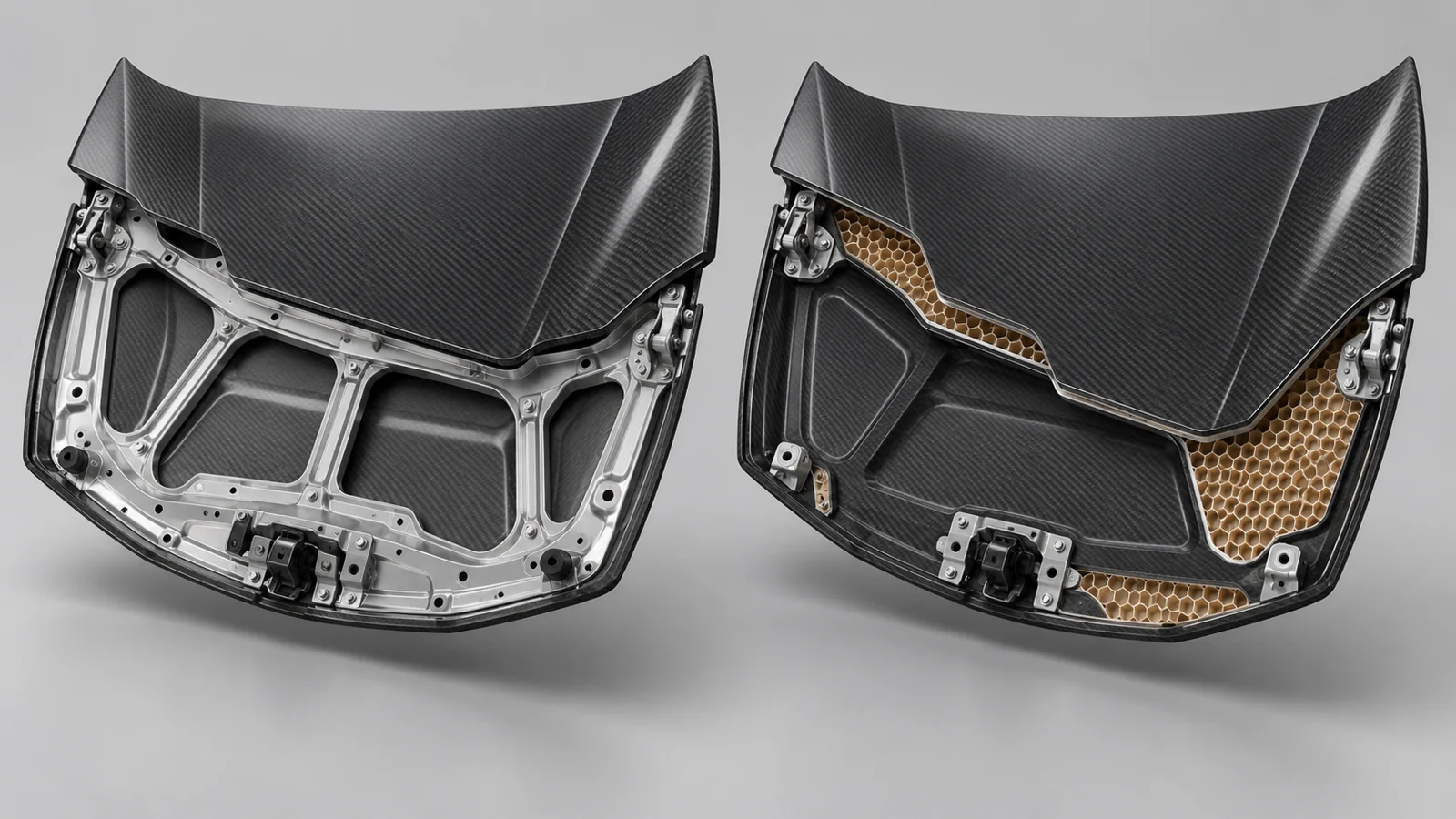
Hood A followed a “black metal design” concept: its shape and two-part construction echoed a conventional metal hood, with an outer face and a backside frame. The frame carried important connection points, including the chassis supports, hinges and closing area. The researchers made this version from carbon-fiber prepreg, a fabric pre-impregnated with resin and laid up in layers.
Hood B kept a similar outside appearance but changed the structure underneath. Instead of relying on a largely continuous backside frame, it used a smaller frame around the important attachment points. Its outer panel was a sandwich: carbon-fiber faces enclosing a 10-millimeter Nomex honeycomb core. The core’s hexagonal cells measured 3.2 millimeters. In a sandwich panel, spaced outer layers and a lightweight core make up the structure, allowing the design to use less material than a solid build.
The change was substantial in the outer surface as well as the frame. The researchers report that the outer face of hood B, without its backside frame, had about 53% less mass than the corresponding hood A surface. Across the complete hoods, B weighed 717 grams less. This is a comparison of these prototypes and their particular designs, not a general mass saving guaranteed for carbon-fiber parts.
The prototypes were made and checked against their designs
Both hoods were made using vacuum-bag technology and cured in an autoclave. In this process, a sealed bag applies pressure to the layered composite while it is cured. For hood A, the researchers laid the prepreg layers on a mold and prepared the back edge for bonding to the frame. These manufacturing steps matter because the stiffness tests were performed on built components, not just on digital designs.
After fabrication, the team scanned the hoods in three dimensions and compared the measured shapes with their computer-aided design models. The scans showed where the manufactured parts differed from the intended geometry, including deviations around the backside frames. This check helped characterize the prototypes whose mechanical response was then measured.
Stiffness describes movement under a known load
For these tests, stiffness means resistance to deflection under an applied force. The researchers mounted each hood at its supports, including the rear hinges and front buffer points, and applied loads in different positions. They measured displacement—the amount the hood moved—and used load and displacement measurements to calculate stiffness. Strain gauges also recorded local stretching in parts of the structure.
The tests covered lateral and transverse bending, as well as torsion, or twisting. The load and support arrangement varied by test. For hood A, forces reached 500 newtons for the bending cases and 50 newtons for torsion. Hood B was tested at about 230 newtons laterally, 524 newtons transversely and 206 newtons in torsion. Because the forces were not identical in every case, the reported stiffness comparisons are more informative than comparing the raw displacements alone.
In the authors’ comparison with the modeled steel hood, the composite designs had higher lateral and transverse stiffness. Hood A’s lateral stiffness was reported as about 80% higher than the steel reference, and hood B’s as about 157% higher. For transverse stiffness, the reported values were about three times the reference for A and 12 times for B. In torsion, A was about 62% higher, while B was similar to the steel reference.
The results show that the reduced-frame sandwich design did not respond identically in every direction. Hood B’s transverse stiffness stood out, while its torsional result was closer to the steel reference. The study also found higher strain for hood B in some transverse and torsional measurements than for hood A. The authors relate this difference to the new material structure and the less continuous backside frame, which changed how forces traveled through the hood.
Measurements and simulations were broadly consistent
The team compared measurements on the composite prototypes with finite-element simulations, which estimate how a structure responds to loads using a computer model. For the composite hoods, measured and simulated displacements, strains and stiffness values generally differed by less than 10%, though the paper reports larger differences in a few cases. The authors attribute some variation to experimental conditions such as supports and the locations where loads or displacement measurements were applied.
The steel comparison had a different evidence status: it was a modeled reference, not a third hood physically tested alongside A and B. The study’s results therefore support a comparison of the prototypes’ static behavior with that reference under the chosen conditions. They do not establish crash performance or pedestrian protection, which require different evidence. Nor do the prototype builds establish production-scale cost or commercial readiness. The paper notes those as broader challenges for automotive composites, but its tests do not resolve them.
How lighter hoods could help small electric cars
A lighter body panel could contribute to a lower-mass small electric car, and lower vehicle mass could help its range. This study did not measure a vehicle’s range, so that remains a possible downstream benefit rather than a demonstrated result. Whether the design could contribute in practice would depend on meeting safety requirements and making the manufacturing process economical, alongside the structural performance measured here.
Key Sources
- Primary source: Design, Manufacturing and Test of CFRP Front Hood Concepts for a Light-Weight Vehicle.
DOI or Journal Page · Peer-Reviewed Paper · 2021-04-22
Keep exploring