
Research Signal – Source date 2023-10-24
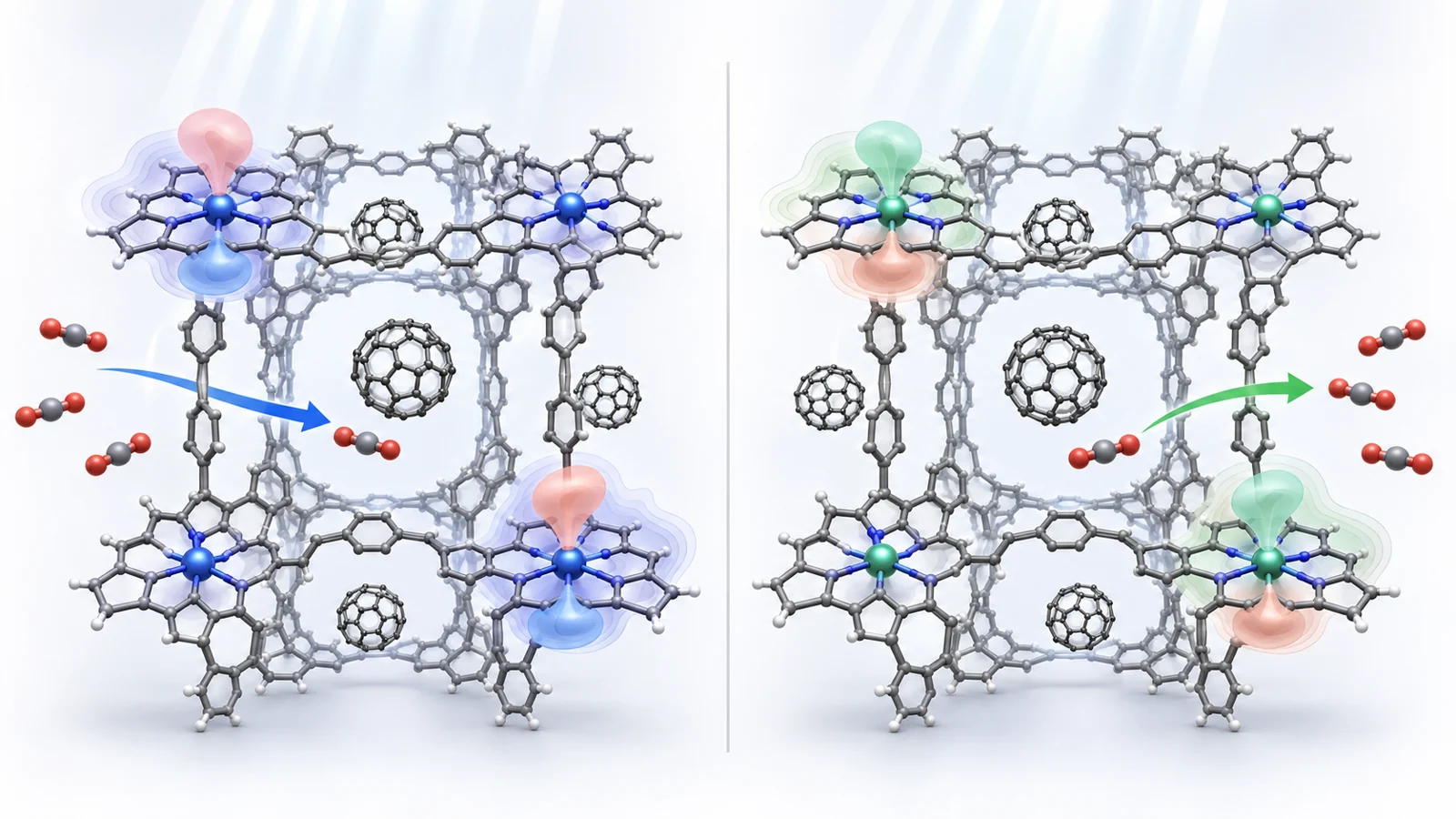
In a laboratory test, light changed how much carbon dioxide two closely related porous materials could hold, but in opposite directions. At 0 °C and 1 bar, the cobalt version’s measured uptake rose from 2.05 to 2.69 millimoles per gram under illumination. The nickel version fell from 2.43 to 1.99 millimoles per gram. The contrast points to a design principle: adding a light-responsive component is not enough by itself. The metal at the adsorption site can determine whether light strengthens or weakens the material’s attraction to carbon dioxide.
The study, published on October 24, 2023, combined synthesized materials, gas adsorption measurements, lifetime measurements of excited states, and electronic-structure calculations. Its result is a materials finding under controlled laboratory conditions. It offers a way to think about light-controlled adsorption, while leaving open whether that control can be made useful in a working capture system.
The additive only worked as part of the porous material
The researchers started with PCN-222 metal-organic frameworks, porous crystalline materials built around metal-containing porphyrin sites. They made versions containing iron, cobalt, or nickel, then introduced C60, a carbon molecule shaped like a hollow sphere. The resulting composites were labeled CPCN-Fe, CPCN-Co, and CPCN-Ni. The C60-to-framework mass ratio used for the reported composites was 1:8.
C60 was not acting as a carbon dioxide sponge on its own. At 0 °C and 1 bar, it held only 0.11 millimoles of carbon dioxide per gram in darkness, and its uptake decreased to 0.06 under the lamp. The undoped PCN frameworks, meanwhile, showed little change in carbon dioxide uptake when illuminated. The useful response appeared in the combination: C60 interacting with the framework’s metal-porphyrin sites.
The composites also favored carbon dioxide over nitrogen in the reported measurements. In darkness, their carbon dioxide capacities ranged from 2.05 to 2.43 millimoles per gram, while nitrogen uptake was much lower. The authors calculated initial carbon dioxide-to-nitrogen selectivity values from the adsorption data using ideal adsorption solution theory. Under illumination, the calculated selectivity rose for the iron and cobalt composites and fell for nickel. These are calculated selectivities based on the measured adsorption data, not results from separating a flowing carbon dioxide–nitrogen mixture.
Light shifted electron density near the binding sites
The authors’ explanation centers on charge transfer: after absorbing light, electrons become redistributed among the porphyrin ring, its coordinated metal, and C60. This changes the electron density distribution, or where electrons are concentrated, around the sites that adsorb carbon dioxide. If that redistribution makes a site more favorable for adsorption, its capacity can rise; if it makes the site less favorable, capacity can fall.
Calculations were used to explain why the three metals responded differently. In the authors’ model, the iron and cobalt sites can accept electron density from the porphyrin when excited. Nickel, with a different electron configuration, tends instead to donate electron density. The cobalt composite’s modeled charge-transfer pattern was more effective at increasing adsorption activity than the corresponding iron or nickel patterns. For nickel, the redistribution was associated with weaker adsorption in the excited state.
This account is supported in part by electronic-structure calculations; the experiment did not directly track every electron-transfer step as a carbon dioxide molecule bound. The comparison across composites, together with the unchanged response of undoped frameworks and the uptake loss for C60 alone, supports the authors’ view that the interacting components and the choice of metal both matter.
The excited state lasted long enough to matter for adsorption
An electronic change would have little bearing on adsorption if it vanished before a gas molecule could respond. The researchers measured light-triggered phosphorescence decay and reported excited-state lifetimes of 41 microseconds for CPCN-Fe, 44 for CPCN-Co, and 35 for CPCN-Ni. They describe these lifetimes as long enough to meet the timescale of molecular adsorption equilibrium, which they identify as about one microsecond.
That timing makes the proposed mechanism plausible on the scale relevant to an adsorption event: the light-induced state persists long enough to affect how molecules interact with the sites. It does not, by itself, show how quickly a practical bed could switch between operating states, how many cycles it could withstand, or how much energy a useful system would need.
The measured capacity belongs to a controlled test
The adsorption experiments used high-purity carbon dioxide and nitrogen and a static gas-adsorption analyzer. For illuminated measurements, the samples were exposed to a xenon lamp filtered to provide light from 350 to 780 nanometers. The reported capacity comparison was made at 0 °C and 1 bar. The authors also observed a light response at 25 °C, but the headline values above are from the 0 °C measurement.
These conditions let the researchers compare the materials’ adsorption behavior with and without light. They do not establish performance in ambient air or in a moving mixture of gases. Nor does a higher uptake measurement alone show whether the adsorption benefit would justify the energy needed to illuminate a larger amount of material. Those questions require tests that include gas flow, repeated switching, and the energy needed to illuminate the sorbent.
What this could make possible
If the light-driven change proves repeatable and can be achieved with an acceptable energy cost, an operator might one day adjust how strongly a sorbent holds carbon dioxide by changing its illumination while gas moves through a bed. The potential difference would be dependable optical control of adsorption during operation, built on the observed link between illumination, electron redistribution, and changed uptake in these composites. Whether illumination could provide that control in a flowing gas mixture remains untested.
A useful nearer milestone would be a repeated light-on/light-off test with a mixed gas flowing through the material, measuring both the separation achieved and the energy spent on illumination. That would show whether the laboratory change in uptake can become a controllable separation step. Until then, this study shows a promising way to tune adsorption in a material, rather than a demonstrated carbon capture process.
Key Sources
- Primary source: Photo-Responsive Carbon Capture over Metalloporphyrin-C<sub>60</sub> Metal-Organic Frameworks via Charge-Transfer.
DOI or Journal Page · Peer-Reviewed Paper · 2023-10-24
Keep exploring