
Research Signal – Source date 2022-04-07
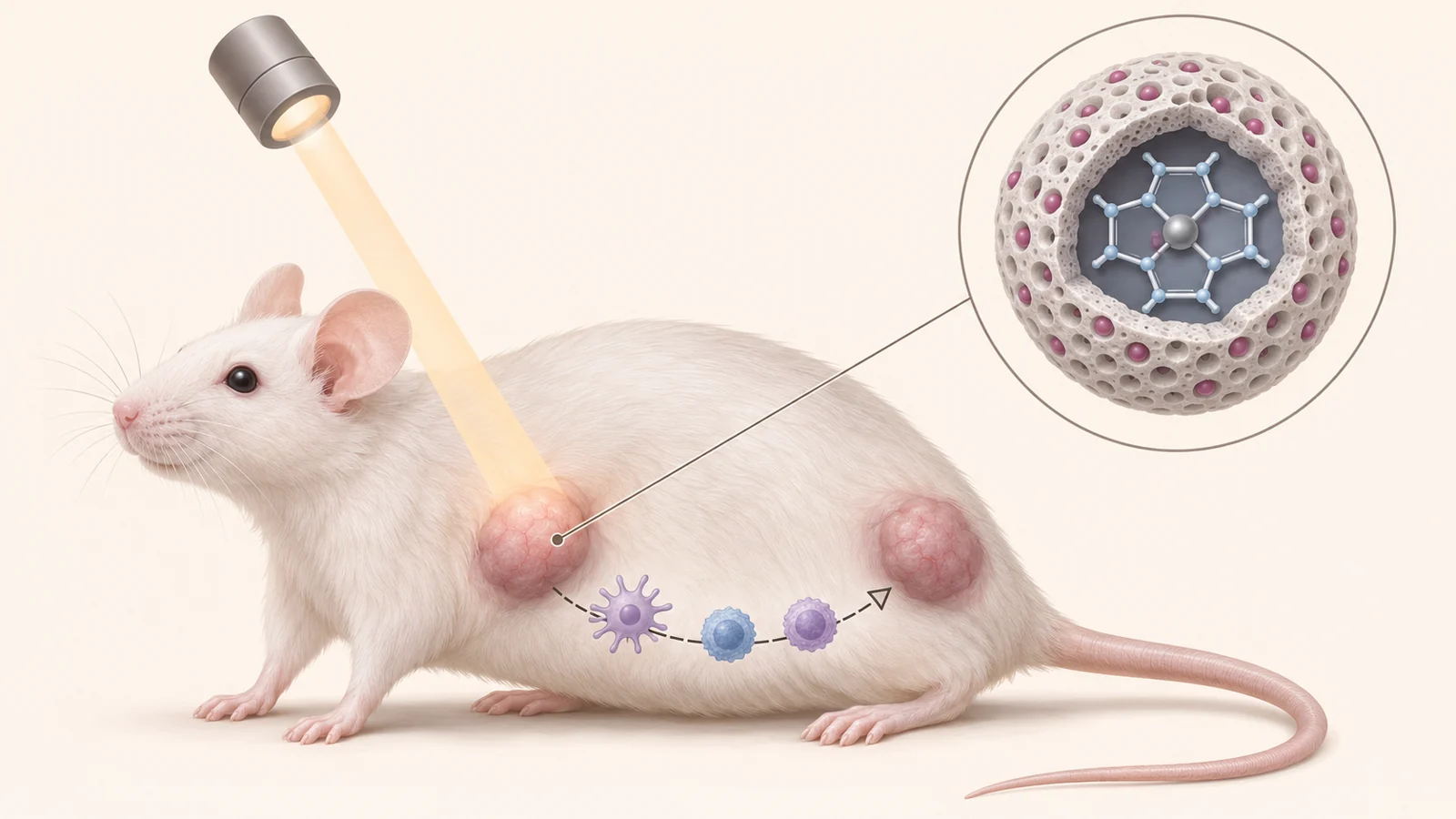
In a mouse experiment, researchers illuminated one tumor and left a second tumor on the same animal untouched by light. The unlit tumor grew more slowly when the treatment combined light-activated nanoparticles, an immune-stimulating drug, and a drug that blocks the PD-L1 immune checkpoint. Without the PD-L1-blocking drug, the unlit tumor continued to grow rapidly.
The result, published on April 7, 2022, offers a carefully bounded answer to a compelling question: can damage at one tumor help the immune system act elsewhere? In these mouse models, the combination was associated with that broader response. The experiments do not show that shining light on one human tumor can control cancer elsewhere.
One particle was built to do three jobs
The researchers designed mesoporous hexagonal core-shell zinc porphyrin-silica nanoparticles, abbreviated MPSNs. Their zinc porphyrin core interacts with light, while the porous silica shell can hold another substance. The researchers loaded the shell with R837, an immune stimulant that helps activate immune cells.
Under a single light source, MPSNs could produce two kinds of local stress. Photothermal therapy (PTT) converts absorbed light into heat. Photodynamic therapy (PDT) uses light to generate reactive oxygen, chemically active molecules that can damage cells. Combining those effects in one particle meant the researchers could test both forms of light-triggered damage while also carrying R837.
In cell tests, the team separated the two light-driven effects to estimate their contributions. When they suppressed heating by keeping cells cool, about 65.5% of 4T1 breast cancer cells remained viable. When they used an antioxidant to quench reactive oxygen, viability was about 59.6%. With both effects together, viability fell to about 40.3%. These laboratory comparisons suggest that heat and reactive oxygen each contributed to cell killing, with the combined exposure producing the strongest effect in that assay.
Cell damage was meant to start an immune handoff
Killing tumor cells was only one part of the design. The researchers also looked for signs that damaged cells might help immune defenses recognize tumor material. They measured calreticulin on cell surfaces and the release of HMGB1 and ATP, signals associated with immunogenic cell death. These markers increased after irradiated MPSNs or R837-loaded MPSNs were applied to 4T1 cells.
The proposed handoff involves dendritic cells, which can take up material from damaged cells and help activate other immune cells. In a laboratory co-culture setup, dendritic cells exposed to the products of irradiated, R837-treated tumor cells showed more signs of maturation than cells in comparison groups. The cells also released higher levels of the measured immune signaling molecules IL-12 and TNF-α.
R837 was included to support this step. It is an immune adjuvant, a substance intended to strengthen an immune response. The nanoparticle’s shell was designed to release R837 in response to changes in pH. The cell and marker results fit the researchers’ proposed sequence: light damages tumor cells, tumor material becomes available, and the adjuvant helps dendritic cells respond. They do not, by themselves, prove that every step caused the later effects at distant tumors.
Light treatment slowed primary-tumor growth in mice
The researchers first tested tumor treatment in mice carrying 4T1 tumors. After intravenous injection, imaging showed nanoparticle accumulation in tumors, with the strongest signal reported around 12 to 24 hours. When the tumor area was illuminated, the R837-loaded particles inhibited primary-tumor growth more than the comparison treatments in that experiment.
The local result has a direct explanation: the treated tumor received both the particles and the light that activated their heating and reactive-oxygen effects. In mice, the researchers also measured more mature dendritic cells in nearby lymph nodes and higher levels of several inflammatory signals after treatment. These findings support immune activity accompanying the local tumor damage, while leaving open how much each measured immune feature contributed to the overall response.
Distant effects depended on the treatment combination
The paper tested effects beyond the illuminated site in two separate mouse models. In one, mice with 4T1 tumors were also assessed for cancer nodules in the lungs. Mice receiving both irradiated MPSNs@R837 and anti-PD-L1 treatment had fewer lung nodules than mice receiving either treatment alone. The combination was also associated with longer survival in this model; half of the mice in that group survived to 60 days.
In a different experiment, each mouse had tumors on both flanks. Researchers illuminated the right-side tumor and left the tumor on the other flank unilluminated. Light-based treatment reduced primary-tumor growth, but the distant tumors were notably inhibited when anti-PD-L1 was added to irradiated MPSNs@R837. With the photo-immunotherapy but no checkpoint-blocking drug, the distant tumors continued to grow rapidly.
Anti-PD-L1 blocks a signal tumors can use to restrain immune attack. In these experiments, adding that checkpoint blockade was associated with the difference in control at distant sites. The result suggests that light-driven tumor damage and immune stimulation alone were not enough for a strong effect in the unlit tumor model. Immune-cell measurements and cytokine levels also changed with the combination, but those measurements cannot establish which immune mechanisms produced the distant-tumor effects.
These are model-specific findings in mice, not evidence that light delivered to one tumor will control metastases in people. The experiments also leave practical questions about how particles would reach tumors in humans, how light could be delivered to relevant tumor locations, and whether the treatment would be safe and effective in patients.
How this could shape the future
If a comparable approach could safely deliver the particles, activate them at a reachable tumor, and generate a dependable immune response, light might contribute to treatment beyond the spot it directly illuminates. That would matter for cancers with disease at multiple sites, where local treatment alone cannot reach every tumor. The mouse results offer an early evidence bridge toward that possibility: tumor damage, immune stimulation, and checkpoint blockade coincided with effects in unilluminated tumors and lungs.
A meaningful milestone would be showing, in further controlled studies, that distant-tumor effects reliably track with a measurable immune response while particle delivery and light exposure remain safe. Until that bridge is built, the study is a preclinical demonstration of a possible capability, not a treatment option or a prediction of human benefit.
Key Sources
- Primary source: Light-triggered multifunctional nanoplatform for efficient cancer photo-immunotherapy.
DOI or Journal Page · Peer-Reviewed Paper · 2022-04-07
Keep exploring