
Research Signal – Source date 2022-10-04
A light-activated treatment had reached clinical use for some low-risk prostate cancers by the time a 2022 review assessed the field. Ultrasound-activated treatment, by contrast, was still being studied in cells and animals; the review reported no clinical trials of sonodynamic therapy for urological cancers. That gap helps explain why researchers are testing sound: light has a clinical foothold, but its reach and the chemistry it depends on leave room for other approaches.
The review, published October 4, 2022, surveys photodynamic therapy (PDT), which uses light to activate a drug-like molecule called a photosensitizer, and sonodynamic therapy (SDT), which uses ultrasound to activate a related type of molecule. Its examples range from prostate treatment in people to experimental bladder-tumor models. They show different kinds of progress, not interchangeable evidence of benefit.
A prostate treatment targets tumor blood vessels
The clinical example is WST11, also called TOOKAD soluble. The review says it had been approved in Mexico, Israel and 31 countries in the European Union for low-risk prostate cancer. Its method, vascular-targeted photodynamic therapy, aims at blood vessels supplying the tumor rather than illuminating the tumor tissue directly.
During treatment, clinicians place thin needles in the prostate using ultrasound imaging as a guide. Optical fibers inside the needles deliver 753-nanometer laser light. The patient receives WST11 through a vein; when the light activates it, reactive oxygen species (ROS)—chemically reactive molecules—form in blood vessels. The resulting clots block those vessels, cutting off oxygen and nutrients and leading to cell death in the treated area.
A phase III trial across 47 European university centers and community hospitals compared this treatment with active surveillance in men with low-risk prostate cancer. As summarized by the review, a smaller proportion of men in the treatment group had disease progression, and a higher proportion had a negative prostate biopsy 24 months after treatment. The review does not give the outcome percentages in the cited passage, so the comparison is best read as a reported clinical result, not a measure of how much any individual patient might benefit.
This example establishes a useful benchmark: light-activated treatment can be delivered to a specific prostate target and has been studied in a large clinical trial. It does not mean newer sensitizers—or ultrasound activation—have reached the same stage.
Light and sound pose different engineering problems
PDT depends on three things meeting in the tumor: a photosensitizer, light at a wavelength it can absorb, and oxygen. The activated sensitizer transfers energy into reactions that generate ROS, which damage nearby cells. Delivering light can be difficult in tissue, and photosensitizer that remains in skin may cause light-related side effects when exposed to sunlight. The prostate procedure illustrates one solution: place optical fibers close to the treatment area. It also shows the extra equipment and intervention that approach entails.
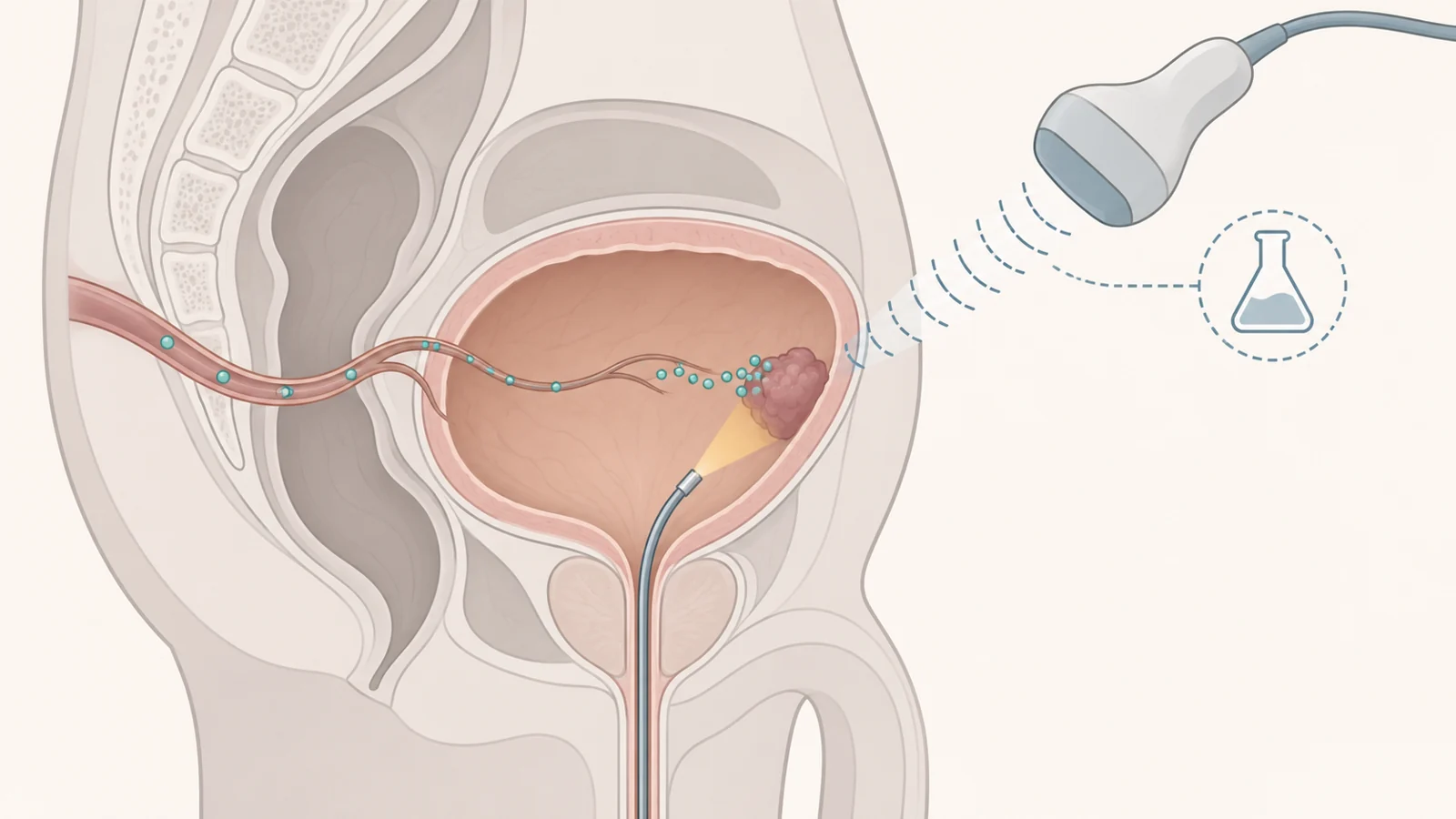
SDT is proposed as another way to activate a sensitizer. Low-intensity focused ultrasound stimulates a sonosensitizer, which can then help generate ROS. Ultrasound may reach tissue beyond light’s useful penetration, and the review compares an external ultrasound probe with one prostate PDT approach that inserts a fiber through the urethra. That potential difference in access is a reason to investigate SDT, not evidence that it is already easier, safer or more effective for patients.
The underlying sound-triggered chemistry remained unsettled in the review. Researchers had proposed mechanisms such as cavitation—the formation and collapse of tiny bubbles—and sonoluminescence, in which sound is associated with brief light emission. Other possibilities include heat-driven reactions or cell damage that does not depend on ROS. The review notes that the precise mechanism had not been determined, and that SDT’s ROS yield was relatively low compared with PDT. Better understanding and more effective sonosensitizers remain part of the research challenge.
A bladder-tumor model shows why oxygen matters
Reaching a tumor does not solve every problem. Many bladder tumors are oxygen-poor, and PDT needs oxygen to generate ROS. The treatment can consume oxygen as it proceeds, adding to the shortage. Researchers are therefore testing ways to deliver oxygen, make it locally, or reduce how quickly cells use it.
One example in the review combines several of these design choices in a mouse model of bladder cancer. Researchers administered nanoparticles into the bladder. They combined a chlorin photosensitizer with nitazoxanide, a compound used in the design to reduce oxygen consumption, and fluorinated chitosan, which can reversibly loosen connections between bladder-lining cells and help material cross the tissue barrier. The formulation also used human serum albumin to improve biocompatibility.
The review reports improved PDT efficacy in mice with orthotopic bladder tumors—tumors growing in the organ they resemble. This is a tangible preclinical response to two linked constraints: getting a sensitizer through the bladder lining and preserving oxygen for the reaction. It is not a human test of the formulation, and the result does not show that this delivery strategy would be safe or effective in people.
Tumor delivery and tumor selectivity are separate hurdles
A treatment can reach the bladder and still accumulate unevenly across cancer and healthy tissue. One approach discussed in the review tries to improve selectivity by exploiting galectin-1, a protein found at high levels in some bladder tumors. Researchers attached galactose-rich branching units to a porphyrin photosensitizer, creating PorGal8, designed to bind galectin-1. In a bladder-tumor xenograft model using cells with high galectin-1 levels, it preferentially accumulated in tumor tissue. This is evidence of targeting in an experimental model, not proof that the same selectivity or benefit would occur in patients.
The review also describes a different bladder-cancer experiment using ultrasound. Researchers packaged a sonosensitizing molecule called DCPy in microvesicles prepared from patient-derived bladder-cancer cells. In laboratory tests, the resulting system generated ROS in T24 bladder-cancer cells. In patient-derived xenograft (PDX) models, where a patient’s tumor tissue is grown in mice, the researchers observed tumor regression. The patient-derived material was intended to improve compatibility and tumor targeting, while ultrasound supplied the activation. These results add a model-based example of SDT, but they do not amount to a sonodynamic treatment tested in patients.
Pairing treatments may address resistance
Some formulations are designed to combine PDT with another treatment rather than solve a delivery problem alone. The review describes a heat-responsive nanoparticle system that co-encapsulated the photosensitizer zinc phthalocyanine and the chemotherapy drug doxorubicin. In a mouse model using 5637 bladder-cancer cells, the combined treatment suppressed tumors more than PDT or chemotherapy alone.
The comparison suggests a possible advantage to putting two treatment mechanisms together in one formulation. But this was an animal result in a particular model; it does not establish that the combination would outperform chemotherapy or other care in people. The practical rationale is to explore whether PDT can complement drugs and help address treatment resistance, while testing the combination against relevant clinical options.
Translation depends on comparable, disease-specific tests
The reviewed research spans different sensitizers, tumor types, delivery systems, laboratory conditions and animal models. That variety makes it difficult to tell whether one design is better than another. The authors identify inconsistent treatment parameters and variable biological samples as problems for reproducibility. They also argue that new compounds are often developed broadly across cancers without a specific clinical indication, and that laboratory work may not test them alongside drugs already used in care.
A more useful development path would start with a defined cancer type and clinical need, then compare candidate sensitizers under standardized conditions, including against clinically used compounds where relevant. Clinicians, cancer biologists, device makers and treatment developers would need to work together because the treatment depends on more than a molecule: it also needs a delivery method and a protocol that can be reproduced. The review places ultrasound-activated approaches earlier still, calling for stronger preclinical research before clinical testing in urological cancers.
How this could shape the future
A credible future for these therapies would be more choice in how a localized bladder or prostate tumor is treated: light delivered through a carefully placed fiber, or—if the chemistry and dosing can be made reliable—ultrasound activation from outside the body. Better targeting and oxygen management could help sensitizers act where intended, while combination designs might complement existing drugs. That possibility depends on a clear bridge from reproducible, disease-specific animal results to human trials. A meaningful milestone would be a well-controlled clinical study of a defined formulation and protocol; the 2022 review describes WST11 as having crossed that threshold, while the newer nanomaterials and SDT examples had not.
Key Sources
- Primary source: Emerging photodynamic/sonodynamic therapies for urological cancers: progress and challenges.
DOI or Journal Page · Review or Meta-Analysis · 2022-10-04
Keep exploring