
Research Signal – Source date 2026-04-30
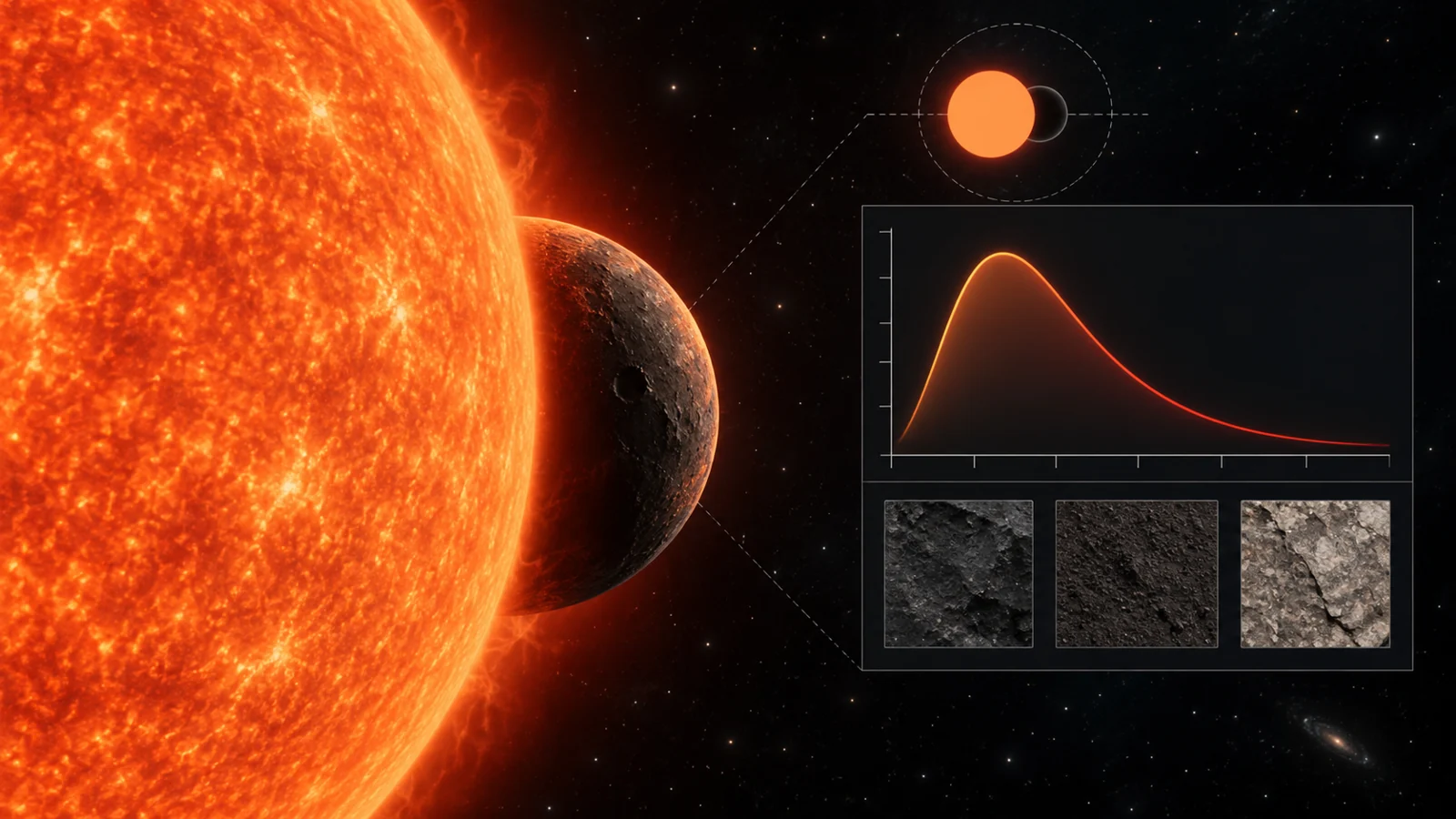
LHS 3844 b is too distant for astronomers to photograph its ground. Instead, a preprint that has not been peer reviewed uses JWST to infer the planet’s heat from the dip in infrared light when it passes behind its star. Across wavelengths from about 5 to 12 microns, the measured spectrum is relatively featureless and best matches models of a dark, low-silica surface.
That sparse pattern still carries clues. Different rocks and surface textures shape infrared emission in different ways, so a planet’s heat can help narrow down what its surface might be made of. The observations favor dark, low-silica material, but they leave an important question open: is the surface old and altered by exposure, or could it be a comparatively fresh slab of rock?
Three eclipse visits, two independent reductions
The team based its spectrum on three successful JWST observations. One planned visit failed because the telescope could not acquire its guide star; the observation was repeated with a different guide star and succeeded. A third successful observation followed later. The resulting data captured the planet’s reduced contribution to the combined light during each eclipse.
The researchers processed the JWST measurements in two independent ways. The resulting spectra broadly agree, giving the interpretation a useful check against choices made during data reduction. The largest disagreement appears in the two reddest wavelength bins, where the reductions differ more than they do across most of the spectrum. That extra scatter matters when weighing subtle spectral features, especially at the edge of the measured range.
The study compares the measured thermal emission with models of rock surfaces and possible gases. It is not a direct chemical sample: the measurements are light, and the surface descriptions are interpretations of how candidate materials would shape that light.
Rock leaves a pattern in infrared heat
Minerals can alter the way a surface emits and reflects infrared radiation. In the 8–12 micron region, features associated with the interaction of light and rock are sensitive to composition, crystal structure and grain size. A broad or subtle pattern can therefore help distinguish among candidate materials, even when the planet itself appears only as a point of light.
In the authors’ comparisons, dark, low-silica surfaces fit the observed spectrum best. Basalt and olivine-rich materials are examples of the broad class that can match it; the result does not uniquely identify a rock or mineral. A possible feature associated with silicon–oxygen bonds appears in the data, and its shape could point toward an olivine-rich surface if future measurements confirm it. For now, it remains tentative.
Powder and solid rock do not fit alike
The texture of the surface changes the comparison. The tested fresh powders produce spectra that conflict with the observations, so those particular fresh-powder models are disfavored. But the study also considers what exposure in space could do to powdered material. Space weathering can darken a powder, making its modeled spectrum more compatible with the data.
A fresh slab is a different possibility from fresh powder. A coherent, newly exposed piece of rock could be dark and relatively featureless without having first been ground into powder. The observations do not settle whether the surface is such a slab or weathered material. They show why texture and exposure history have to be considered alongside composition when interpreting the same heat spectrum.
Gas limits narrow one part of the story
The team also compared the spectrum with models containing carbon dioxide or sulfur dioxide. The observations disfavor the specified atmospheres, with reported upper limits of 100 millibars for carbon dioxide at five sigma and 10 microbars for sulfur dioxide at three sigma. These limits describe how much of those gases the spectrum can accommodate under the study’s analysis.
The gas results matter because volcanic outgassing could add gases to an atmosphere. The measured limits therefore provide no evidence for accumulated volcanic gases at the levels tested. They do not show that volcanic activity has never happened, and they do not rule out every possible thin atmosphere or transient episode of outgassing. A limit on detectable gas is narrower than a history of the planet’s geology.
A surface history still has more than one fit
The rock comparisons favor a dark surface, while the gas limits provide no evidence of accumulated volcanic gases at the levels tested; neither result establishes the surface’s age. One interpretation is an old exposed surface that has been darkened by space weathering. Another is a comparatively fresh slab, which could retain a dark, featureless appearance without the same history of powdering and alteration.
The tentative silicon–oxygen feature offers a possible way to sharpen the comparison. If a more precise spectrum confirms the feature and establishes its shape, it could help assess whether an olivine-rich mineralogy is a better explanation. Additional JWST observations were proposed for that test; they are a prospect in the paper’s 2026-04-30 account, not evidence already obtained. Even a clearer mineral clue would need to be interpreted with models of texture and exposure before it could resolve the surface’s history.
What this could reveal about rocky worlds
More precise heat spectra, paired with rock and weathering models, could let astronomers compare the surface materials and possible geological histories of rocky planets that cannot be sampled directly. That capability depends on separating mineral clues from the effects of grain size, surface alteration and atmospheric gases. LHS 3844 b shows both the promise of reading a planet’s surface through its heat and the remaining challenge: a good spectral fit can narrow the possibilities without choosing a unique history.
Key Sources
- Primary source: The dark and featureless surface of rocky exoplanet LHS 3844 b from JWST mid-infrared spectroscopy
arXiv · Preprint · 2026-04-30
Keep exploring