
Research Signal – Source date 2021-03-20
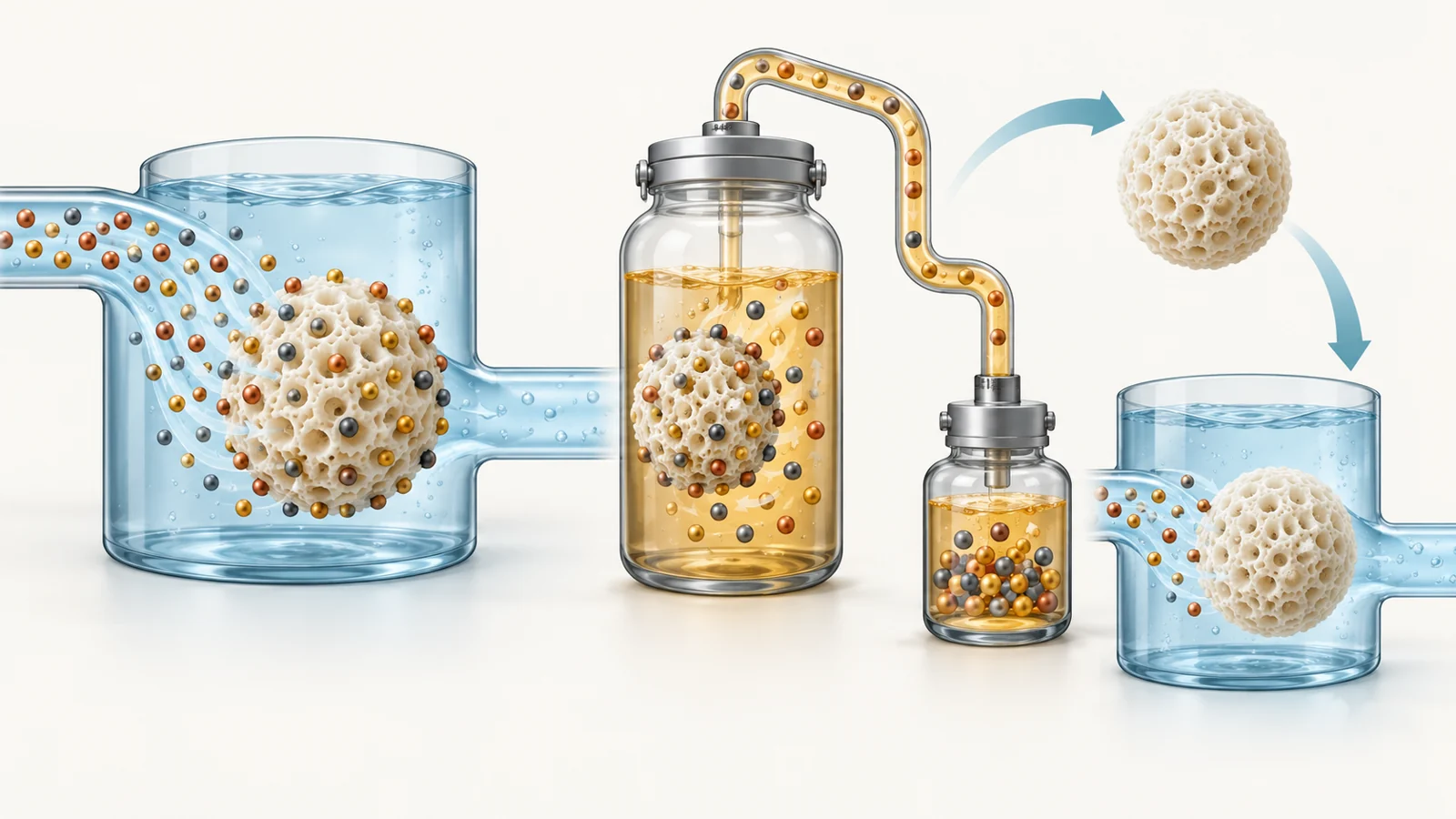
When a material pulls lead out of wastewater, the metal has not vanished. It has moved from the water onto a solid adsorbent. That shift can make contaminated water easier to treat, but it leaves a concentrated, metal-loaded material that must be recovered, cleaned, or otherwise managed.
A 2021 review examined adsorbents made from chitosan, cellulose, alginate, and lignin, including versions combined with other materials or chemically modified. It discussed tests for capturing cadmium, lead, and zinc, as well as ways to regenerate used adsorbents and possible uses for spent materials. The examples show why a natural starting material alone does not determine performance: the chemical groups added to it and the conditions of the water can change how much metal binds and how readily the material can be used again.
Binding metals takes more than a natural starting material
Adsorption is the transfer of dissolved substances onto a solid surface. In these materials, chemical groups such as amine, hydroxyl, and carboxyl groups can interact with metal ions. They act as binding sites: places where dissolved metals can attach. A polymer’s structure and those sites help determine how well it takes up a particular metal.
The review describes several ways researchers altered the materials, including grafting new groups onto a polymer, blending materials, or combining polymers with nanomaterials. Such changes can add binding sites or alter the material’s structure. They can also affect its mechanical properties, which matter when it must be handled and put through repeated treatment and cleaning cycles.
The examples are specific to their tests. In one, cross-linked chitosan microspheres were grafted with polymethacrylic acid, adding carboxyl groups. At pH 5, the modified material reached its reported cadmium uptake in one hour; the unmodified cross-linked chitosan comparator took about seven hours. The modified material’s maximum reported uptake was 1.3 milligrams per gram. It was regenerated with dilute nitric acid for another cycle without a reported change in structural integrity.
A lignin example also shows how modification can matter. After oxidative treatment, a lignin material had more carboxyl and aliphatic hydroxyl groups while its underlying structure was maintained. At pH 5 and 20°C, its reported saturated uptake was 35.9 milligrams of cadmium per gram and 155.4 milligrams of lead per gram—three times and twice the amounts reported for the starting lignin, respectively.
These are separate material comparisons, not a common contest among adsorbents. Their reported values cannot establish a universal ranking. The review describes tests in which pH, contact time, initial concentration, and the presence of other metals were among the factors examined. In one modified-cellulose example, lead was taken up more readily than cadmium in a mixture; for another chitosan composite, the mixture changed cadmium uptake. A result for one metal in a prepared solution therefore cannot stand in for performance in every wastewater stream.
Cleaning the material moves the metal again
Regeneration uses a liquid reagent to desorb—release—the captured metal from the adsorbent. The intended cycle is adsorption, followed by desorption and another opportunity to capture metals. The released metal enters the cleaning liquid, which also needs appropriate management.
The cycle studies in the review measured different things under different conditions. A chitosan, polyethylene glycol, and polyacrylic acid hydrogel was cleaned with an EDTA solution and retained its reported lead-adsorption capability through four adsorption–desorption cycles, including when cadmium was also present. A cellulose-based hydrogel, by comparison, was reported to retain 85% of its initial adsorption capacity after three cycles using nitric acid. The review also describes a biomass-derived porous carbon regenerated with sodium carbonate: after five cycles, reported desorption efficiencies were 96% for lead and 92% for cadmium.
Those percentages describe different steps. Adsorption capacity measures how much a material can capture; desorption efficiency measures how much captured metal is released during cleaning. They do not provide a single, standardized measure of long-term treatment performance. The choice of cleaning reagent matters too: in the porous-carbon example, higher concentrations of nitric acid damaged the adsorbent’s structure, while 0.1 M sodium carbonate was used for the reported five-cycle results.
A reused adsorbent could reduce demand for replacement material, but a cycle count alone does not show safe metal recovery, durable operation in varied wastewater, or lower overall treatment costs. Any metal not removed during regeneration can remain on the adsorbent and still needs to be managed. The review identifies disposal and recycling as concerns because poorly managed, metal-loaded adsorbents can contribute to secondary pollution.
A possible second use needs its own evidence
The review also discusses latent fingerprint detection using nanomaterials applied as powders. It describes reports of fluorescent materials producing visible fingerprint ridge patterns, including carbon dots and quantum-dot materials. These examples concern fingerprint imaging as a possible use for spent adsorbents, but the supplied evidence does not connect them to the same heavy-metal-loaded wastewater adsorbents described in the treatment examples.
That distinction matters for the fate of the captured metal. A possible second use is not evidence that a contaminated adsorbent has been made safe, or that the metals it captured have been recovered. Any reuse pathway would need to account for what remains attached to the material and how it will be handled.
What safe reuse could mean for metal-polluted water
Materials that repeatedly capture lead, cadmium, or zinc could reduce replacement-material demand and the amount of contaminated solid waste generated during treatment. If they work in the wastewater at hand, and if the concentrated metals can be recovered or handled safely, reuse could also help lower treatment costs. The review’s cycle examples make that possibility worth investigating; they do not establish those operational outcomes.
Key Sources
- Primary source: Carbohydrate biopolymers, lignin based adsorbents for removal of heavy metals (Cd<sup>2+</sup>, Pb<sup>2+</sup>, Zn<sup>2+</sup>) from wastewater, regeneration and reuse for spent adsorbents including latent fingerprint detection: A review.
DOI or Journal Page · Review or Meta-Analysis · 2021-03-20
Keep exploring