
Research Signal – Source date 2021-04-17
Among 5,588 patients in 35 trials of anti-PD-1 or anti-PD-L1 based regimens, 254 had a response after initial scan-defined progression. That is 4.6% across the trials that reported this outcome. The finding shows that a first scan-defined worsening was sometimes followed by a response. It does not tell an individual patient how likely that outcome is, or whether continuing treatment caused it.
The figures in a 2021 systematic review answer different questions. One counts later responses across a group of trials; another counts how many patients continued treatment after progression; a third looks at later responses among a smaller group who continued in trials reporting both measures. Keeping those populations separate is essential to understanding what the results can say.
What a first progression finding captures
In cancer trials, a standard set of scan criteria called RECIST classifies a tumor as progressing when the findings meet a defined threshold for worsening. The review examined what happened after this initial, RECIST-defined progression in patients receiving anti-PD-1 or anti-PD-L1 based regimens for advanced solid tumors.
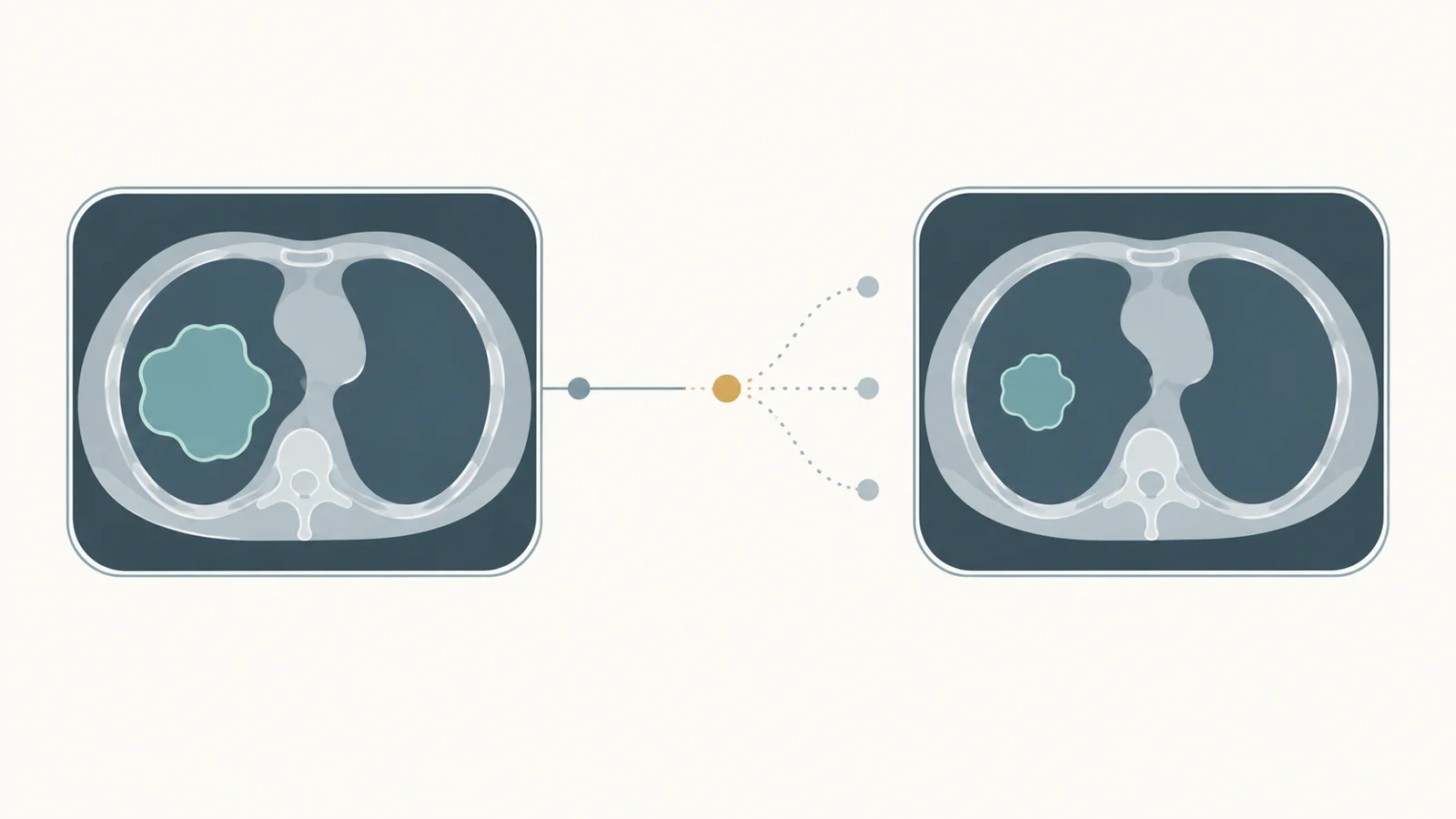
Immune-related response criteria were developed to account for patterns in which an initial increase in tumor burden, or new lesions, is followed by tumor regression or prolonged stability. Under the general approach described in the review, an apparent progression is checked at a later tumor assessment before it is treated as confirmed progression, provided the patient’s clinical condition is not deteriorating.
This approach makes room to observe a possible delayed response in selected circumstances. It does not mean that every worsening scan is temporary or that treatment should routinely continue. The review documents what trial reports recorded; it does not provide a rule for deciding what should happen for a particular patient.
Three percentages, three reported populations
Across 35 trials that reported responses after an initial RECIST-defined progression, 254 of 5,588 patients had a later response: 4.6%. This denominator includes patients evaluated in those trials, not only people who continued treatment after progression.
A separate set of 36 trials reported whether patients received treatment beyond progression. In those reports, 30.2% of 5,334 patients continued treatment after progression. This figure describes how often continuation occurred in the reporting trials; it is not a response rate.
The 19.7% figure addresses a narrower question. Across 25 trials reporting both continuation and later response, 853 patients received treatment beyond progression, and 19.7% of them had a later response. Because the trial sets and reported populations differ, these percentages are not successive steps in one shared group of patients. In particular, 19.7% is not the chance that any patient who continues treatment will respond.
Responses appeared across different regimens
The review found later responses reported with anti-PD-1 or anti-PD-L1 drugs used alone and in combinations with other treatments. The single-agent reports included 232 later responses among 5,053 patients evaluated for response, or 4.6%. Among 783 patients in reports that included both continuation and later response after single-agent treatment, 156 had a later response, or 19.9%.
Combination reports were much smaller and covered different groups. For combinations with other immunotherapies, six of 249 patients had a response after initial progression in trials reporting that outcome; three trials reporting both continuation and response recorded six later responses among 42 patients who continued. For combinations with targeted agents, three later responses were recorded in the three trials reporting that outcome (3.7%). In two trials with both measures, two of ten patients who continued had a later response. In chemotherapy combinations, six of 204 patients had a later response in trials reporting that outcome; among 18 patients who continued in the two studies reporting both measures, four had a response.
The denominators vary because each figure uses the studies that reported the relevant information. The combination groups, especially those reporting both continuation and response, were small. The results show that later responses were observed across several regimen types, but they do not support ranking regimens by the likelihood of benefit after progression.
Among the more represented cancer types in the single-agent analysis, reported later-response rates also varied: 4.0% for lung cancer, 6.1% for urothelial cancer, 7.2% for melanoma, and 4.6% for renal-cell carcinoma. These figures describe trial reports included in the review. They are not a comparison of treatments or a basis for ranking cancers.
Many trial reports left gaps
The review examined full texts from 321 prospective studies and included 81 articles that met its reporting criteria. Those 81 articles covered 9,644 patients for whom some information on immune-related clinical activity was reported. Many of the examined reports did not provide the information needed to connect treatment beyond progression with what happened afterward; some gave only part of it.
As a result, the review had to answer its questions using different subsets of trials. The pooled figures are descriptive summaries, not a complete account of every patient in every prospective trial of these drugs. The included studies also differed in their design, cancer populations, regimens, timing of assessments, and response evaluation. These differences, together with the small combination groups, limit how directly the results can be compared.
A later response is not proof that continuing helped
The review establishes that some patients had a response after an initial scan-defined progression. It does not establish that continuing treatment after progression improves survival, symptoms, or quality of life compared with stopping or switching treatment. Patients who continued and those who did not were not shown here in a comparison that could answer that causal question.
The distinction matters because a later response after continuing treatment is an observed outcome, while the benefit attributable to continuing is a comparison between possible choices for similar patients. The review’s descriptive rates cannot supply that comparison. Nor does it validate a test that can reliably distinguish delayed response from true progression across the cancers and regimens it surveyed.
A clearer decision after the first worsening scan
If reliable selection tools can identify patients whose apparent progression may be followed by a response, clinicians could have a better basis for a carefully monitored second look while directing patients with true progression toward other care. That capability would depend both on dependable tools and on evidence that using them improves patient outcomes. The review discussed circulating tumor DNA, a blood-based measure of tumor material, as a candidate for distinguishing patterns in disease status; it was not an established answer across the cancers and treatments examined.
Key Sources
- Primary source: Treatment beyond progression with anti-PD-1/PD-L1 based regimens in advanced solid tumors: a systematic review.
DOI or Journal Page · Review or Meta-Analysis · 2021-04-17
Keep exploring