
Research Signal – Source date 2022-10-28
Kaolin, an abundant and relatively inexpensive clay, offers an appealing starting point for making ceramics. Chemical activation can help turn its silicon- and aluminum-containing material into a connected mineral binder called a geopolymer. That opens a manufacturing question with practical consequences: could some of the heat used to prepare the clay be avoided while still producing a useful, durable ceramic?
A review published on October 28, 2022, brings together earlier research on kaolin ceramic geopolymers, their processing conditions and possible reinforcement. Its examples reveal why that question needs more than a furnace temperature or a strength score. Preparing a reactive clay, allowing a binder to harden and firing a ceramic body are different steps. A route that avoids heating at one stage may still require substantial heat later.
There is a second distinction inside the material itself. A specimen can withstand considerable crushing pressure yet remain vulnerable to cracks. The review’s discussion of zirconia, a ceramic additive, shows how attempts to address mechanical performance can introduce tradeoffs of their own.
Where the heat enters the process
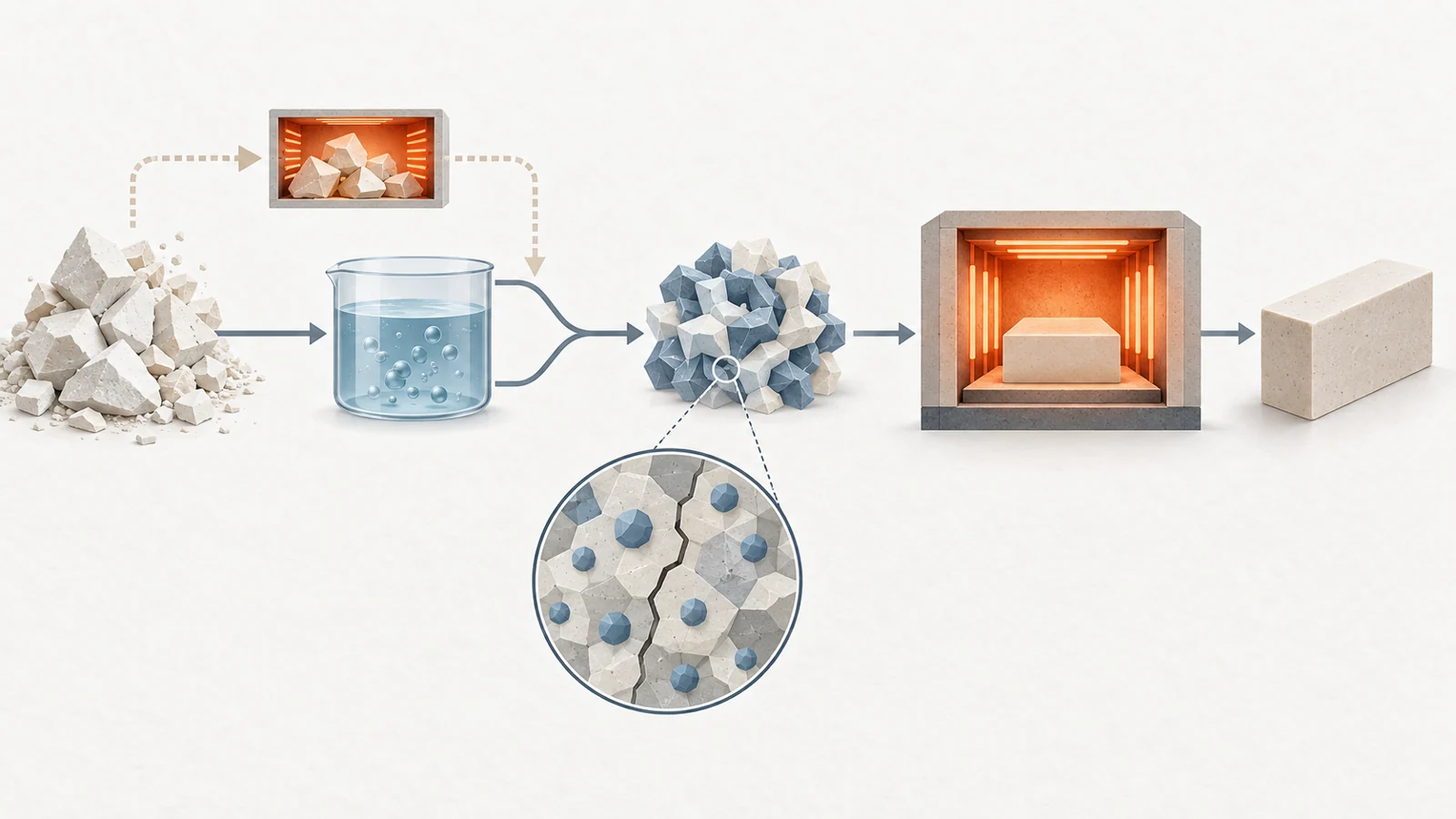
A geopolymer forms when an alkaline mixture reacts with suitable silicon- and aluminum-containing material. Some of those constituents dissolve and reorganize into a network linked through oxygen atoms. This network binds the material together. The starting clay, the activating solution and the amount of liquid all influence what develops.
Kaolin can first undergo calcination, a heat treatment that removes chemically bound hydroxyl groups and converts it into the more reactive material metakaolin. The review describes this transformation at roughly 550–800 °C. This is preparation of the precursor, before the resulting binder has become a finished ceramic component.
After activation comes curing, during which the binder develops and hardens. Some of the reviewed work examines curing near room temperature. A further operation, sintering, heats a formed body to promote particle bonding and changes in its structure and mineral phases. One reviewed route uses sintering at 1200 °C.
These distinctions explain how a process described as requiring less heat can still involve a hot furnace. Using non-calcined kaolin could remove the precursor heat treatment while retaining a later firing step. A low curing temperature likewise says little by itself about the temperature needed to produce the final ceramic. The abstract’s mention of 200 °C should therefore not be read as a general manufacturing temperature for finished kaolin ceramics with all the properties an application requires.
There is a chemical reason to consider the route carefully. Unheated kaolin is less reactive than metakaolin, so the alkaline activator and any other ingredients must support sufficient reaction. One example in the review combines kaolin with ground granulated blast-furnace slag and reports changes in setting and the phases formed after sintering. Such combinations make it possible to investigate avoiding preliminary calcination, but the heating sequence remains part of the recipe. Removing one operation changes the route; it does not establish the energy demand of the whole process.
What a strength number actually measures
“Stronger” can describe several different capabilities. Compressive strength measures resistance to failure under crushing pressure. Flexural strength measures resistance to failure under bending, which puts part of a specimen in tension. Fracture toughness concerns resistance to the growth of a crack. A result from one test cannot stand in for the others.
The review reports a kaolin-based formulation reaching a compressive strength of 68 megapascals after 28 days of curing. That example used a particular density of water glass, an alkali silicate solution used in activation. The number describes how that material performed under compression after that preparation and curing period.
A separate powder-processing example produced ceramic geopolymers with a flexural strength of 90 megapascals after firing at 1200 °C. Heating also changed the material’s phases, producing the crystalline mineral nepheline. The 90 and 68 megapascals are not competing scores: they come from different materials and processing histories, and they measure different ways of failing.
This matters for any component that must carry a load. Crushing a test specimen and bending a ceramic part challenge its structure differently. A high compressive strength can be useful while leaving the behavior of an existing crack unresolved. Understanding that gap is essential before treating an additive that raises one strength measurement as protection against brittle failure.
When zirconia helps and when it hurts
Zirconia is zirconium oxide, a ceramic material investigated as an addition to geopolymer and other ceramic matrices. Its appeal in the review is the possibility of improving mechanical performance. The most revealing example, however, is a reversal within a single system.
As summarized by the review, one earlier study found that adding 3% zirconia by mass to a geopolymeric matrix increased compressive strength by 30%. At additions of 5% or more, the researchers reported considerable brittleness, which they associated with the physical effects of excess filler on the binder network. A modest addition and a larger addition had meaningfully different consequences. These percentages describe that study’s matrix; they are not a general dosing recommendation for kaolin ceramics.
Other ceramic systems discussed in the paper help explain why adding particles can complicate the internal structure. In one clay–zirconia example, higher zirconia contents were associated with greater porosity as the clay contribution decreased. In another, researchers proposed that differences in thermal expansion between zirconia and a mullite matrix could create internal fissures and weaken the material. That explanation was a hypothesis about the system studied, rather than a demonstrated mechanism for every kaolin geopolymer.
The distinction between a particle’s properties and the behavior of the composite is crucial. Zirconia sits within a surrounding matrix, and the two must respond together during processing and use. Interfaces, pores and stresses can influence failure alongside the binder chemistry. The reviewed strength gain makes reinforcement worth investigating, while the loading-dependent reversal explains why simply adding more zirconia is not a reliable route to crack resistance.
Water changes the question
A ceramic’s surroundings introduce a different test of performance. The review describes particular binder specimens that developed cracks and lost compressive strength after immersion in water. Images discussed in the paper showed microcracks and discontinuous gel in room-temperature-cured material, with a larger crack identified after immersion. These observations concern the specimens examined, rather than all kaolin-derived ceramics.
The internal pore structure helps connect manufacturing to exposure. Water in a geopolymer mixture provides a medium for reaction, and its release as the gel solidifies can leave pores. The review links pore development to solution chemistry, the silicon-to-aluminum ratio and water content. A hardened binder is therefore not necessarily a uniform, solid block; its connected material, voids and cracks all contribute to its behavior.
For a part expected to encounter moisture, the useful question becomes how well it retains its properties under that exposure. An initial strength test establishes performance at one point in its history. Testing after immersion addresses a service condition that the initial measurement cannot resolve. The water examples also show why results for a cured binder need to remain distinct from results for a subsequently fired ceramic body.
What these examples can establish
The value of this 2022 synthesis lies in connecting processing choices with specific observations. It draws attention to separate heating stages, different modes of mechanical failure and the consequences of adding another ceramic phase. Those relationships give researchers useful directions for developing kaolin-based materials.
Its examples span different feedstocks, matrices, additive amounts, heating histories and test methods. They cannot be combined into a single best formulation or a universal firing schedule. A mechanism proposed in one ceramic matrix remains a candidate explanation when applied to another.
The environmental argument also requires a complete process comparison. Avoiding precursor calcination offers a plausible opportunity to reduce thermal demand, but a net saving depends on the remaining operations and the performance achieved. The results discussed here do not justify a quantified energy, emissions or cost reduction. Nor do material-level strength measurements establish qualification for a structural component, electronic device or biomedical use; each application would bring its own demands.
What this could change
From the October 2022 perspective, the practical possibility is a ceramic manufacturing route that starts with accessible kaolin clay and requires less thermal processing. If avoiding precursor heating can be combined with adequate crack resistance and durability in service, manufacturers could gain a less energy-demanding way to make heat-resistant components.
Heat-resistant structural elements are one potential beneficiary. They would need to retain useful mechanical properties in their intended environment, while the complete manufacturing route would need to deliver a net energy saving. Meeting both conditions could make abundant clay a more useful feedstock for durable ceramic parts and reduce the heat required to produce them. The processing and reinforcement studies brought together in this review identify ways to pursue that capability.
Key Sources
- Primary source: Geopolymer Ceramic Application: A Review on Mix Design, Properties and Reinforcement Enhancement.
DOI or Journal Page · Review or Meta-Analysis · 2022-10-28
Keep exploring