
Research Signal – Source date 2025-06-06
A ready-made cancer cell treatment sounds like a manufacturing breakthrough. But can it also help patients? A June 2025 review points to an encouraging early result for FT596, an engineered natural killer cell product: 17 of 20 people in a relapsed follicular lymphoma group had a complete remission in a Phase I trial. That is a striking figure, but it describes one product, one disease setting and a small patient group. The review itself did not test a treatment; it brought together laboratory, animal and early clinical reports.
The larger question is how to make immune cells in advance and still ensure they can find tumors, keep working there and be produced consistently. The appeal of cells grown from reprogrammed stem cells lies partly in supply. Their clinical promise depends on solving a much more demanding set of biological and manufacturing problems.
The promise behind a prepared cell dose
Natural killer, or NK, cells are immune cells that can attack abnormal cells. Their activity reflects a balance of signals. Inhibitory receptors can recognize markers on healthy cells and restrain an attack. When a tumor has altered or reduced some of those markers, the restraint can weaken; activating signals from stress-related molecules may add to the push to kill. NK cells can also respond to antibodies attached to a target, using the receptor CD16 to help destroy it.
Researchers have explored several sources for therapeutic NK cells. Cells taken from a patient or donor can vary between people, and blood- or cord-derived products can be difficult to store consistently. The review also describes tradeoffs in an established NK cell line, including the need to irradiate it before use, which reduces its capacity to proliferate and kill.
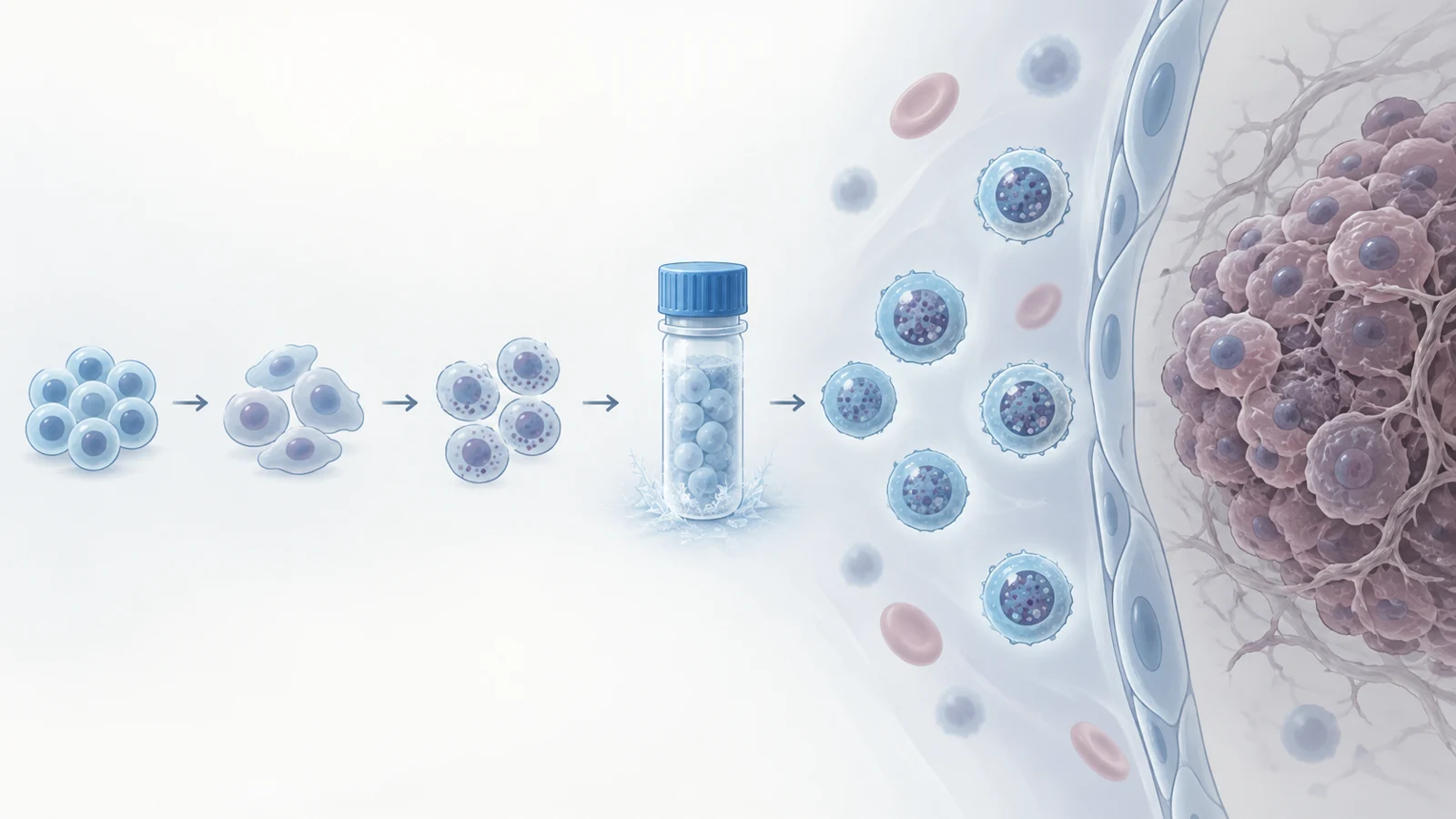
Induced pluripotent stem cells, or iPSCs, are reprogrammed cells that can be grown and directed to develop into other cell types. The proposed advantage is a renewable starting material: a selected iPSC line could generate batches of NK cells with more consistent characteristics, be engineered during production, and be frozen for later use. The review cites a production study reporting roughly 3,000-fold expansion and the potential to make more than 200 doses of over one billion cells each. Those figures illustrate manufacturing potential in a reported system; they are not proof that every facility or product can deliver the same output.
Three ways to change what an NK cell does
Engineering approaches address different tasks. A chimeric antigen receptor, or CAR, gives an NK cell a designed recognition system aimed at a chosen tumor marker. It adds a targeting route; it does not guarantee that cells will reach every tumor or that all cancer cells will carry the target.
A modified CD16 receptor serves a different purpose. It can strengthen the cell’s response to a therapeutic antibody bound to a tumor cell, supporting antibody-dependent killing. The review describes engineered high-affinity, non-cleavable CD16 designs intended to maintain that antibody-assisted attack. This strategy depends on the antibody and its target, rather than replacing them with a CAR-style recognition system.
Cytokine support is a third design aim. Interleukin-15 (IL-15) helps NK cells develop, survive and function. Some iPSC-NK designs add an IL-15-related support system in the cell product, with the aim of improving function or persistence. These choices can be combined, as in FT596, but each addresses a different part of the problem: recognition, antibody response or cellular support.
What the early patient examples show
In the review’s account of a Phase I study, FT596 combined a CD19 CAR, a high-affinity non-cleavable CD16 receptor and an IL-15–IL-15 receptor fusion. Among 20 people with relapsed follicular lymphoma, 17 had a complete remission; the reported median duration of response was about 16.9 months. In a subgroup previously treated with CD19 CAR T-cell therapy, the complete remission rate was 30%.
These are results from an early clinical study of FT596 in a specific lymphoma group, as summarized by the review. They should not be read as an estimate for all patients with lymphoma, other cancers or other NK products. The review also notes an association between a higher proportion of PD-1-positive CD8 T cells in tumors and efficacy. That observation suggests a possible interaction with patients’ own immune cells, but an association alone does not show that the NK product caused that response.
FT576 offers a separate example, not a second result to combine with FT596. It was designed with a CAR against BCMA, a different target, and an IL-15 receptor fusion. In an evaluation involving nine patients, the review reports no dose-limiting toxicities, immune-related neurotoxicity or cases of graft-versus-host disease. One heavily pretreated patient achieved a very good partial response after a second FT576 administration. A small, distinct patient group and a different product cannot establish a general response rate, but the example shows why outcomes must stay attached to the product and setting that produced them.
Reaching a tumor is part of the treatment
An NK cell’s capacity to kill a target in a laboratory setting is only one link in a chain. After infusion, cells must travel to the tumor and enter it. Dense surrounding tissue, abnormal blood vessels and high pressure within tumors can hinder that access, according to the review. Even cells that arrive may face a hostile environment: lactic acid can suppress NK activity, while regulatory T cells, suppressive myeloid cells and other local factors may dampen immune function.
Persistence matters too. The review identifies limited survival of NK cells in the body as a barrier to durable tumor control. A cell may recognize its intended target yet have too little time in the tumor to make a lasting difference. Researchers are investigating ways to improve migration, infiltration and resistance to suppressive conditions, but the review presents these as unresolved challenges rather than established clinical solutions.
Tumors also contain varied cell populations. If some cells lack the target recognized by a CAR, or respond differently to immune pressure, targeting one marker may not address the whole disease. Improving recognition therefore cannot, by itself, solve the problems of access, local suppression and persistence.
Consistency and safety begin before infusion
A renewable cell line does not automatically produce a uniform treatment. Differentiation protocols vary, and the review describes how different methods can yield cells with different maturity and functional profiles. Production must reliably direct stem cells through blood-forming precursors to NK cells, then expand the final cells while preserving the desired properties. Residual unwanted cells, variation between batches and the effects of freezing and thawing all matter to whether a prepared dose behaves as intended.
Genetic engineering adds another layer of quality control. The review highlights the need to assess editing safety, including off-target changes, and to monitor long-term risks associated with the stem-cell starting material and its expansion. Reprogramming factors linked to cell growth raise particular safety concerns. Choosing stable cell lines, controlling production and following patients over time are part of the work required to establish a safe product; a convincing laboratory killing result cannot answer those questions on its own.
What a reliable cell bank could change
If researchers can make consistent, safe batches and the infused cells can reach tumors, function in their surroundings and persist long enough to matter, stem-cell-derived NK products could make prepared doses available without relying on a new donor collection for each treatment. That could give clinicians a more predictable cell supply and make it practical to pair NK cells with selected tumor targets or antibodies. The early results offer a reason to investigate that possibility, while the unresolved manufacturing and tumor-access barriers show why dependable supply and dependable benefit remain separate achievements.
Key Sources
- Primary source: IPSC‑derived NK cells for immunotherapy and therapeutic perspective (Review).
DOI or Journal Page · Review or Meta-Analysis · 2025-06-06
Keep exploring