
Research Signal – Source date 2025-01-03
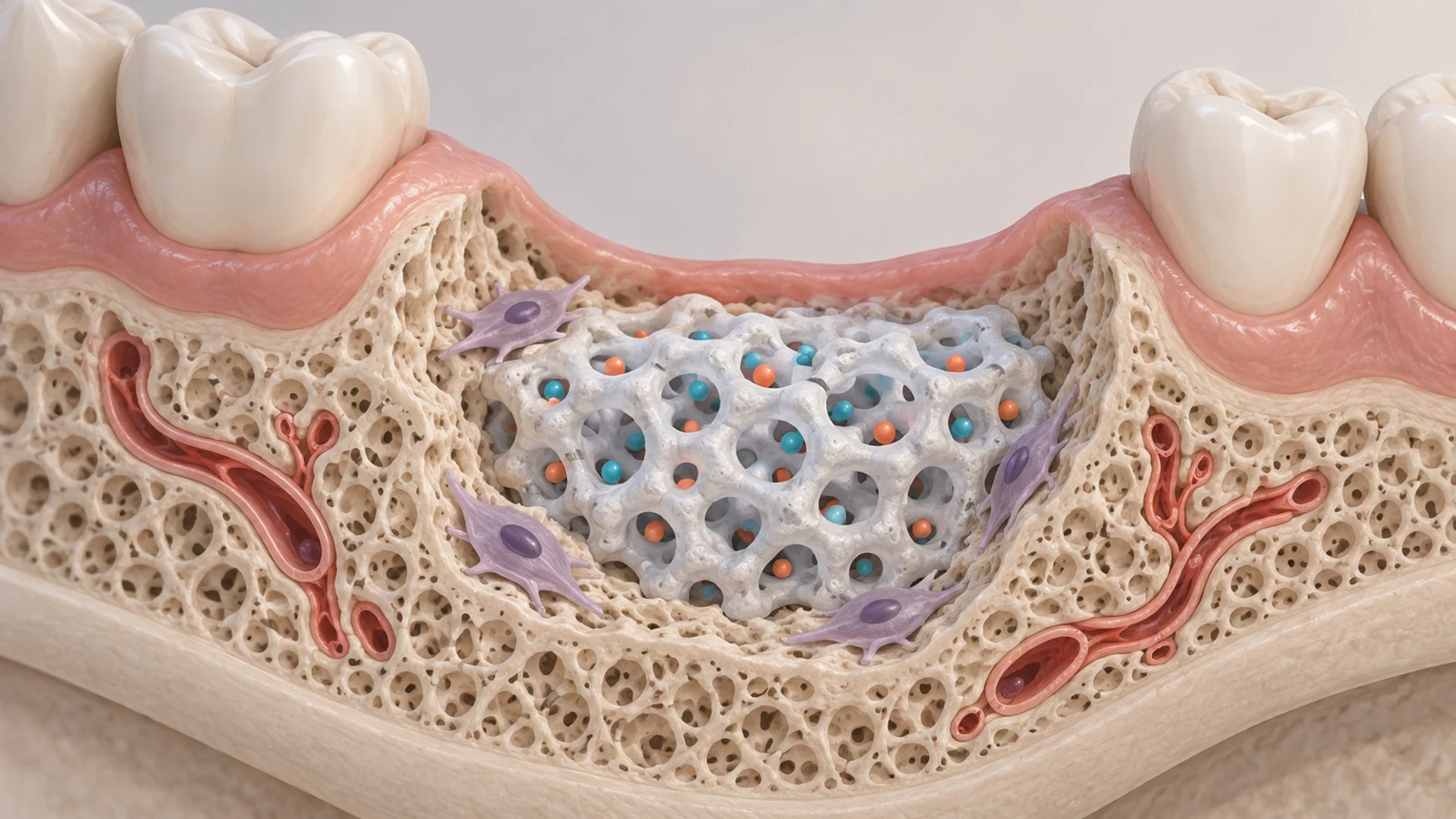
Bone loss after a tooth extraction or from periodontitis presents a repair problem involving both tissue structure and living cells. A material placed in a bone defect can provide support. Researchers are also interested in whether that material could carry a substance that influences the cells involved in rebuilding bone.
A review published on January 3, 2025, examines insulin as one such substance, delivered through nanomaterials and supporting structures called scaffolds. Its rationale connects insulin’s effects on bone remodeling with materials designed for oral tissue repair. That connection offers a reason to investigate the approach; it does not establish that a particular insulin-containing material helps patients heal.
Bone formation and breakdown both matter
Bone remodeling involves forming bone and resorbing it, meaning breaking down and removing bone tissue. These are distinct parts of the process. Encouraging formation and reducing resorption would act on different sides of that balance.
The review describes insulin acting directly through receptors on osteoblasts, the cells that form bone. It links this action to PI3K/Akt and MAPK, two systems that relay signals inside cells. For a general reader, the relevant point is the connection between a signal received at the cell surface and the cell’s internal activity. Insulin is being considered for its biological influence on bone-forming cells.
The authors also describe an indirect route involving RANK, RANKL, and OPG, a system involved in regulating bone breakdown. They associate insulin’s modulation of this system with reduced resorption. This gives the rationale two connected parts: effects on bone formation and effects on how much bone is removed.
The review further connects insulin with angiogenesis, or blood-vessel formation. Its interest therefore extends beyond the production of bone tissue to the blood vessels associated with that tissue.
A biological signal needs a delivery material
Insulin and its carrier have different jobs. Insulin provides the biological signal. A scaffold is a supporting structure intended for tissue repair, while a nanocarrier is a very small vehicle for carrying a substance. Combining these roles is the engineering idea behind an insulin-containing repair material.
The review discusses delivery systems using nanomaterials and scaffolds functionalized with polymeric biomaterials—materials made from long molecular chains that can give a structure additional properties. The broad aim is to bring the delivery function into the material used at an oral bone defect.
This interest arises against practical limitations of traditional bone regeneration methods. The authors identify problems including harm at a site where donor bone is collected, difficulty accommodating particular shapes, inflammation, and resorption of implanted bone. Those limitations help explain the search for other materials and biological approaches.
An insulin-containing scaffold brings two design questions together. What structure is suitable for the repair site, and how can it carry the biological signal? A useful supporting shape and a biologically active ingredient each contribute something different to the proposed design.
What the abstract lets us judge
The available basis for this account is the review’s abstract. It supports an explanation of why insulin and delivery materials are being investigated together. It does not let us determine the size of a regenerative benefit, a reduction in healing time, or an advantage over an existing treatment.
Nor can the abstract establish a usable dose, how insulin is released from a particular material, whether delivery reliably reaches its intended target, or whether a formulation is safe. The word “targeted” in the paper’s title should therefore be read as part of the research topic, rather than as proof of demonstrated targeting performance.
Assessing treatment performance would require details about the tested materials, study designs, populations, comparisons, and outcomes. Those details cannot be characterized from the abstract available here. This limits what can be concluded from it; it does not establish what evidence the full paper may contain.
The authors describe their contribution as a theoretical basis for future research on insulin delivery through scaffolds and composite materials. That framing fits the evidence available for this account: a biological and materials rationale whose clinical performance remains unresolved here.
What this could change
If a supporting material could deliver insulin in a safe and useful way, its role in oral bone repair could extend to influencing the surrounding tissue’s rebuilding activity. The proposed causal path combines physical support with insulin’s effects on bone formation, resorption, and blood-vessel formation.
If those functions translated into reliable repair of a functional bone defect, clinicians could gain a material that helps shape the local biological conditions for regeneration as well as supporting the repair site. That is the concrete capability this line of research puts within consideration.
Key Sources
- Primary source: Insulin for oral bone tissue engineering: a review on innovations in targeted insulin-loaded nanocarrier scaffold.
DOI or Journal Page · Review or Meta-Analysis · 2025-01-03
Keep exploring