
Research Signal – Source date 2026-05-04
A cancer-recognition receptor gives an immune cell a new way to find a target, but it does not erase the cell’s original habits. That matters in solid tumors, where engineered cells must locate cancer amid uneven target expression, reach tumor tissue, and keep working in a setting that can suppress immune activity.
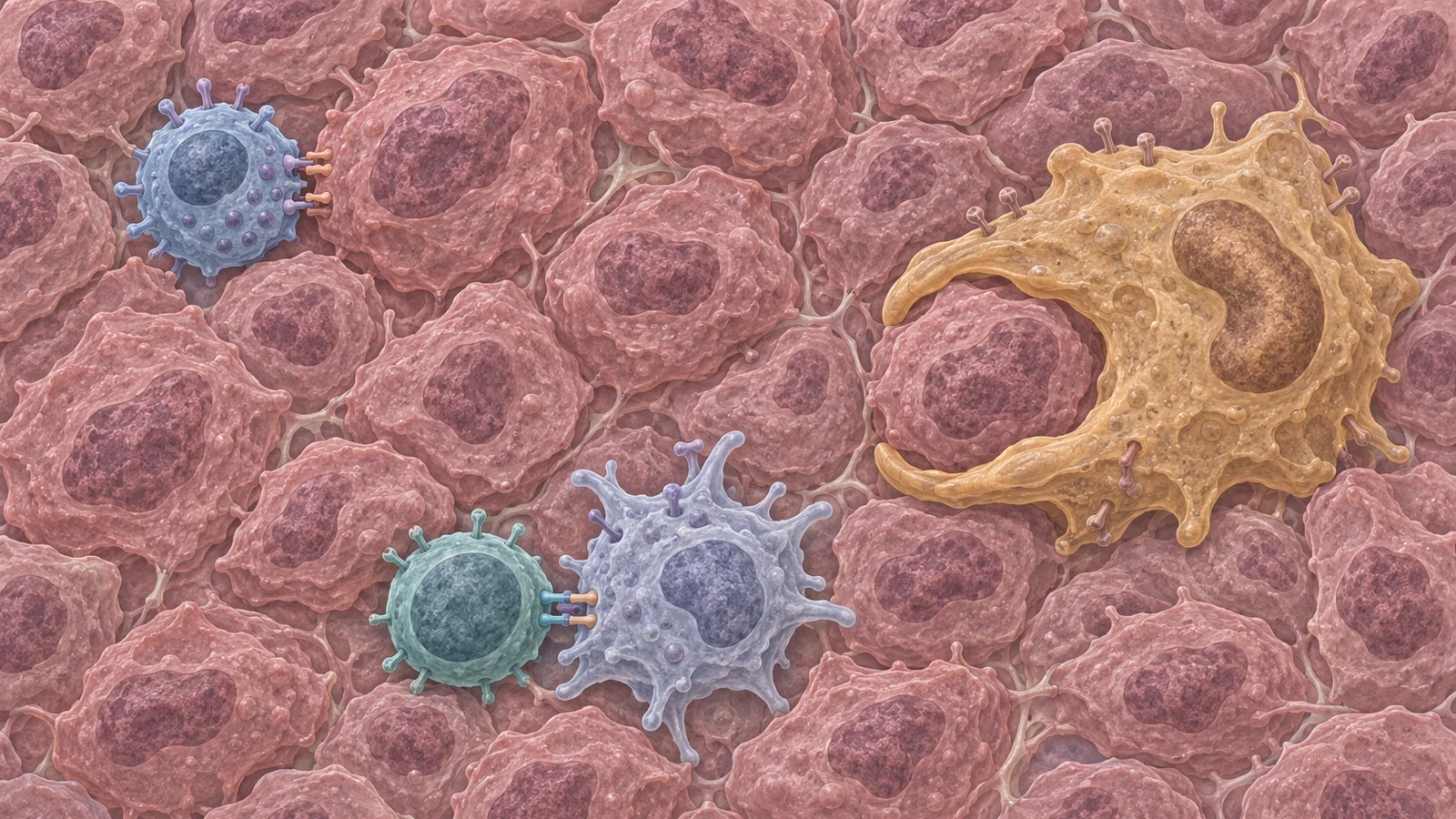
A review published May 4, 2026, surveys research on putting chimeric antigen receptors, or CARs, into natural killer cells, two kinds of innate-like T cells, and macrophages. The review draws on preclinical work and small, varied human reports. Its central idea is that each carrier cell could bring a different native function to the engineered receptor. The clinical evidence is still too early and unlike-for-like to show which approach works best.
A receptor adds recognition, while the cell keeps its own biology
CAR-T cells have changed treatment for some blood cancers, but solid tumors pose a different set of barriers. A target found on many cancer cells may also appear on healthy tissue, creating a risk of collateral damage. And tumor cells can vary in how much of a target they display. Cells with little or none may escape an attack aimed at that marker.
Getting into a tumor is another challenge. Abnormal blood vessels and dense tissue can impede immune-cell movement. Once inside, the tumor microenvironment—the local mix of cells and signals around a tumor—can suppress immune activity and contribute to exhaustion, a gradual loss of a cell’s ability to keep attacking. The review also notes that the intensive preparation used for some CAR-T treatments may be harder for older or frailer people to tolerate, while fast-moving disease can make manufacturing delays consequential.
A CAR can help an immune cell recognize a chosen surface target, but it does not by itself solve those access, suppression, or target-variation problems. Researchers are therefore testing different carrier cells. Their native behavior may complement the added receptor, although it can also bring its own limits.
Natural killer cells bring a second way to sense danger
Natural killer cells can attack abnormal cells through receptors that detect stress signals, even apart from a CAR’s chosen target. When activated, they can release perforin and granzymes, molecules that damage target cells. They also have other routes for killing and can respond to antibodies attached to a target. The CAR adds a more directed recognition route to this existing set of responses.
That combination could matter when a tumor changes or loses the specific marker a CAR recognizes: a natural killer cell may still detect other signs of cellular stress. But this is a biological possibility, not proof that CAR-natural-killer cells prevent tumor escape in patients. The review describes preclinical promise alongside a practical problem: engineered cells may lose metabolic fitness, become exhausted, or fail to persist long enough. Adding cytokine support such as interleukin-21 or interleukin-15 has improved expansion and antitumor activity in models, but those findings are not patient outcomes.
Two innate-like T-cell routes could broaden the response
Natural killer T cells, or NKT cells, carry features of both T cells and natural killer cells. Alongside a CAR’s target, they can recognize a different kind of signal involving CD1d, a molecule that presents lipid material. In preclinical work discussed by the review, this route helped CAR-NKT cells attack CD1d-bearing, tumor-associated macrophages with an M2-like, tumor-supporting profile. The review also describes longer lifespan and epitope spreading—the widening of an immune response to additional tumor markers—as potential advantages. These mechanisms could extend activity beyond the CAR’s original target, but they have not been established as clinical benefits.
Gamma-delta T cells, written γδ T cells, offer another blend of innate and adaptive behavior. They can recognize stress-related molecules and other surface features without relying on the same recognition pathway as conventional T cells. After activation, they may also take up tumor material and present it to other T cells, potentially recruiting a wider response. Their reported tendency to move toward tumor sites adds to the interest, while the ability to present tumor material remains a proposed bridge to broader immunity rather than a demonstrated patient benefit.
The distinction between these cell types is functional: NKT cells have an additional CD1d-related recognition route, while γδ T cells may help pass tumor information to other T cells. Whether either feature translates into more durable or effective treatment remains an open question.
Macrophages can act inside the tumor, but may not spread evenly
Macrophages are common in the tumor microenvironment, where they can either support or hinder tumor growth depending on local signals. A CAR may direct them toward cancer cells, which they can engulf. Researchers also aim to steer macrophages away from tumor-supporting behavior and toward inflammatory activity that recruits or activates other immune cells.
In preclinical studies summarized in the review, CAR-macrophages showed target-directed engulfment and, in some models, helped draw other immune cells into tumors or altered the balance of local immune cells. These functions address a different problem from simply recognizing a cancer cell: a macrophage might also change the conditions surrounding it. Yet macrophages have limited ability to multiply after infusion, so maintaining enough cells may require repeat dosing. Their many adhesion molecules may also cause them to accumulate unevenly, leaving some tumor areas less reached.
The human reports are promising in different ways, not comparable
The review describes a phase 1 study of GD2-directed CAR-NKT cells in 12 children with heavily pretreated neuroblastoma. Three children had an objective response: one complete response and two partial responses. This is an early human signal in a particular cancer and patient group, not evidence of durable benefit across solid tumors.
For CAR-natural-killer cells, the review cites a single prostate cancer case in which a patient had stable disease and a 97.5% reduction in prostate-specific antigen, with no toxicity reported in that case. A one-person report cannot establish how often such a result might occur or how the approach compares with other treatments.
The review also describes early safety findings and signs of antitumor activity in a first-in-human phase 1 study of HER2-directed CAR-macrophages in people with advanced HER2-overexpressing solid tumors. It reports ongoing CAR-γδ T-cell trials, including studies in solid tumors, but no published trial results for those cells in its survey.
These examples involve different cell types, cancers, and kinds of evidence. They cannot rank the platforms or establish that alternative CAR cells are generally safer than conventional CAR-T cells. The review is a survey of existing studies, not a matched clinical comparison, and the reported observations do not show that any approach delivers lasting benefit across solid tumors.
Engineering can help with persistence and production constraints
Cell choice is only one part of the design. Cytokine support may help engineered cells expand or remain active, while gene-delivery methods influence how a CAR is introduced and how long it is expressed. The review discusses non-viral approaches, including transposon systems that can integrate genetic instructions and messenger RNA methods that produce temporary CAR expression. Temporary expression could offer a way to limit how long a receptor is present, but may require repeated administrations. More precise gene editing is another approach under development.
These are engineering strategies, not established treatment options for solid tumors. Better production methods will matter only if the resulting cells can reach tumors, remain functional, and avoid unacceptable harm. The review presents no single method as having resolved that chain of challenges.
What this could make possible
If future studies show that these cells can reach solid tumors, stay active, and produce meaningful responses with acceptable risk, changing the carrier could give treatment designers more than one way to confront the same disease. A natural killer cell might combine CAR targeting with stress sensing; an NKT or γδ T cell might connect tumor recognition to other immune activity; a macrophage might engulf cancer cells while changing local immune conditions. That could eventually make cell therapy a more adaptable option for some people with solid tumors, including those whose tumors resist a single recognition strategy.
The evidence bridge is still narrow: preclinical mechanisms and early reports in distinct patient groups must lead to reproducible clinical benefit before that possibility becomes a dependable care option. A meaningful milestone would be a larger, clearly reported human study showing that a defined cell platform can reach tumors and produce sustained, clinically relevant responses without unacceptable toxicity. Until then, the review offers reasons to investigate different carrier cells, not a basis to choose among them as proven therapies.
Key Sources
- Primary source: CAR-engineering of innate and innate-like immune cells: a new horizon in adoptive cell therapy for solid tumors.
DOI or Journal Page · Review or Meta-Analysis · 2026-05-04
Keep exploring