
Research Signal – Source date 2022-08-19
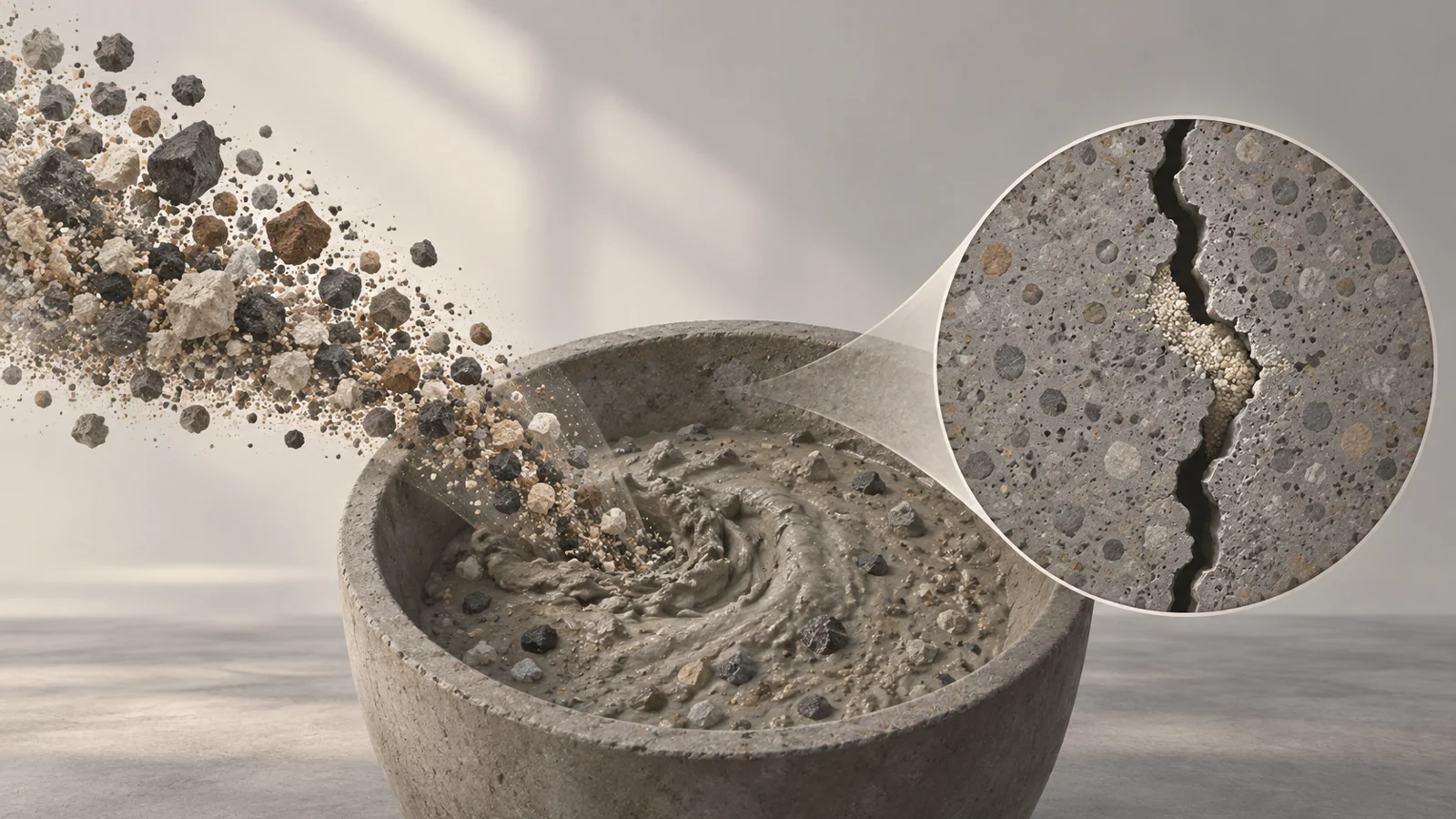
Concrete designed to repair its own cracks offers an appealing prospect for infrastructure owners: fewer maintenance interventions and structures that last longer. But giving concrete that ability can increase the expense of making it. Advanced healing techniques and costly chemical agents create a manufacturing barrier before any maintenance benefits can be realized.
A review published on August 19, 2022, examines industrial waste as a possible way to lower that barrier. It brings together research on using waste materials in self-healing concrete, connecting material reuse with the effort to make crack repair more practical. Its central qualification is consequential: useful waste-derived concrete depends on appropriate mix design and treatment. A discarded material does not become a suitable ingredient simply because it is available.
Several ways to give concrete a healing capability
“Self-healing” covers more than one approach. The paper distinguishes autogenous healing, which draws on the concrete’s own capacity to heal, from autonomous healing, which involves an intentionally incorporated healing capability. Waste materials have been investigated within both categories.
The approaches named in the review include mineral admixtures, bacteria-based technology and engineered cementitious composites. Mineral admixtures are additions to the concrete mixture; engineered cementitious composites are specially designed cement-based materials. These examples span different ways of formulating a material or providing it with a healing function. They do not describe a single ingredient that could be added interchangeably to any concrete.
That variety matters to the cost question. “Waste-derived self-healing concrete” describes a family of material designs. The role a waste material plays must be understood within the particular approach using it. The review’s broad conclusion therefore concerns the potential of waste reuse across several approaches, rather than one construction-ready formula.
The mix and its surroundings work together
The review identifies mix design and treatment methods as conditions for successfully reusing waste in self-healing concrete. Choosing the material is only part of that task. How it is prepared and incorporated into the mixture also matters to whether the resulting concrete can perform its intended function.
The environment adds another dependency. According to the review, environmental conditions can significantly influence healing efficiency because the reaction mechanisms differ. A formulation and the conditions under which it heals need to be considered together. Evidence that an approach works under one set of conditions cannot, by itself, establish that it will be equally useful elsewhere.
This is why the prospect does not translate into a universal recipe for every structure. Selecting a waste ingredient, choosing its treatment and designing the concrete mixture are connected decisions. Their usefulness ultimately depends on the environment in which healing must occur. Treating waste content alone as a sign of performance would miss that relationship.
The verified abstract supports this research direction, but it does not provide enough detail to compare approaches numerically or select a mix for construction. Nor does the available evidence establish field readiness, restored load-bearing capacity or a particular level of savings. Those limits concern what can be concluded from the material available here; they are not findings that the full paper lacks such information.
What this could change
If suitable waste-derived formulations can make crack healing practical under service conditions, infrastructure owners could gain concrete structures that require fewer maintenance interventions and remain useful for longer. The potential benefit would extend beyond the initial purchase of the material to the work needed to keep a structure in service.
Industrial waste could also gain a construction use as part of those formulations. From the August 2022 perspective, the opportunity is to connect that reuse with a durable function: concrete that can address some of its own cracking. Making such materials affordable to produce would help open the way to those maintenance and longevity benefits, provided the mix, treatment and service environment support effective healing.
Key Sources
- Primary source: Recycling industrial wastes into self-healing concrete: A review.
DOI or Journal Page · Review or Meta-Analysis · 2022-08-19
Keep exploring