
Research Signal – Source date 2022-02-02
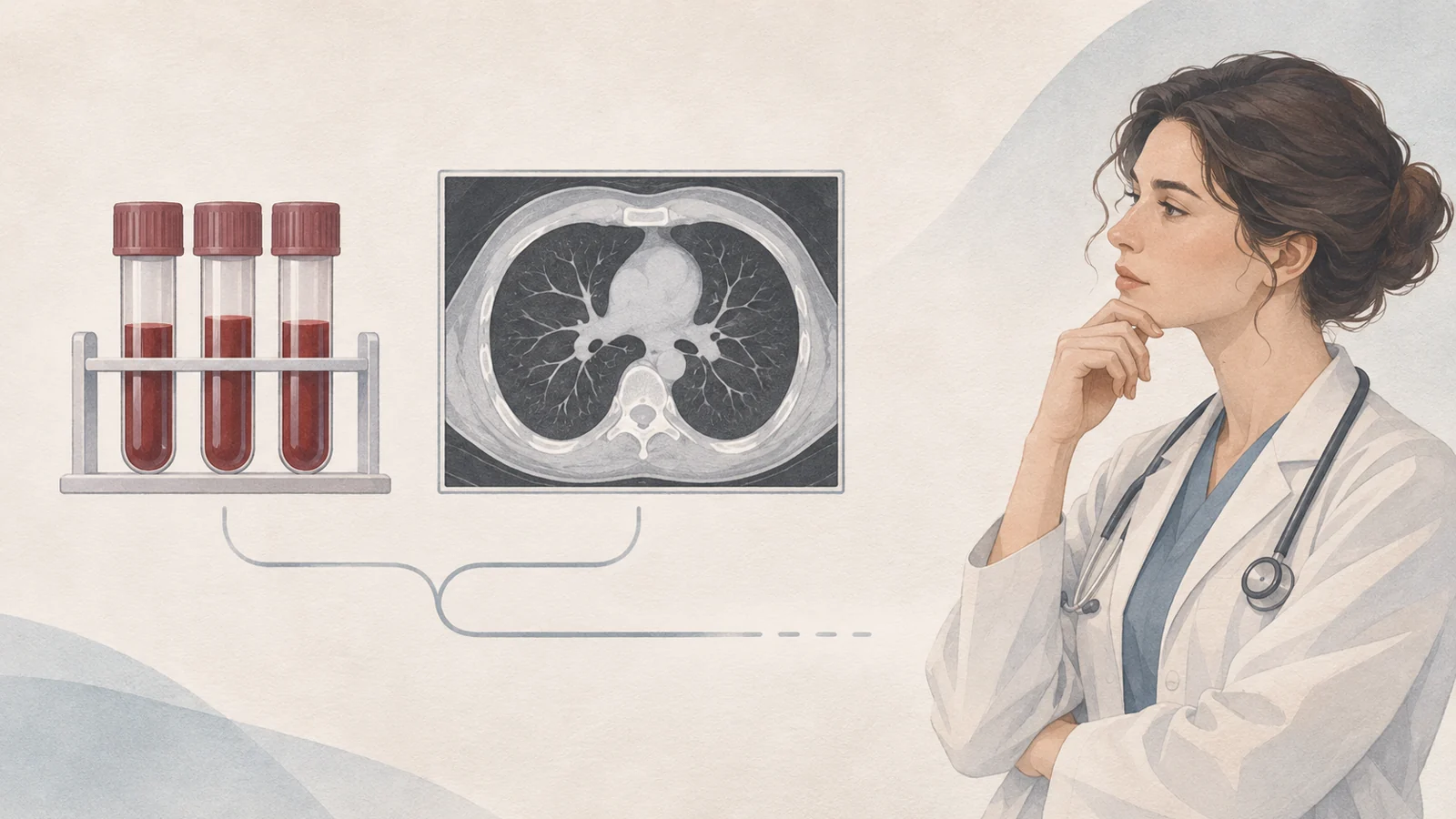
An earlier scan analysis reported 100% accuracy in predicting an immune-related lung problem. Yet only two of the 290 treated patients developed that problem, and the comparison group contained 30 people without it. The result is striking, but with so few cases it cannot tell us how well the scan would work in a larger or different group.
The finding appears in a review published on February 2, 2022, about possible early predictors of immune-related adverse events, or irAEs. These are harmful effects that can occur when cancer treatment activates the immune system. The review brings together proposed warning signs from different cancers, treatments and organs. Its evidence raises a practical question: when does a measurable change offer advance warning, and when does it simply reveal inflammation or injury already underway?
When immune defenses affect healthy tissue
Checkpoint inhibitors are cancer drugs that release some of the immune system’s restraints, helping immune cells attack tumors. But immune activity can also affect normal tissue. The review describes several possible routes: immune cells may react to antigens shared by tumors and organs, or treatment may activate self-reactive immune cells and increase inflammatory substances or autoantibodies. The precise causes remain under study.
Because immune activity occurs throughout the body, related harm can involve the gut, lungs, thyroid and other organs, sometimes in more than one place. The type and timing of an adverse event vary. A useful warning for one organ may therefore say little about risk to another.
A change before symptoms is different from a sign of injury
Timing matters. C-reactive protein, or CRP, is a blood marker that can rise with inflammation, including inflammation caused by infection. In one study summarized by the review, CRP increased before clinical symptoms in 42% of patients who developed adverse events. The authors suggested that a rise might help anticipate an event when infection is absent. If infection is present, however, it can complicate the reading. A CRP result near the time symptoms begin is also different from a change that reliably appears beforehand.
The review describes a different example in heart injury. Troponin T is a marker of damage to heart muscle. In a study of patients who developed heart inflammation after checkpoint treatment, higher troponin T measured at discharge or near the event was associated with a greater risk of major cardiac complications. This is clinically important evidence about injury and risk, but it is not, by itself, proof that the marker gives advance notice before heart damage begins.
Warning signs depend on the organ
The review describes different candidate signs for gut, lung and thyroid effects. In patients with melanoma treated with checkpoint inhibitors, some studies linked gastrointestinal effects such as diarrhea or colitis to changes in immune-related blood markers, including increased white blood cells and a lower relative lymphocyte count. Another reported an association with a particular HLA type, a gene variant involved in immune recognition. These findings concern gut events in specific patient groups; they do not make the same markers universal predictors.
Lung inflammation presents a different problem because its symptoms can resemble a respiratory infection. The review describes breathlessness, cough and fever, and notes that symptoms may be easy to miss. In one study of patients with melanoma treated with a checkpoint inhibitor, higher white blood cell counts and lower relative lymphocyte counts were associated with severe lung events. A separate study in lung cancer reported associations with a different set of blood measurements and immune markers. These are candidate clues from particular studies, not a single established pattern for every patient receiving treatment.
Thyroid studies examined yet other changes. One prospective study linked later thyroid effects to early rises in thyroglobulin, a thyroid-related protein, and thyroid-related antibodies, as well as an early fall in platelet count. It also linked certain baseline inflammatory markers and later changes in others to those events. A change that may be relevant to thyroid dysfunction cannot automatically be treated as a warning for lung or gut injury.
Patient traits can tell different stories in different groups
Age and sex might appear to offer simple ways to identify risk, but results summarized in the review did not line up consistently. Some studies found more adverse events among younger patients, while pooled analyses differed on whether age separated risk. Findings about sex also varied: one study linked being female with a higher risk for a specific diabetes-related event, while another found women less likely to experience adverse events overall. The studies considered different cancers, treatments and types of harm, so they were not necessarily answering the same question.
Smoking offers a concrete example of how the question can change the result. One study found no overall association between smoking and adverse events. Another, in patients with lung cancer, associated heavier smoking with a higher risk of interstitial lung disease. Looking at smoking as a yes-or-no trait and examining smoking intensity are different comparisons. Neither result alone settles how smoking relates to risk across cancers and treatments.
What would make a warning credible
The scan analysis that reported 100% accuracy used pretreatment CT scans from 290 patients, but only two developed the lung event. A group of 30 patients without the event served as controls. The analysis linked features of the scans to the two cases. With so few affected patients, a perfect score in this sample gives little assurance about performance when more cases are tested or when the patients differ. The result is a reason to investigate the approach, not a dependable estimate of how it would perform in practice.
The review describes another promising prediction effort: researchers combined two molecular markers, LCP1 and ADPGK, and predicted 26 of 28 pneumonia cases in a validation group. Those cases were all in patients with lung cancer. That result provides more affected cases than the scan analysis, but evidence in other cancer groups was still needed to judge whether the combination could apply beyond that setting.
For either approach, three questions matter: how many people actually experienced the event, whether the study included a suitable comparison with people who did not, and whether performance held up in another group. The review notes that many studies were retrospective, lacked a validation group, or did not include unaffected controls. It calls for prospective studies, especially to identify predictors of severe events. Finding a marker pattern is only one step; the review does not show that acting on a candidate warning prevents severe harm or improves outcomes.
Where this research could lead
A future care team might use an ordinary blood count to recognize a validated pattern associated with early lung inflammation in a defined group receiving checkpoint treatment. The review’s reported links between blood-cell changes and lung events, together with its account of symptoms that can resemble infection, offer a starting point for that possibility. A dependable interpretation could help clinicians investigate a concern while symptoms are mild or have not appeared. Blood counts and the treatment already exist; what would need to be developed is a warning that works reliably for specified patients and is assessed alongside possible infection and other clinical information.
A nearer milestone would be a prospective study that defines its blood-marker pattern in advance and tests whether it predicts severe lung events before symptoms in a clearly described checkpoint-treatment population, with an unaffected comparison group. Confirmation in a separate group would show whether that warning travels beyond the first study. Until then, the scan’s perfect score and the blood findings remain leads to test, not a proven early-warning system.
Key Sources
- Primary source: Biomarkers and risk factors for the early prediction of immune-related adverse events: a review.
DOI or Journal Page · Review or Meta-Analysis · 2022-02-02
Keep exploring