
Evidence date · 2025-03-01 · Research note 2 of 2
1 2
See current Track status →
Since the previous research note · Partly supported
Track continuity
Since the previous research note: How patients and carers helped shape five immunotherapy videos
Previous expectation: Patient- and carer-shaped videos might make immunotherapy side-effect information more usable if viewers understood and used them.
What this study adds: This review brings together seven studies of other education approaches, some reporting better knowledge or self-efficacy and some linking education with follow-up.
What changed in this study
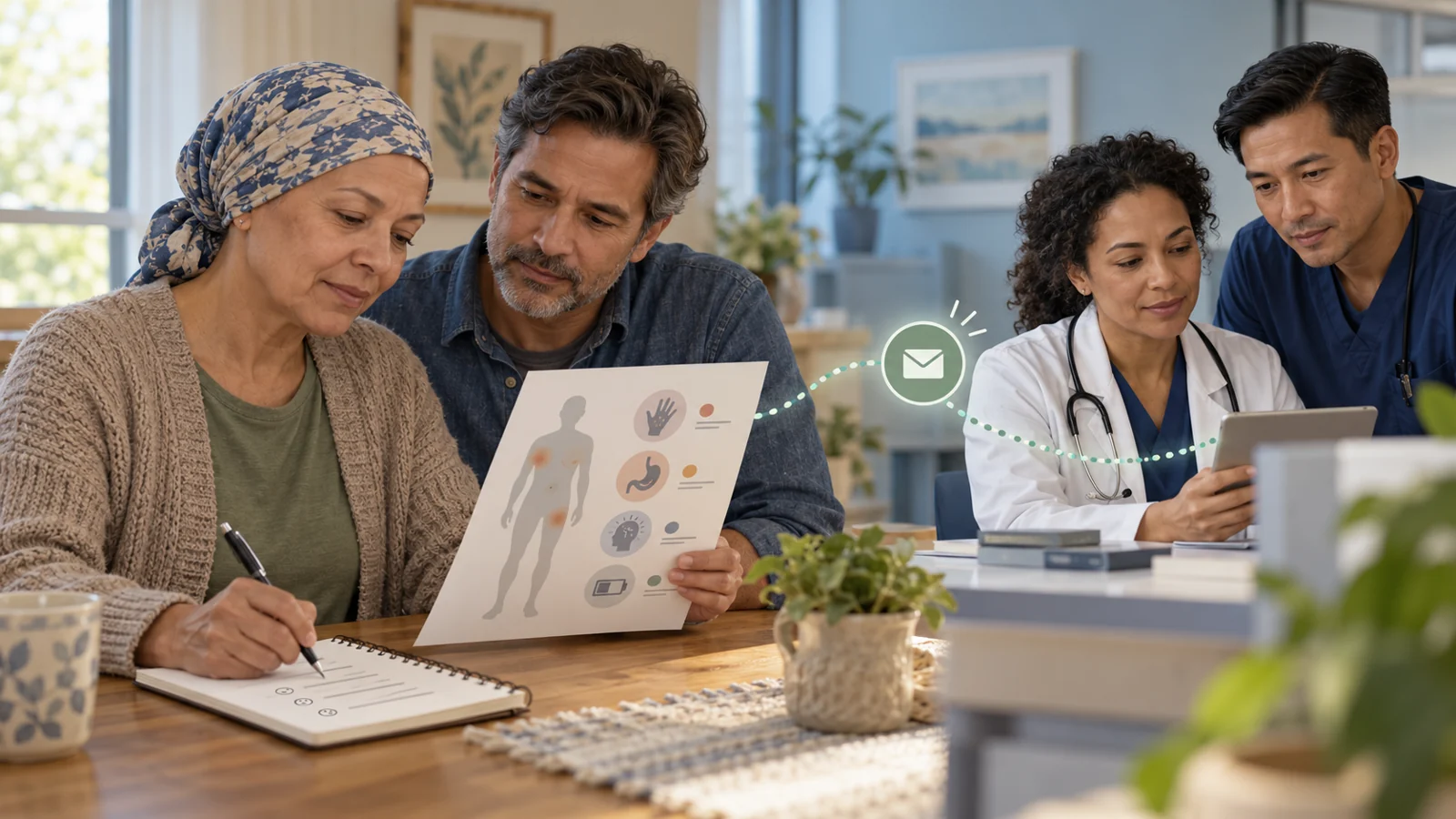
A handout can help someone recognize a change in their health. An app can make information easier to revisit. A follow-up call can give a patient a way to report what has changed. These are connected tasks in cancer immunotherapy care: noticing a possible side effect and getting that information to clinicians who can respond.
A March 2025 integrative review brought together seven quantitative studies of education about immune checkpoint inhibitors, a type of cancer treatment often called immunotherapy. Some programs reported better understanding or confidence in managing symptoms. Others paired teaching with calls or electronic symptom reports. The studies suggest how education might support patients, but their different designs and small number make it hard to rank the approaches.
Why these side effects need a reporting path
Immune checkpoint inhibitors work by blocking signals that restrain immune activity, allowing T cells to attack cancer cells. That change can also prompt the immune system to affect healthy organs. These problems are called immune-related adverse events, or irAEs. Their timing and symptoms can be unpredictable, although they are seen most often during the first three to four months after treatment begins.
Because a possible irAE may first appear as a symptom noticed by the patient, education has a practical role before a clinician can assess what is happening. Information can help a person recognize a change as potentially relevant to treatment. A reporting route—such as a call or an electronic report that reaches the care team—lets that observation enter the clinical conversation.
One nursing education program illustrates how reports can arrive through different routes. In that study, patient self-reporting accounted for 62% of reported irAEs, while proactive phone calls accounted for 27%. These figures describe that program’s reported events; they are not general rates for patients receiving immunotherapy. They show why teaching warning signs and maintaining contact with patients can serve related but distinct purposes.
From leaflets to calls and digital tools
The seven studies tested a range of formats. Some used written information alone or combined written and oral teaching. Others included an online education module, a smartphone app, or a nurse-led session with follow-up calls. One pharmacist-led program gave information before treatment and used telephone monitoring before treatment cycles during the first three months.
These approaches do different jobs. A leaflet can provide information to consult again; a conversation can explain it in person. Online modules and apps can deliver material digitally, while calls and electronic patient-reported outcomes offer ways to send symptom updates back. The review does not compare all formats under the same conditions, so it cannot establish a best format across patients and care settings.
The app study offers a useful example of why usability and impact should be kept separate. The SOFIA app pilot had 85% retention after three months, and no patients declined participation after randomization. Those findings indicate that people in the study were willing to take part and continue using the approach. They do not show that the app improved confidence: the pilot found no difference in self-efficacy between the app group and the control group, which received information and an emergency telephone number.
Understanding a warning sign is not the same as feeling able to act
The review describes several kinds of outcomes. Some studies found that patients knew more about immune checkpoint inhibitor treatment after education or could better recognize irAEs. One nursing education program reported improved comprehension of irAEs. A study of pharmacist support also described education and follow-up as helping patients take an active role in care and notice new symptoms.
Self-efficacy is a separate idea: a person’s confidence in their ability to act. In one study, average scores on a brief cancer-behavior inventory improved after a nursing assessment, education, and follow-up calls. The review also reported positive effects on self-efficacy overall, while the app pilot did not find a between-group difference. The measures and interventions varied, so these results should be understood as findings from individual programs rather than a single estimate of how much education changes confidence.
Confidence, knowledge, and clinical outcomes are not interchangeable. Learning which symptoms may matter can help a patient decide what to report, and feeling able to act may make that step more manageable. Neither change alone shows that education prevents severe irAEs or determines what treatment a clinician should provide.
Materials have to work for the people using them
The review points to health literacy—the ability to find, understand, and use health information—as one reason the same material may not work equally well for everyone. Two studies assessed literacy and found contrasting results: one reported adequate overall health literacy for 97% of participants, while another found limited cancer health literacy in 41%. Those figures came from different studies using different assessments; they do not describe a single patient group or establish how literacy affected every outcome.
A handout or digital module still depends on someone being able to understand and use its contents. The review therefore emphasizes tailoring education to different levels of health literacy. It also highlights a gap in evidence about caregivers. Only one of the seven included studies enrolled both patients and caregivers, so the review cannot establish a general caregiver benefit—even though caregivers may be involved in helping patients manage treatment day to day.
A promising area with a small evidence base
The authors screened 4,182 references after removing duplicates and included seven studies. The studies used different designs: one randomized pilot trial, three pre- and post-education studies, two observational studies, and one cohort study. Four of the seven were reported as abstracts, limiting the methodological detail available for appraisal. The authors also noted that their search terms may have missed relevant studies.
A development article listed alongside the studies described materials used in an education program, including a teaching video, booklet, symptom diary, and other resources. It was not an additional independent patient-outcome study. This distinction matters because descriptions of educational materials can show what a program contains, while outcome studies are needed to assess what changed for participants.
The review’s findings are encouraging but early. It brings together varied approaches and reports that some were associated with better knowledge, recognition, or confidence. Different interventions, measures, and study designs limit direct comparison, and the limited caregiver participation narrows what can be said about education for families.
What earlier side-effect reporting could change
If education helps patients recognize a possible irAE and gives them a reliable way to share that change with clinicians, care teams may be better positioned to assess symptoms and respond. That could support earlier management and, in turn, better quality of life during immunotherapy. The review makes this a plausible role for education paired with follow-up; it does not establish that any particular format prevents severe side effects or improves outcomes for every patient.
Key Sources
- Primary source: Patient and Caregiver Education to Support Self-Efficacy and Self-Management During Immunotherapy-An Integrative Review.
DOI or Journal Page · Review or Meta-Analysis · 2025-03-01