
Research Signal – Source date 2021-02-23
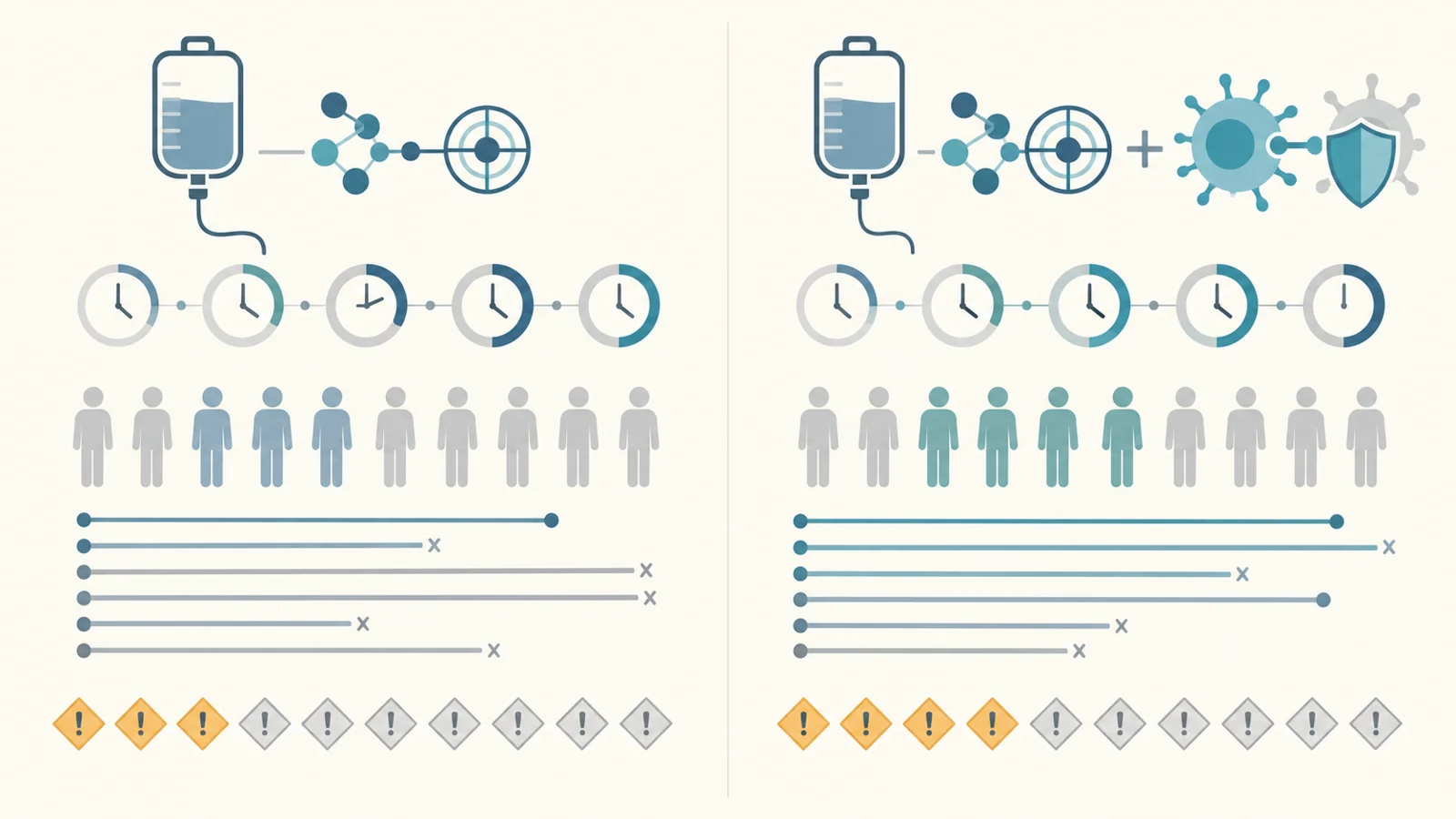
Adding an immune checkpoint inhibitor to another cancer treatment was linked to better survival and a higher chance of tumor response in a large review of clinical trials. Yet the review found no statistically significant difference in how quickly a response appeared. The two findings can coexist: how many people respond, how long people live, and how soon a response begins are separate measures.
The review, published in 2021, combined results from 19 randomized trials involving 10,536 adults with metastatic cancers or multiple myeloma. The comparisons tested chemotherapy, targeted therapy or both, with or without an added PD-1 or PD-L1 inhibitor. These checkpoint inhibitors are drugs that release one of the immune system’s brakes. The comparison was combination treatment against the corresponding standard treatment, not against checkpoint-inhibitor treatment alone.
Better survival and more responses in the pooled results
Across the trials, the combination groups had results favoring them on progression-free survival, overall survival and response rate. Progression-free survival measures how long people live without their cancer worsening; overall survival measures how long they live from the trial’s starting point. The hazard ratios were 0.74 for progression-free survival (95% confidence interval 0.67–0.81) and 0.76 for overall survival (0.69–0.84). In these pooled comparisons, values below 1 favored the combination groups.
The relative response rate was 1.27 (95% CI 1.13–1.43), meaning the measured response rate was higher in the combination groups. A response rate counts the share of patients whose tumors met the trials’ criteria for response. These pooled figures summarize results across several cancers and drug combinations; they do not predict an individual patient’s outcome.
Time to response asks a different question: among the measurements available, did responses appear sooner in one treatment group? The review found no statistically significant difference between groups. That is not evidence that response times were identical. The timing result came from only six studies, and the pooled estimate was imprecise enough that a modest difference could not be ruled out.
The authors discussed a possible reason the measures might diverge. Chemotherapy can act more quickly against a tumor, while checkpoint inhibitors may take longer to show an effect. Combining treatments could, in theory, pair an early effect from one partner with a more durable benefit from another. This analysis did not test that mechanism, however, and it does not directly establish that combinations remove the early mortality concern described for checkpoint-inhibitor monotherapy.
Cancer type changed the picture
The pooled average did not apply evenly across the cancers studied. The trials covered non-small-cell and small-cell lung cancers, kidney cancer, melanoma, myeloma, head and neck cancer, triple-negative breast cancer, liver cancer and urothelial cancer. Results differed by tumor type, particularly for response rate and adverse events.
Multiple myeloma stood out as a concern. The review described potentially unfavorable progression-free and overall survival findings for patients with myeloma receiving checkpoint-inhibitor combinations; the subgroup difference reached statistical significance when compared across the tumor types in the analysis. Response-rate findings in myeloma were also less clear. These results call for caution in interpreting the overall average as a benefit across every cancer.
The review also found no detected difference between the chemotherapy-backbone and targeted-therapy-backbone subgroups. That does not mean every partner drug performed alike: the analysis grouped varied regimens, and it did not compare anti-PD-1 drugs directly with anti-PD-L1 drugs.
Severe side effects rose slightly
The review counted adverse events graded 3 or higher, a category for severe events. Their relative risk was 1.07 with combinations compared with standard care alone (95% CI 1.01–1.14). In relative terms, this is a modest increase, though the confidence interval indicates the estimate is close to no increase at its lower end.
The authors judged the added toxicities to be manageable and consistent with the known profiles of the treatments. That is their interpretation of these trial results, not a guarantee that every combination is safe for every person. The higher frequency of severe events, and the especially concerning myeloma subgroup findings, matter alongside the pooled efficacy results.
A pooled average cannot select treatment for one person
All but one trial studied people starting their first treatment in the setting examined, but the trials involved different cancers, drugs and control regimens. The analysis also did not provide shared outcome comparisons organized by tumor PD-L1 expression. It therefore cannot identify which individual patients are most likely to benefit, or establish one benefit-and-risk estimate for every cancer and combination.
The authors searched MEDLINE and EMBASE for eligible randomized trials. It included randomized trials in adults with metastatic solid tumors or myeloma, and excluded unpublished or non-peer-reviewed reports. Its broad scope helps show an overall pattern, while the variation among trials limits how specifically that pattern can guide treatment choices.
How better matched combinations could widen the benefit
If future trials establish which cancer groups gain a survival benefit from specific combinations large enough to justify added severe adverse events and cost, more patients could receive treatment matched to their cancer while others avoid an added drug with uncertain benefit. The myeloma findings show why that capability would need to distinguish who is likely to gain, rather than treating the pooled average as a rule for all cancers.
Key Sources
- Primary source: Efficacy and safety of anti-PD-1/PD-L1 combinations versus standard of care in cancer: a systematic review and meta-analysis.
DOI or Journal Page · Review or Meta-Analysis · 2021-02-23
Keep exploring