
Research Signal – Source date 2025-02-09
In one small series, four of five patients with conjunctival squamous cancer that had extended into the orbit had a complete response to an immune drug. The fifth patient’s cancer progressed. Elsewhere in the same review, two patients’ noninvasive squamous lesions grew during treatment—even though cancer in other parts of one patient’s body responded.
Those cases raise a practical scientific question: why might an immune treatment affect one eye-surface tumor and leave another growing? The answer is not yet a reliable rule for choosing treatment. But the contrast helps explain why researchers are studying these drugs for cancers that can be difficult to control with surgery or other local therapies.
The evidence comes from a review published on February 9, 2025. Its authors searched PubMed for studies published between January 2014 and October 2024, including original research, trials, case reports, case series, and other reviews. The findings they bring together are promising in places, but mostly drawn from small and varied reports rather than comparisons designed to measure how often each cancer responds.
The eye-surface cancers do not pose the same problem
Cancers on the conjunctiva—the thin tissue covering the white of the eye and lining the eyelids—and the cornea can behave differently. Conjunctival melanoma begins in pigment-producing cells. Ocular surface squamous neoplasia, or OSSN, covers a range of squamous abnormalities, from noninvasive cell changes to invasive cancer. Other tumors discussed in the review include sebaceous gland carcinoma and conjunctival lymphoma.
Treatment depends on the tumor. Conjunctival melanoma is commonly treated with surgery to remove the tumor with a margin, often alongside freezing treatment at the edges. Squamous disease may also be removed surgically, while noninvasive or widespread lesions can be treated with medicines applied to the eye. Conjunctival lymphoma is often treated with radiation. For some extensive tumors, local control can be difficult: squamous cancer may invade nearby structures, and surgery for advanced disease can mean removing the eye and surrounding tissue. Melanoma can recur or spread beyond the eye.
These differences matter when interpreting immune treatment. A response in invasive squamous cancer does not tell us how a noninvasive lesion will behave, just as results in melanoma cannot be applied automatically to lymphoma or another tumor type.
Releasing a brake on T cells
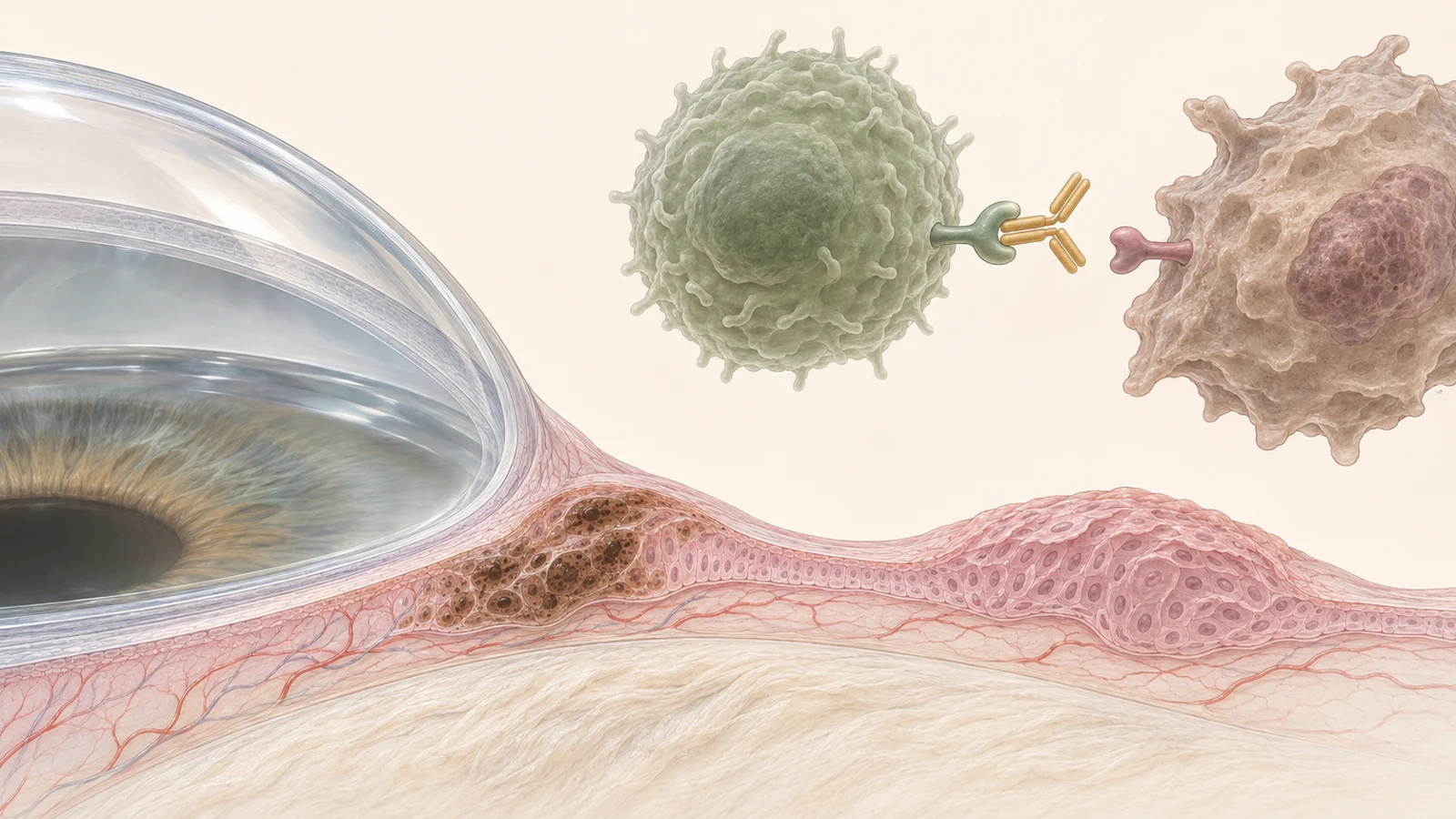
Immune checkpoint drugs try to make it harder for cancer to quiet the body’s T cells, immune cells that can recognize and attack abnormal cells. One way tumors can dampen that response is through a protein called PD-L1. When PD-L1 binds to PD-1 on a T cell, it sends an inhibitory signal. Drugs such as pembrolizumab, nivolumab, and cemiplimab block PD-1; other drugs can block PD-L1 itself. Blocking the interaction can help T cells stay active against a tumor.
The review also discusses drugs aimed at other checkpoints, including CTLA-4 and LAG-3. These targets affect immune regulation in different ways. One reported eye-tumor case involved a combination of nivolumab and relatlimab, which blocks PD-1 and LAG-3, respectively. The central clinical reports, however, largely concern drugs targeting the PD-1/PD-L1 pathway.
Melanoma reports involve advanced disease
The interest in systemic immune treatment for conjunctival melanoma is tied to the difficulty of treating disease that has spread or cannot be controlled locally. In a cited series of five patients with metastatic conjunctival melanoma, four had complete responses after nivolumab. The fifth patient, treated with pembrolizumab, had stable disease. Other reports described tumor regression in people with locally advanced or recurrent disease, including cases where treatment came before surgery or was considered when extensive surgery was declined.
These accounts show why clinicians are exploring checkpoint drugs in serious cases: a response beyond the treated area could matter when a tumor has spread, and shrinkage might affect what local treatment is possible. Yet individual cases and small series cannot show whether treatment routinely avoids radical surgery or preserves long-term eye function. The reports describe what happened to particular patients; they do not compare immune drugs with surgery or other treatments across similar groups.
Invasive and noninvasive squamous lesions diverged
The five-patient orbital-extension series offers a clue about why tumor type or biology may matter. Four patients had complete responses to cemiplimab or pembrolizumab, while one had progressive disease. The tumors in the four responders had a tumor mutational burden (TMB) above 60 mutations per megabase; the tumor in the patient whose disease progressed had a TMB of 8.1. TMB counts DNA changes in a tumor. More changes may produce more recognizable targets for immune cells, which could help explain the difference.
But that contrast came from five cases. It does not establish a TMB cutoff that predicts response or can guide treatment on its own. Nor does it explain every outcome in squamous disease. In two reports involving conjunctival intraepithelial neoplasia, a noninvasive part of the OSSN spectrum, lesions progressed during systemic cemiplimab treatment. In one case, cancer elsewhere in the body responded while the eye-surface lesions grew. The behavior of one tumor site therefore did not guarantee the behavior of another.
The review also describes PD-L1 staining in some squamous tumors, with expression more common in more advanced categories in one cited study. That provides a biological reason to investigate the pathway, but the review notes that PD-L1 expression alone does not fully predict response. The mutation-burden contrast and staining findings are leads for research, not a dependable selection test.
Some evidence stops short of an ocular treatment result
For sebaceous carcinoma, the review recounts one patient with recurrent, extensive disease who received carboplatin chemotherapy and pembrolizumab. The tumor progressed after carboplatin alone, then shrank after pembrolizumab was added; lymph-node involvement also resolved. The patient later received both drugs and then pembrolizumab maintenance. Because the treatment combined chemotherapy with immunotherapy, the case cannot isolate pembrolizumab’s effect or show how often this approach works.
The evidence discussed for conjunctival lymphoma and Kaposi sarcoma is more indirect. In ocular lymphoma samples, immune-marker staining was observed in inflammatory cells around the tumors, not in the tumor cells themselves. That finding suggests a possible avenue to investigate, but it is not evidence that checkpoint drugs treated those eye tumors. For Kaposi sarcoma, the review cites responses to checkpoint treatment in people with nonocular disease and staining observations in ocular samples. Results from other body sites do not establish benefit for conjunctival Kaposi sarcoma.
Keeping these evidence types separate helps show where the clinical record is strongest: reported treatment outcomes in melanoma and squamous cancer, one combined-treatment case in sebaceous carcinoma, and biological rationale or evidence from other sites for lymphoma and Kaposi sarcoma.
The tradeoff includes immune effects throughout the body
Local treatments act on or near the tumor; checkpoint drugs given systemically activate immune responses that can affect healthy tissue as well. The review describes possible immune-related problems in several organs, including inflammation of the lungs, bowel, liver, or kidneys, as well as fatigue and skin reactions. Rare severe effects can involve the heart or nervous system. Combination treatment targeting more than one checkpoint has been associated with more frequent and serious side effects than PD-1 or PD-L1 drugs alone.
The eye can also be affected. Reported problems include dry eye and inflammatory uveitis, an inflammation inside the eye. That risk belongs in the same picture as the potential value of shrinking a tumor that is locally extensive or has spread. The reviewed cases do not show that this balance is favorable for every patient, or that a systemic drug is safer than surgery; they show why both tumor control and immune-related harm matter when studying treatment options.
How much can a handful of cases tell us
A complete response in a small case series is meaningful evidence that a tumor can respond. It is not a response probability for everyone with that diagnosis. The reports differ in cancer type, whether the disease was invasive or metastatic, prior treatment, drug choice, and follow-up. Some describe complete regression, others stable disease or progression. The review gathers these observations but does not conduct a comparative trial that could determine which treatment works best for which group.
The most useful reading is therefore specific. There are reported responses in advanced conjunctival melanoma and invasive squamous cancer. There are also examples of progression, including noninvasive squamous lesions during treatment. The biological clues—such as mutation burden or checkpoint staining—may help explain those patterns, but they have not yet resolved who is likely to benefit.
Where this research could lead
If larger, prospective studies confirm that some advanced eye-surface tumors are especially vulnerable to checkpoint blockade, clinicians could gain a systemic option when local treatment cannot control disease or would carry substantial morbidity. The practical bridge is to connect tumor features, such as mutation burden, with outcomes in clearly defined cancer types and treatment settings. A meaningful milestone would be evidence that those features reliably identify patients more likely to benefit, while accounting for immune-related harm. That could make treatment choices more informed and, for some people, expand the chance of controlling a difficult cancer while preserving useful eye function. The reports available in this 2025 review are an early basis for that possibility, not proof that it has been achieved.
Key Sources
- Primary source: Immune Checkpoint Inhibitors in the Treatment of Ocular Surface Cancers: A Review.
DOI or Journal Page · Review or Meta-Analysis · 2025-02-09
Keep exploring