
Research Signal – Source date 2021-01-25
An immune-cell engager is a molecule designed to bring an immune cell into contact with a cancer cell and trigger an attack. In a review published on January 25, 2021, one example posed a striking clinical puzzle: catumaxomab was used inside the abdomen to treat cancer-related fluid, while a separate study of the same drug given through the bloodstream reported serious liver toxicity, including one fatal case.
Those experiences came from different studies, and they do not show that delivery route alone caused the difference. They do show why results from one treatment setting cannot automatically be carried over to another. The review describes both the promise of immune-cell engagers and the design and safety problems that stood between early activity and broader use in solid tumors.
A molecule that brings two cells together
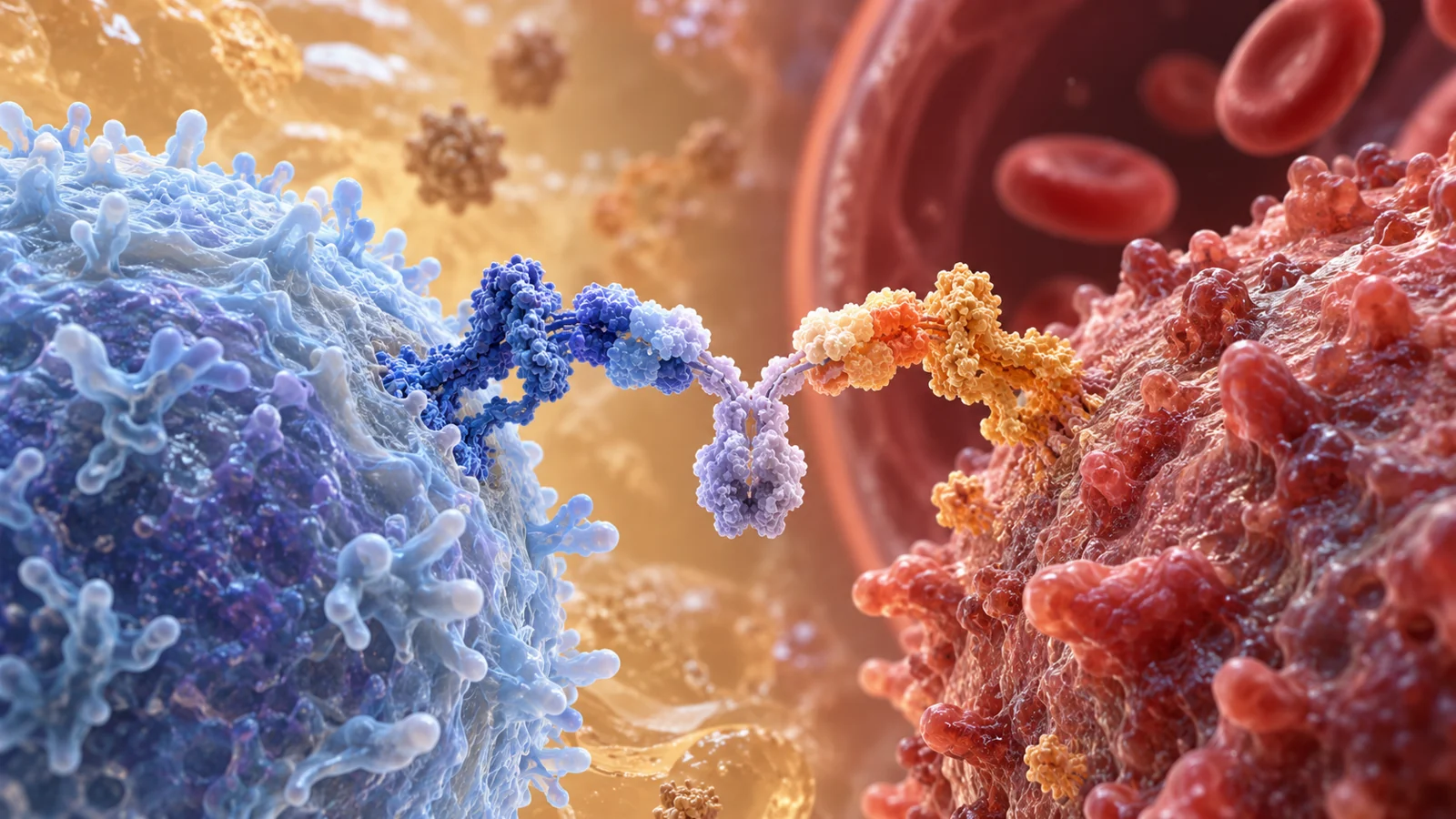
Most immune-cell engagers discussed in the review are bispecific antibodies: molecules with two binding ends. One end recognizes a tumor-associated antigen, a marker on the cancer cell’s surface. The other binds a receptor on an immune cell. When both ends attach, the molecule holds the cells close enough to form an artificial immune synapse, a contact that activates the immune cell’s killing machinery.
For common T-cell engagers, the immune-cell end often binds CD3, part of the signaling complex that helps activate T cells. The activated cell releases proteins such as perforin and granzyme that can kill the contacted cancer cell. It can also release cytokines, signaling molecules that may activate nearby cells and support a broader response. The review notes that nearby cancer cells lacking the target marker may sometimes become vulnerable to this local activity, a proposed “bystander killing” effect that could matter in tumors where marker expression is uneven.
The two-ended design also creates a constraint: a target on cancer cells must be distinct enough from markers on healthy tissues, and immune activation must be controlled. An engager can bring cells together, but the quality and safety of that contact depend on what each end recognizes and how strongly it signals.
The abdominal-fluid result and the bloodstream risk
The review describes catumaxomab, which binds EpCAM on tumor cells and CD3 on T cells. In 2009, the European Medicines Agency approved it for intraperitoneal treatment of malignant ascites—the buildup of fluid in the abdomen associated with cancer. The approval followed a phase II/III trial that reported improvement in time to the next paracentesis, a procedure to drain abdominal fluid, as well as signs and symptoms of ascites.
A separate phase I study tested intravenous catumaxomab. The review reports dose-dependent liver toxicity and one case of fatal acute liver failure; its table lists 16 patients and liver toxicity, including that fatal case. These were different studies with different settings and outcomes, so the contrast cannot isolate route as the sole explanation. It does make the limits of generalizing from a local treatment setting to bloodstream exposure clear.
Catumaxomab had a third binding function beyond its EpCAM and CD3 ends: its Fc region could recruit other immune cells through Fc-gamma receptors. That added activity could intensify immune responses, but the review also discusses how Kupffer cells, immune cells in the liver that bear Fc receptors, may have contributed to excessive activation and toxicity. Later engagers were often designed to reduce Fc-receptor binding or omit the Fc region.
Early studies measured different things
The review’s table also shows why “activity in solid tumors” is not one uniform result. For example, it lists a phase I study of solitomab, another EpCAM–CD3 engager, given intraperitoneally to 65 people with solid tumors. One partial response was recorded, alongside liver toxicity, diarrhea, increased lipase and peripheral edema. That single study result belongs to that drug, patient group, route and set of reported outcomes; it cannot stand in for the whole class.
The review also describes earlier engagers aimed at recruiting cytotoxic or phagocytic cells, with scant clinical activity in early trials despite encouraging tumor-model results. The authors point to the high concentrations of bispecific antibody and high ratios of immune effector cells to tumor cells that appeared necessary for effective killing in those settings. Across these examples, the evidence varied by molecule and study. The review synthesizes prior studies; it does not report a new trial or establish a class-wide survival benefit for people with solid tumors.
A target must separate tumor from healthy tissue
EpCAM illustrates the safety challenge. It appears on some cancer cells, but it is also present in normal tissues, including the colon and liver. An engager that recognizes EpCAM can therefore bring immune cells to healthy tissue as well as to a tumor. The review identifies the target’s density, size and mobility on the cell surface as additional features that may affect whether it is suitable.
The authors discuss more selective candidates. EGFRvIII, a mutated form of EGFR described in the review as confined to malignant cells in glioblastoma, showed antitumor effects in animal models when targeted by an EGFRvIII–CD3 engager. Glypican-3, or GPC3, is found in several solid tumors and is not detected in normal postnatal tissues in the review’s account. A GPC3–CD3 engager was effective in tumor models, and the review noted a phase I trial in solid tumors whose results were then awaited. Model results and a trial’s presence are reasons for investigation, not proof of patient benefit.
Uneven markers and limited exposure pose separate problems
Even a well-chosen target may not appear on every cancer cell. If cells with little or none of the marker survive, they may escape an engager aimed at that marker. The review points to antigen-negative relapse after blinatumomab, a CD19-targeting engager used in acute lymphoblastic leukemia, as evidence that target loss can matter clinically. It describes multi-target antibodies as a possible way to reduce this escape; examples aimed at several tumor markers showed encouraging results in preclinical studies. The review does not establish that this approach improves outcomes in solid-tumor patients.
Drug exposure presents a different obstacle. Some small engagers lack an Fc region and leave the body quickly, making continuous infusion necessary. Researchers had explored attaching an engineered Fc region, albumin or polyethylene glycol to extend exposure. The review also describes a biodegradable polymer delivery system that prolonged the half-life and antitumor activity of a PSMA-targeting engager in a prostate-cancer model.
A drug can also prompt the immune system to make antibodies against it. In a phase I study of MEDI-565, a CEA–CD3 engager, antibodies against the drug were observed in all patients treated at high doses, and the study was discontinued. The review discusses humanized binding components as one design approach to limit this kind of immune response. These exposure and drug-recognition issues are distinct from choosing the right tumor marker: solving one would not automatically solve the others.
What safer immune-cell bridges could make possible
If researchers can identify targets that distinguish tumors from healthy tissues, control immune activation and keep an engager active for a workable period, these molecules could become a practical way to redirect a patient’s own immune cells against solid tumors. That could make immune-cell redirection easier to deliver and reduce some of the infrastructure and cost burdens associated with adoptive cell therapy. For solid tumors, the possibility depends on those design problems being solved and on clinical studies showing meaningful benefit for patients.
Key Sources
- Primary source: Immune cell engagers in solid tumors: promises and challenges of the next generation immunotherapy.
DOI or Journal Page · Review or Meta-Analysis · 2021-01-25
Keep exploring