
Research Signal – Source date 2024-02-08
A lung transplant can replace an organ damaged by disease without replacing every biological process that helped cause the damage. That matters when the underlying problem includes immune aging or short telomeres. The new lungs may improve breathing, but the recipient’s bone marrow, immune cells, liver, and other tissues remain part of the same aging system.
A review published on February 8, 2024, examines how these processes can shape care after lung transplantation. Its central message is not that age can be reduced to one number or one laboratory result. Instead, several forms of biological wear can overlap, and transplantation can reveal vulnerabilities that were previously partly compensated for. The result is a difficult clinical balance: immune defenses may be less effective against infection, while inflammation and immune activity can still threaten the transplanted lungs.
The transplant replaces lungs but not the wider biology
Chronological age gives a person’s years, but it does not fully describe how individual tissues function. The review focuses on several mechanisms associated with immune aging, including telomere dysfunction, changes in gene regulation, immune-cell senescence, thymus involution, and mitochondrial dysfunction. These mechanisms can appear in different combinations, which helps explain why people of the same age may experience very different complications.
Lung transplantation makes the issue especially visible. Lung transplant recipients are often older than recipients of some other solid organs, and the operation itself is a major physiological stress. The transplanted lungs also face a strong alloimmune response, meaning the recipient’s immune system can recognize donor tissue as different. Controlling that response generally requires substantial immunosuppression, which can add pressure to marrow production, antiviral defenses, and other vulnerable systems.
The lungs may therefore be new to the recipient while the immune consequences of a systemic disorder remain. This is particularly important for people with short telomere syndrome, a group of conditions caused by impaired maintenance of the protective ends of chromosomes. In such cases, transplantation can address the pulmonary expression of the disorder without correcting the underlying problem throughout the body.
Telomeres can turn cellular wear into organ problems
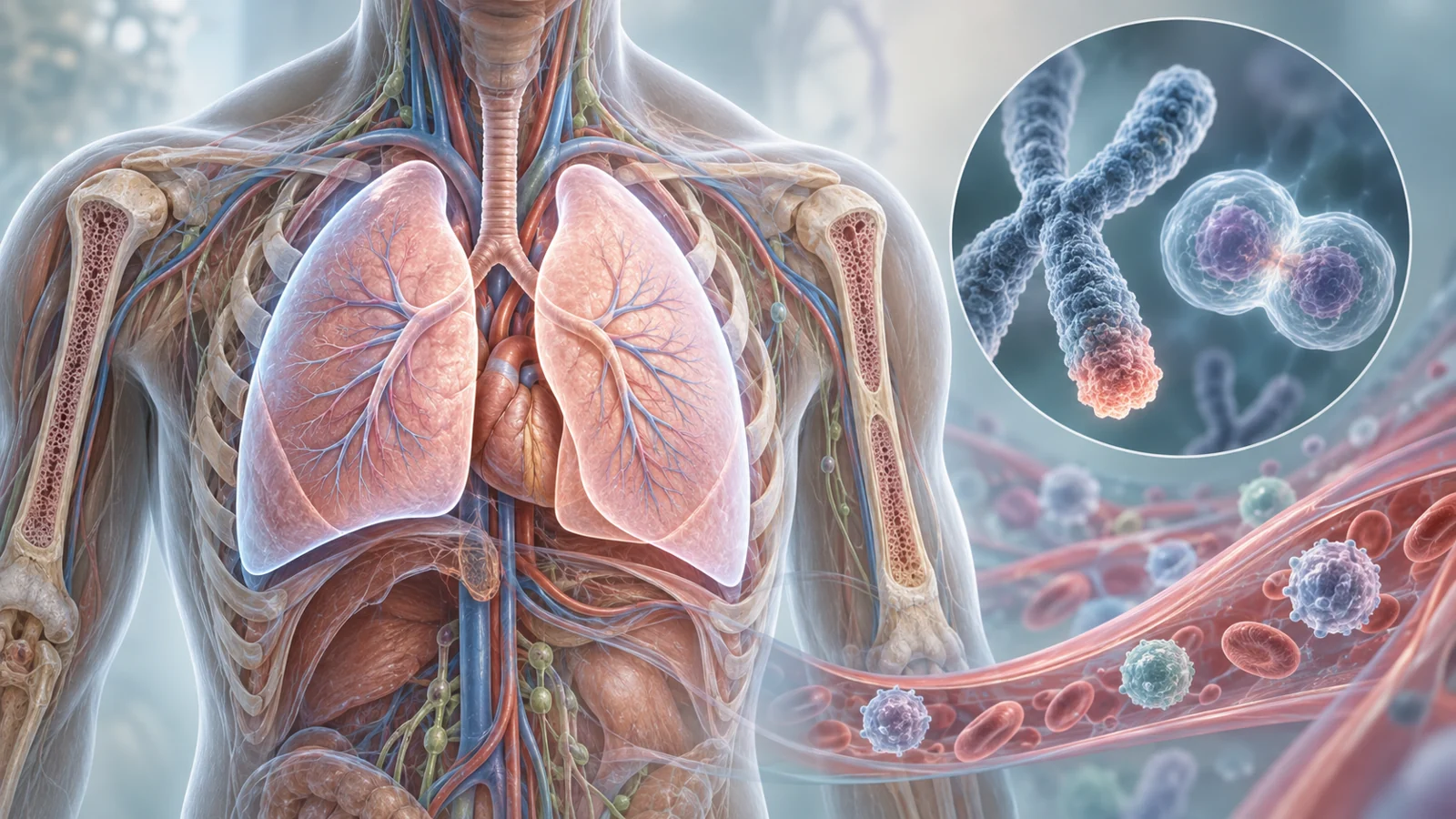
Telomeres are protective structures at the ends of chromosomes. They help shield chromosome ends from being mistaken for broken DNA while cells divide. Because chromosome ends are not copied perfectly during replication, telomeres usually become shorter over time. Telomerase can maintain them in some cells, but inherited or acquired changes in telomere-maintenance systems can accelerate shortening.
Consequences can emerge when telomeres reach a critically short length. Their protective structure can fail, activating a DNA-damage response involving proteins such as p53 and checkpoint kinases. Cells may then stop dividing and enter a senescent state, in which they no longer replicate normally and can release pro-inflammatory signals. Average telomere length is only a summary of a wider distribution: cells in the same person, and even within a population of cells, can have different telomere lengths.
Short telomere syndrome is the clinical expression of this kind of vulnerability. The review describes a range of possible manifestations, including pulmonary fibrosis, emphysema, liver disease, immune deficiency, bone-marrow suppression or failure, and some cancers. The same biological process can therefore connect problems in the lungs with problems in blood production and other organs. It is one mechanism of immune aging, not a universal score that captures every aspect of a person’s biological age.
A quieter immune response can still injure a graft
Immune aging is easy to misunderstand if immunity is treated as a single volume control. A system can lose some capacity to recognize unfamiliar pathogens while retaining cells and signals capable of producing inflammation. The review describes age-related thymus involution as one reason: as the thymus changes, the supply of naïve T cells decreases and memory T cells become relatively more prominent. This can narrow the range of new antigens the immune system responds to and weaken vaccine responses.
Long-term exposure to viruses can further reshape the T-cell population. Cytomegalovirus, or CMV, can drive expansion of highly differentiated CD8-positive cells that retain cytokine production and cytotoxic potential even as they show features associated with senescence. In lung transplant recipients, CMV infection is associated with infection risk and graft failure. These cells are not simply absent or harmless because other parts of immune function have weakened.
The same tension appears in rejection. Some cohorts of lung transplant recipients with short telomere syndrome have shown less acute rejection, alongside evidence of T-cell differentiation, clonal expansion, and exhaustion. A reduced early response may reflect immune senescence or a degree of anergy. Yet the review also describes continued risk of chronic rejection, and strong inflammatory stimulation, such as that associated with infection, may alter the balance. Lower rates of acute rejection in a particular group therefore do not mean the graft is protected from every form of immune-mediated injury.
Medication can collide with limited marrow reserve
Short telomere syndrome can make the usual post-transplant treatment burden harder to manage. Bone marrow reserves may already be fragile, and immunosuppressive drugs or antimicrobial and antiviral prophylaxis can further reduce blood-cell production. The resulting cytopenias may involve low white-cell counts or other abnormalities that limit how comfortably clinicians can maintain the treatment needed to protect the graft.
Antiviral prevention illustrates the dilemma. People with short telomeres can face greater vulnerability to CMV and other herpes viruses, while medicines used against CMV can themselves contribute to marrow suppression. The review reports that recipients with short telomere syndrome may have up to a fivefold higher risk of relapsing CMV viremia. CMV viremia is also associated with chronic lung allograft dysfunction, creating a pathway by which impaired antiviral defense can affect long-term graft health.
Changing one pressure can expose another. Clinicians may need to adjust antimetabolite treatment, reconsider a myelosuppressive prophylaxis medicine, provide supportive treatment for severe neutropenia, or investigate the marrow when abnormalities persist. These decisions are not simple instructions that can be separated from the individual’s infection risk, rejection risk, kidney function, blood counts, and underlying diagnosis. The review’s point is that the biological vulnerability changes the tradeoff, not that one universal medication schedule follows from a telomere result.
This is why care may involve several specialties. Hematology can help evaluate cytopenias and decide whether a marrow examination is needed. Infectious-disease clinicians can help manage prophylaxis when antiviral or antimicrobial toxicity becomes a concern. Hepatology may be relevant when short telomere syndrome raises concern about cirrhosis or hepatopulmonary complications, while genetic counseling can help address inherited risk. The review also proposes routine attention to skin cancer risk and, in selected circumstances, consideration of donor CMV status.
Risk clues are not a simple forecast
Recognizing short telomere syndrome can help clinicians anticipate complications, but the review does not present telomere length as a universal predictor of an individual recipient’s survival or graft course. Studies summarized in the paper reach different conclusions about primary graft dysfunction, acute cellular rejection, chronic lung allograft dysfunction, and survival.
For example, one cited cohort associated short telomeres with higher rates of some graft complications and a substantially higher risk of death, while other work linked shorter telomeres to leukopenia without finding worse chronic graft outcomes. A more recent cohort described in the review did not find telomere mutations or length associated with several major transplant outcomes.
One possible explanation for the disagreement is that “short telomeres” has not been defined consistently. Age-adjusted lymphocyte telomere length below the tenth percentile has been examined as a risk marker, while some candidates have critically short measurements below the first percentile or a known pathogenic variant. Testing has entered routine practice in some interstitial lung disease programs, but the review notes that it had not been integrated into assessment of candidates with idiopathic pulmonary fibrosis at most United States lung transplant centers and that standardization remained incomplete in its 2024 account.
The practical implication is more modest than a pass-or-fail rule. A telomere finding can prompt questions about marrow reserve, family history, liver disease, infection risk, and how treatment toxicity might be handled. It cannot by itself settle whether transplantation is appropriate or reliably determine how an individual graft will perform. The review presents biological aging as a way to organize clinical attention, not as a crystal ball.
Care planning and anti-aging treatment are different questions
The review’s multidisciplinary suggestions are mainly about recognizing and managing vulnerabilities that may already be present. That is different from proving that a treatment can reverse immune aging or improve transplant outcomes. The distinction matters because the biological rationale can be compelling even when clinical evidence is still limited.
Danazol is one example. The review discusses it as a possible intervention for short telomere syndrome, but also describes hesitation in lung transplant recipients because of limited data and concern about myelodysplastic syndrome and acute myeloid leukemia. A plausible effect on telomere-related biology does not establish that the treatment is suitable after transplantation.
Senolytics provide another example. These are drugs intended to remove senescent cells, which are cells that have stopped dividing and can release inflammatory signals. The review places senolytics among approaches requiring investigation, alongside exercise and nutrition strategies aimed at mitochondrial dysfunction. Their mention signals a direction for research rather than a validated therapy for lung transplant recipients.
For now, the more immediate contribution of the review is organizational and explanatory. It connects a pattern of low blood counts, repeated viral problems, liver findings, frailty, or cancer risk to biological mechanisms that may overlap. It also shows why one specialist’s solution can create a new problem elsewhere. Better recognition could support earlier evaluation and more coordinated decisions, but the proposed care framework itself is not evidence of improved survival or quality of life.
What more tailored transplant care could change
For recipients whose immune vulnerabilities can be identified reliably, care matched to the relevant biology could eventually reduce avoidable marrow complications and infections while preserving protection of the transplanted lungs. That possibility depends on more than recognizing short telomeres or another aging mechanism: clinicians would need dependable testing and evidence that tailored approaches control rejection without adding unacceptable risks.
From the review’s February 2024 perspective, the potential benefit is a more realistic fit between the recipient’s underlying biology and the demands of transplantation. Such care could help teams anticipate where prevention, monitoring, or treatment toxicity may become limiting, giving patients a better chance of avoiding complications that are foreseeable but not inevitable. It remains a conditional prospect, not a demonstrated anti-aging solution.
Key Sources
- Primary source: Immune aging: biological mechanisms, clinical symptoms, and management in lung transplant recipients.
DOI or Journal Page · Review or Meta-Analysis · 2024-02-08
Keep exploring