
Research Signal – Source date 2026-07-27
A porous crystal that can be processed from solution offers useful design flexibility, but it may need other materials to perform catalytic work. A July 2026 review surveys how hydrogen-bonded organic frameworks (HOFs)—porous crystals assembled through reversible hydrogen bonds—are combined with partners for light-driven reactions and environmental cleanup.
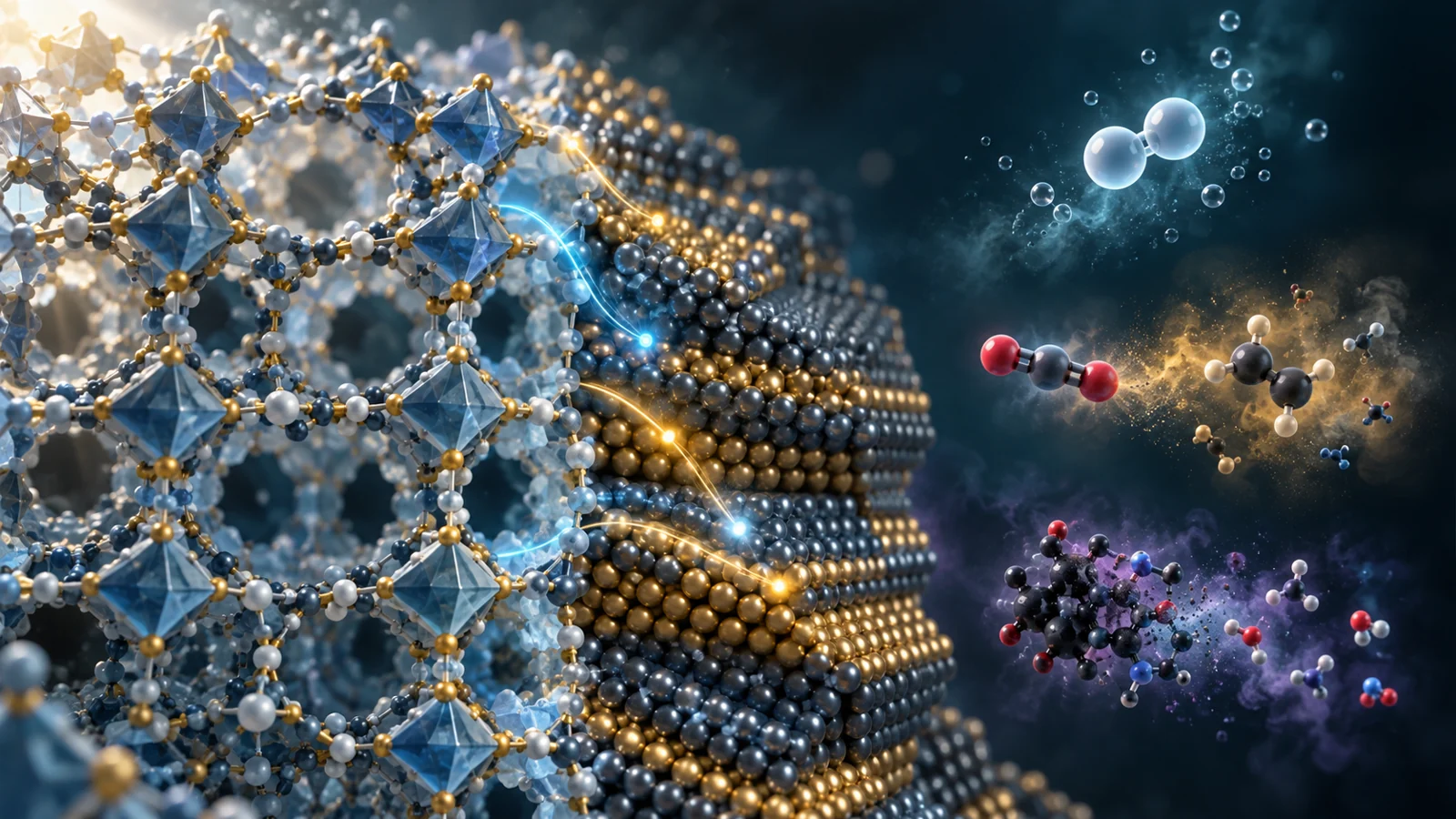
The review’s central idea is the interface: the working relationship where a HOF meets an added material. The framework can provide tunable pores and an ordered structure; its partners can help absorb light, move electrical charges apart, or support catalytic activity. The design challenge is to make those contributions work together.
Reversible links meet practical processing
HOFs are built from molecules held together by hydrogen bonds that can form and break reversibly. The review connects this assembly to two useful qualities: crystallinity and solution processability. In broad terms, a material that can be handled in solution offers routes for combining it with other components, while its ordered porous structure provides a tunable setting for those combinations.
Those qualities do not make a HOF a complete catalyst by themselves. The review describes composites that bring the frameworks together with semiconductors, metal nanoparticles, light-absorbing dyes, polymers, or inorganic oxides. Each partner can contribute a different function, and the interface is where the design aims to coordinate them. Better light absorption matters only if the resulting energy can support a reaction; charge separation matters because charges that remain available can contribute to catalytic activity.
The review surveys these pairings as design strategies across several application areas. It does not provide system-specific efficiency, durability, or scale-up figures in the supplied evidence, so the approaches cannot be ranked here as independent performance results.
Different reactions, different jobs
One area is photocatalytic hydrogen evolution: using light to drive hydrogen production. Another is carbon dioxide reduction: using light-driven reactions to convert carbon dioxide into other chemicals. Both concern energy conversion, but they are distinct reaction goals. A third area, pollutant degradation, focuses on breaking down contaminants rather than making a fuel or transforming carbon dioxide.
The review considers HOF-based composites in all three areas. That range describes the field surveyed, not one demonstrated material that carries out every reaction. Different components and interfaces may be suited to different tasks, and the supplied evidence does not give a common set of measurements for comparing them.
A distinct branch uses enzymes held within HOF-based materials. The framework can bring contaminant adsorption—the capture of contaminants at a material’s surface or within its pores—together with enzyme-assisted catalytic degradation. This biohybrid approach combines a framework material with a biological catalyst, rather than relying only on combinations of inorganic or synthetic partners. The review presents it as a way to join capture and catalytic breakdown within a composite.
Stability and scale remain practical tests
A promising interface must keep doing its job beyond an initial demonstration. The review identifies stability as a challenge: the framework and its partners need to retain useful properties while the intended reaction takes place. If the components change or lose their functions, a carefully designed combination may not remain useful.
Scalable processing presents another test. Solution processability is a material advantage, but making a composite conveniently in the lab does not by itself show that it can be manufactured reliably at larger scale. The route for combining components, and the consistency of the resulting material, matter to any move toward practical use.
Mechanistic understanding also matters. Researchers need a clearer account of how the framework and partner interact and how that interface contributes to the reaction. Without it, a composite’s overall activity is harder to connect to a design choice, making it difficult to know which features to preserve or improve. These are challenges the review identifies, not evidence that a particular system has already solved them.
What durable catalyst hybrids could enable
If researchers can make these composites durable, reliably effective, and practical to manufacture at scale, different hybrids could help produce hydrogen with light, convert carbon dioxide, or break down contaminants. The review presents those as research possibilities across distinct systems; it does not establish one all-purpose catalyst or a deployed process.
Key Sources
- Primary source: Advancing hydrogen-bonded organic framework-based composites for integrated catalysis: A review of interface-oriented dual energy conversion and environmental cleanup.
DOI or Journal Page · Review or Meta-Analysis · 2026-07-27
Keep exploring