
Research Signal – Source date 2022-01-25
Giving a water-rich gel a useful function can change the very interactions that hold it together. A nanoparticle chosen for its magnetic properties, for example, also has to fit into the gel’s network. Its usefulness alone does not guarantee that the mixture will form a suitable material.
That constraint motivates a 2022 materials study on polymer–nanoparticle hydrogels. The authors report that adding α-cyclodextrin, a ring-shaped molecule, reinforces these gels through molecular associations. Their central contribution is a way to make the choice of functional ingredients less tightly tied to the interactions responsible for the material’s mechanical behavior.
How temporary connections hold a gel together
Hydrogels contain water within a network of connected components. In polymer–nanoparticle gels, long polymer chains interact reversibly with tiny particles. These connections can come apart and form again, giving the material behavior that combines flow with an ability to retain structure.
This helps explain two useful characteristics of moldable gels. Under applied stress, they can become easier to flow, a behavior called shear thinning. After that disturbance, connections can reform and restore a stable network. The term “self-healing” describes this network recovery here; it does not promise repair of arbitrary cuts, tears, or other physical damage.
The difficulty is that those temporary connections depend on the ingredients. Only certain polymer and nanoparticle combinations interact suitably to form the original gels. Replacing a component can therefore alter both whether a network forms and how it behaves under force.
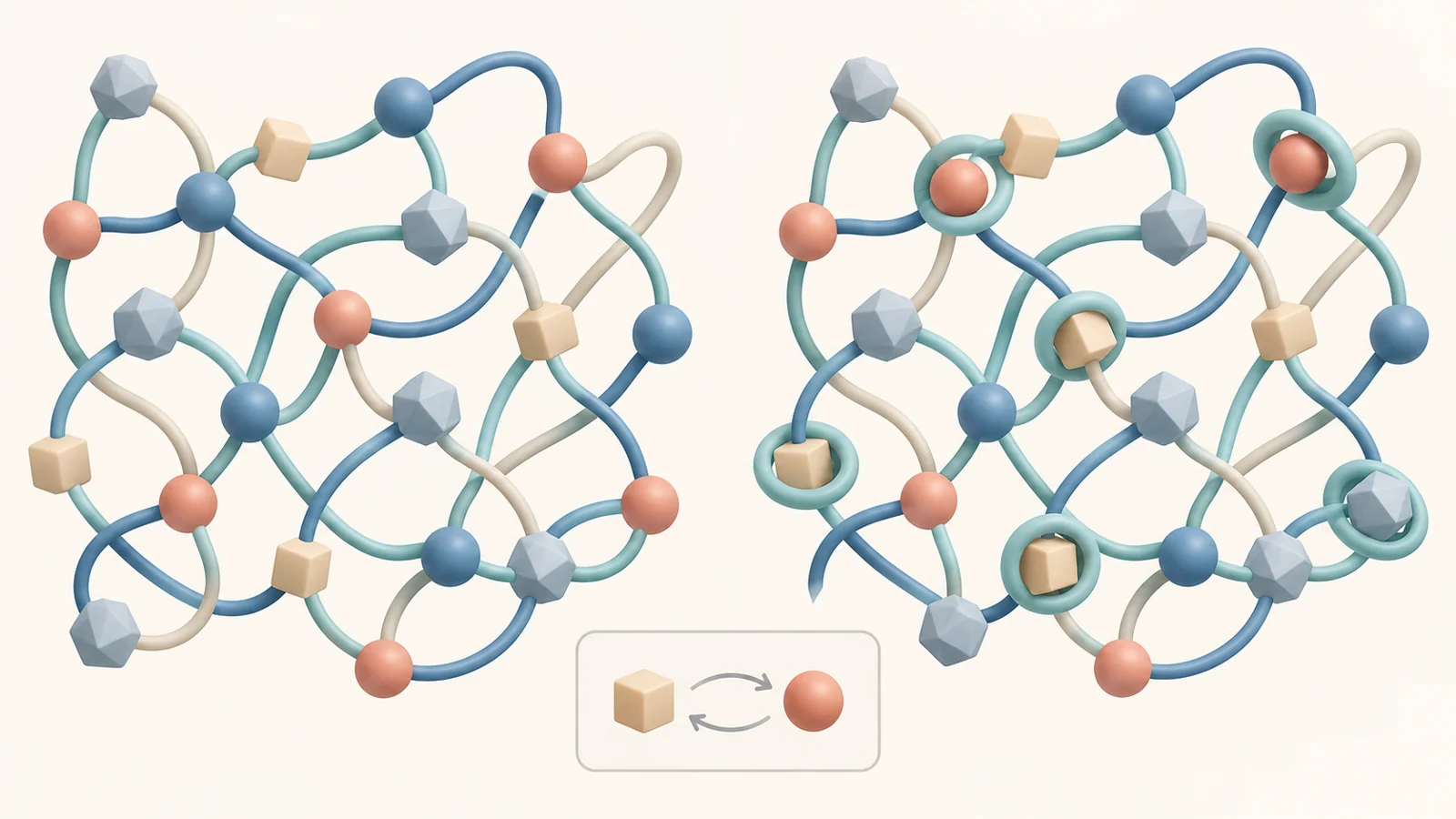
The added α-cyclodextrin supplies another form of association. The authors attribute reinforcement to assemblies called polypseudorotaxanes, in which ring-shaped molecules associate along chain-like components. These are supramolecular structures, meaning that molecules assemble through noncovalent interactions. The reported mechanism concerns associations among gel components rather than simply adding more solid material to the mixture.
Making functional ingredients easier to exchange
The design comparison is between a network whose structure depends on a narrow set of compatible ingredients and a reinforced network that accommodates a broader component library. In the original arrangement, choosing a polymer or particle for a particular function also commits the researcher to its contribution to the network. An attractive functional ingredient may be a poor structural partner.
With α-cyclodextrin reinforcement, the authors report greater independence between mechanical properties and material functionality. Their abstract describes exchanging functional polymers and nanoparticles within the reinforced gels. This makes ingredient substitution a more practical design option, although it does not imply that every polymer will work with every particle or that all properties become independent.
The reported range includes biopolymer formulations for 3D printing and bioprinting, as well as drug delivery, and inorganic nanoparticle formulations for magnetic or conductive materials. These examples show the breadth of the authors’ design approach. Each use still places different demands on a gel, from maintaining a deposited shape to providing the intended functional response.
What the reported reinforcement establishes
The abstract reports a substantial enhancement of mechanical properties, but it does not provide enough information here to assign a numerical improvement or identify which measurements support that description. Stiffness, resistance to flow, and recovery after deformation describe different aspects of a material. A general statement about improved mechanics cannot establish equal gains in all of them.
The evidence available for this account is the verified publication identity and its abstract. That supports the reported reinforcement mechanism and modular formulation strategy. Quantitative comparisons would require the paper’s measurements, formulation details, and test conditions; their absence from this account should not be mistaken for their absence from the study.
Application judgments require a further level of detail. The named uses do not, by themselves, establish safety or clinical effectiveness, device performance, manufacturing scale, or commercial readiness. Nor does the general description of moldable hydrogels establish identical injection, extrusion, or recovery behavior for every reinforced formulation. The useful conclusion at this stage is a materials-design result with several application directions.
What this could change
If suitable formulations can combine useful mechanical behavior with the performance their functional ingredients are meant to provide, researchers could fabricate a wider variety of shapeable soft structures. A gel could be deposited into a chosen form while its particles supply a magnetic or electrical function. The causal opportunity is concrete: reinforcement could help maintain the network needed for fabrication while selected ingredients contribute another capability. That would expand the kinds of functional objects researchers can make from water-rich materials.
Key Sources
- Primary source: Supramolecular Reinforcement of Polymer-Nanoparticle Hydrogels for Modular Materials Design.
DOI or Journal Page · Peer-Reviewed Paper · 2022-01-25
Keep exploring