
Research Signal – Source date 2023-06-07
Concrete cracks carry costs beyond the damaged surface. Repairs consume money and materials, and the cement used for that work adds to the climate burden. Concrete that can repair some of its own damage offers a possible way to reduce that recurring demand. But what actually does the repairing?
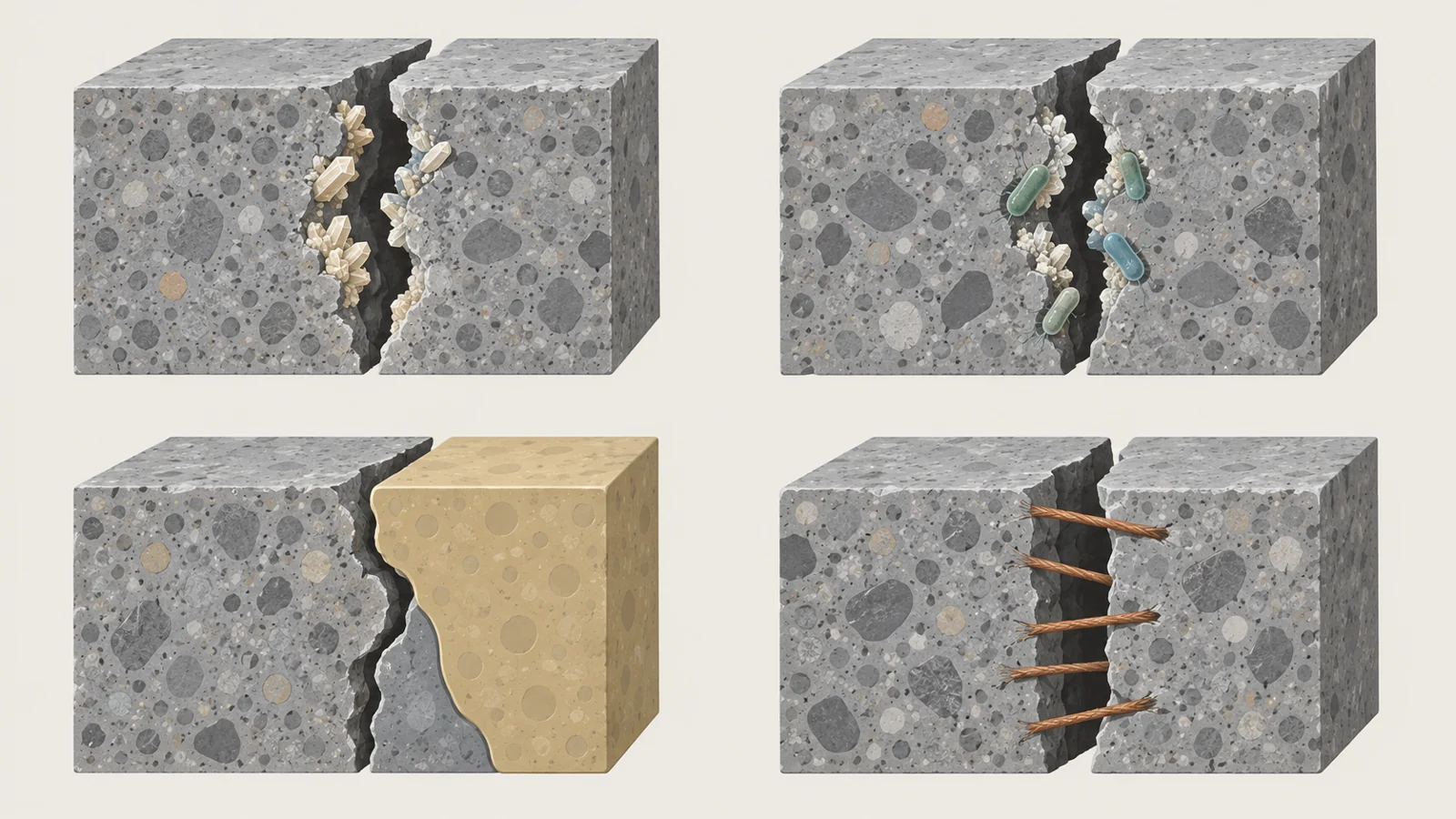
A review published June 7, 2023, brings together experiments and simulations on several approaches to self-healing cement-based materials. Its starting point is that some healing can come from the material’s own reactions. This is called autogenous healing. The review identifies carbonation and crystallization as intrinsic processes that help repair defects and small cracks by forming material within them.
That gives “self-healing” a concrete meaning, but added ingredients can contribute in quite different ways. Bacteria can produce minerals. Polymers can heal within themselves and where they meet cement. Fibers help keep cracks from spreading, giving the material’s own repair processes a better opportunity to work. Making repair material and controlling damage are distinct parts of the same problem.
What supplies the repair material
The review discusses intrinsic healing in ordinary portland cement, systems containing supplementary cementitious materials, and geopolymers. Across these cementitious systems, the relevant idea is repair through chemistry already available within the material. Carbonation and crystallization can contribute to filling defects without a separate biological or polymer repair component. The authors describe the contribution of these autogenous reactions in terms of small cracks.
Bacteria introduce another route to mineral formation. In the process called biomineralization, bacteria within the cement produce carbonates, silicates or phosphates that can help repair damage. Their role is therefore specific: they generate mineral repair products. Calling concrete “bacterial” does not explain its healing behavior unless that connection between biological activity and mineral production is made clear.
Polymer-cement composites place repair in a different part of the material. The review describes healing both within the polymer and at the polymer-cement interface—the boundary where the two materials meet. This distinction matters because the proposed repair function includes the connection between constituents, as well as the polymer itself. The phrase “self-healing concrete” can thus cover repair occurring in different locations and through different chemistry.
Fibers help by controlling the crack
Fibers have a less obvious place in this picture. The function highlighted in the review is to inhibit crack propagation, meaning the advance of a crack through the material. That restraint allows intrinsic healing mechanisms to be more effective.
A healing component therefore does not always have to manufacture a substance that fills a gap. Fibers contribute through crack control, while bacteria contribute through mineral production. This helps explain why the approaches should not be treated as interchangeable ingredients. One changes how damage develops; another supplies products that participate in repair. Polymer healing adds the further possibility of repair within a constituent and along its boundary with cement.
The authors see particularly fruitful opportunities in designing additional components that can reach cracks and initiate chemistry that slows crack propagation and repairs the cement matrix. Their emphasis connects the location of damage with the location of repair activity. A useful repair component must be able to act where the crack needs it.
What experiments and simulations can establish
The review’s contribution is to bring mechanisms together with experimental work and computational modeling from the nanoscale to the macroscale. That range connects questions about very small material interactions with questions about behavior at larger scales. It presents modeling developed from experimental data for the healing approaches discussed, giving chemistry and material behavior a shared place in the explanation.
From the abstract alone, however, it is not possible to assess the selection and comparability of individual studies, numerical crack-repair limits, healing times or strength recovery. Nor does its description of modeling establish how particular models were independently validated or how reliably their predictions transfer to infrastructure. These are limits of an abstract-based account, not findings that the full paper lacks such work.
The mechanisms described support an explanation of how repair can happen. They do not establish which approach is most effective, least costly or best suited to a particular structure. Repairing a crack also does not by itself demonstrate recovery of every structural function or lasting performance through repeated damage. That distinction is central to interpreting the practical significance of the research.
What this could change
If repair chemistry and crack control can deliver durable benefits in service, infrastructure owners could face fewer recurring repairs. Reducing that maintenance demand could also reduce the cement needed to keep structures functioning, offering a public environmental benefit alongside the practical benefit of less repair work.
That possibility depends on lasting performance and on the overall costs and material burdens of the added components. The opportunity described in June 2023 is to build some capacity for managing damage into the material itself, so that maintaining concrete infrastructure could require fewer repeated interventions and resources.
Key Sources
- Primary source: Toward Self-Healing Concrete Infrastructure: Review of Experiments and Simulations across Scales.
DOI or Journal Page · Review or Meta-Analysis · 2023-06-07
Keep exploring