
Research Signal – Source date 2023-08-21
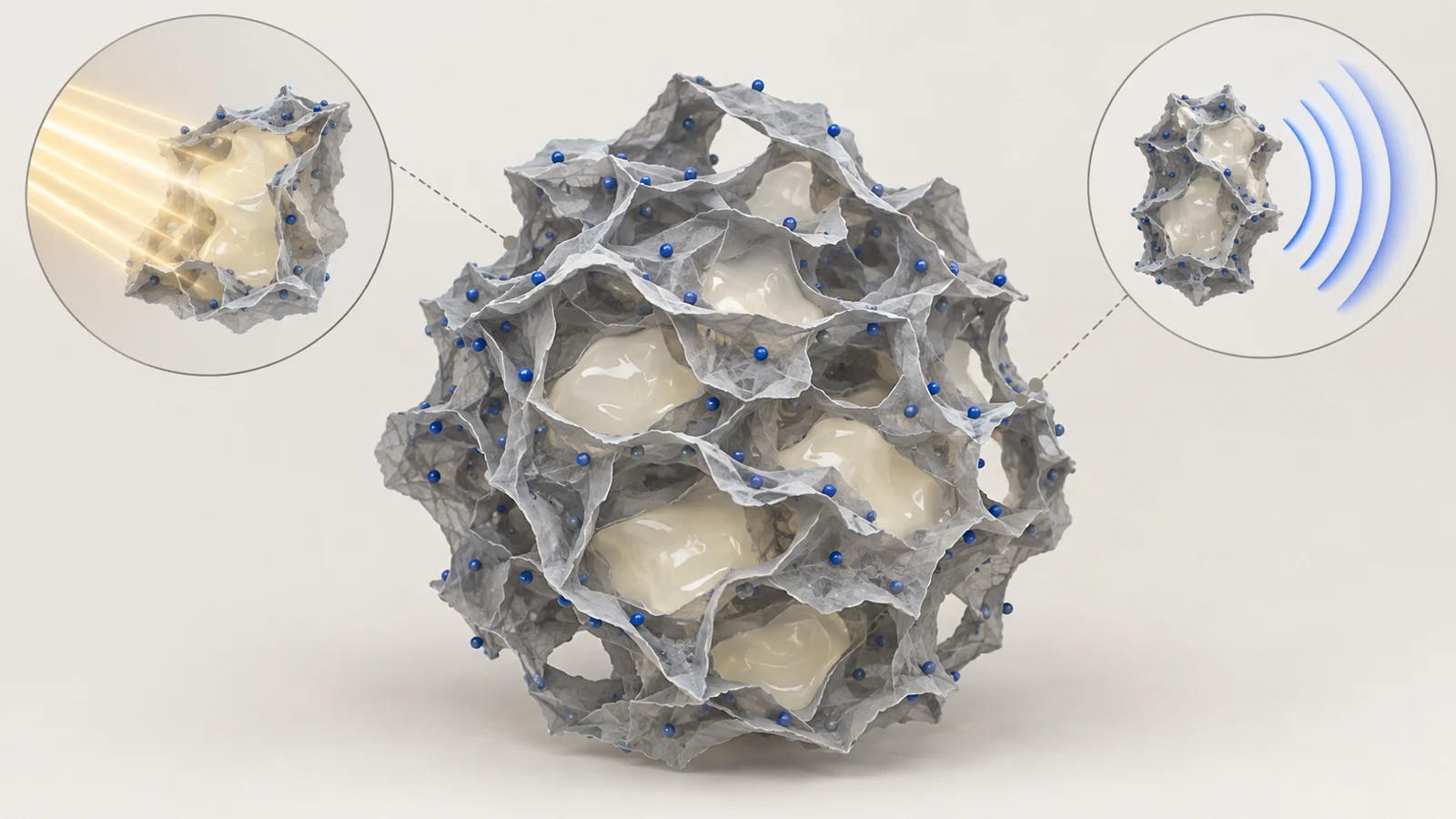
Paraffin wax can store heat as it melts. Give it a carefully engineered host, and the resulting material can also interact with microwaves. A research article published online on August 21, 2023, reports a composite designed around that pairing, combining wax with a hollow structure made from ultrathin sheets and modified with cobalt nanoparticles.
The interest lies in bringing these functions into a shared material architecture. Understanding the result, however, requires separating three measurements that answer different questions about stored heat, conversion efficiency, and microwave reflection.
Giving thin sheets room to work
The starting material is MXene, a family of materials made of ultrathin sheets. The authors identify a practical difficulty with those sheets: they tend to aggregate. They also describe insufficient dielectric loss—the dissipation of energy through electrical responses—and a lack of magnetic loss as limitations for microwave absorption.
Their design reorganizes the sheets into a hollow, three-dimensional structure. They first use electrostatic attraction to assemble MXene with layered double hydroxides, or LDH, derived from a polyhedral precursor called ZIF-67. A subsequent heat treatment, called calcination, produces a framework modified with cobalt nanoparticles. That framework then hosts paraffin wax.
The spatial arrangement matters. Instead of allowing the MXene sheets to collect into aggregates, the authors describe a connected hollow structure that keeps them organized in three dimensions. The wax occupies internal space, while the surrounding host supplies the conductive network and cobalt-containing components.
Heat capacity and efficiency answer different questions
Paraffin is a phase-change material. During melting, it takes in energy that can later be released as it solidifies. This gives the wax a storage role beyond simply becoming warmer.
The abstract reports an energy storage density of 131.04 joules per gram for the material system. This is an amount of thermal energy relative to mass. It helps describe how much heat a given quantity of material can store; it does not say how quickly the material charges or how efficiently incoming light reaches that stored form.
The reported photothermal storage efficiency of 96.52% addresses the conversion and storage process instead. It describes the authors’ measured efficiency for turning light energy into stored heat under their test conditions. It is not an electricity-generation efficiency or the efficiency of a complete energy system.
The authors attribute the thermal performance to the three-dimensional conductive network, which helps transport energy from the interface toward the interior. They also propose a contribution from localized surface plasmon resonance involving MXene and cobalt nanoparticles—a localized electronic response to light. These are the authors’ explanations for the result; the available abstract does not let us separate the contribution of each feature.
A microwave result tied to frequency and thickness
For microwaves, the reported measure is reflection loss, expressed in decibels. More negative values indicate less reflected microwave power under the relevant measurement conditions.
The composite reached a minimum reflection loss of −20.87 dB at 13.30 GHz with a matching thickness of 2 mm. Those conditions belong with the number. The minimum identifies a particularly favorable point in the material’s response, rather than describing every microwave frequency.
Thickness also matters because electromagnetic waves interact with the depth and internal properties of a material layer. A result obtained at 2 mm cannot simply be transferred to a thinner or thicker layer. Likewise, one minimum does not establish a broad absorption bandwidth. Reflection alone also does not provide a complete account of transmission, so this value should not be turned into a general claim that the material blocks all microwaves.
What the available evidence leaves open
This account rests on the paper’s PubMed record and abstract. They establish the reported fabrication approach, proposed mechanisms, and headline performance values. Detailed methods, controls, uncertainty estimates, and replication information are outside the evidence available here. That limits independent assessment without implying that such information is absent from the complete paper.
Practical integration would depend on retaining useful behavior through repeated heating and cooling and under relevant microwave conditions. The available evidence does not establish long-term cycling durability, scalable manufacturing, comparative cost, or simultaneous operation in a working device. In particular, reporting thermal and microwave results for the same composite does not by itself show how those properties interact while the wax changes phase.
What this could change
If the thermal and microwave behavior remain useful together through repeated use, and the hollow structure can be fabricated reliably at practical scales, engineers could develop a shared material layer that stores light-derived heat while attenuating selected microwave frequencies. Hosting the wax within the functional structure could then reduce the need for separate heat-storage and microwave-absorbing materials. That possibility gives the design a concrete engineering purpose, with any reduction in device size or weight still to be demonstrated.
Key Sources
- Primary source: Engineering 2D MXene and LDH into 3D Hollow Framework for Boosting Photothermal Energy Storage and Microwave Absorption.
DOI or Journal Page · Peer-Reviewed Paper · 2023-08-21
Keep exploring