
Research Signal – Source date 2024-12-30
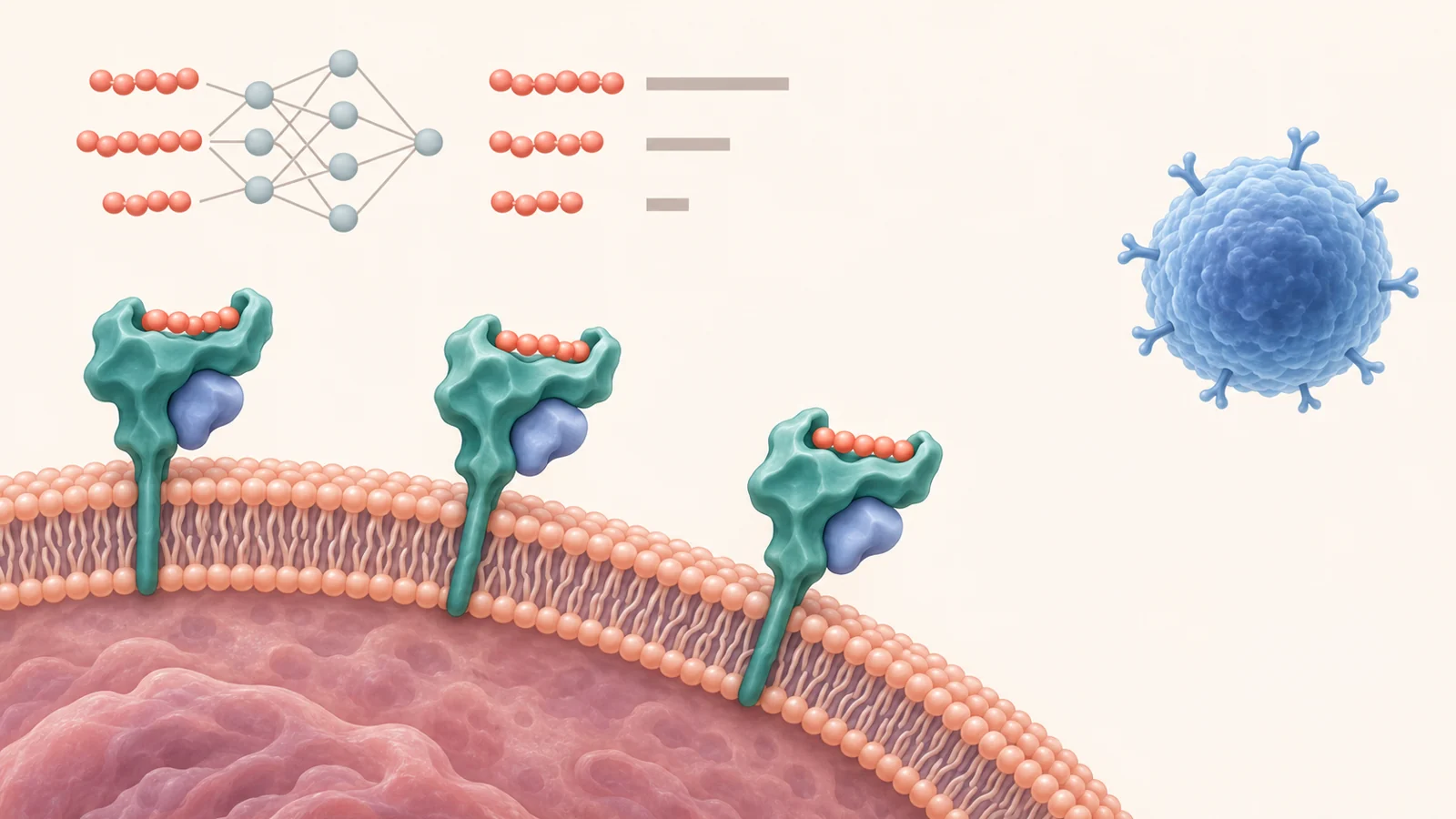
A tumor mutation can look promising on paper and still be invisible to the immune cells a personalized cancer vaccine aims to engage. For a CD8 T cell to recognize a mutated fragment, the tumor cell must first process it and display it on its surface using an HLA class I molecule. HLA is the highly variable human version of these peptide-display molecules.
That makes presentation prediction an important screening step. Researchers have many possible fragments to consider, and each person’s HLA variants influence which fragments can be displayed. A model can help rank candidates for investigation, but its score addresses display, one part of a longer chain that also includes whether a T cell responds.
In a paper published on December 30, 2024, researchers introduced HLApollo, a model designed to predict which short protein fragments are presented by HLA class I. In its main benchmark, it achieved 78.7% average precision, reported as 12.65% above the next-best model considered. The result offers a stronger computational sorting method; it is not a test of whether vaccines chosen with the model improve patient outcomes.
The screen starts with a crowded candidate list
A cell’s displayed peptides are fragments of proteins that have been processed and loaded onto HLA class I. Some may include mutations found in a tumor. For vaccine design, the question is not only whether a mutation exists, but whether a fragment containing it is likely to reach the cell surface in a form the immune system can inspect.
The task is difficult in part because HLA varies widely between people. The HLA-A, HLA-B and HLA-C genes encode different class I molecules, and a person typically carries several variants across them. Each can present a different range of peptides. A useful model therefore needs to learn which fragments fit which HLA variants, including variants with less training data.
HLApollo uses a transformer-based model to process peptide sequences and HLA features, then estimate presentation. The authors assembled immunopeptidomics data, which records peptides detected in association with HLA molecules, to train and evaluate it. Their main benchmark held out peptides so that the test examples did not overlap with training examples in the specified allele-based split. The test set also used a 1:99 ratio of positives to negatives, reflecting a task where presented peptides are outnumbered by candidates treated as negative examples.
The headline 78.7% is average precision, a summary of how well a ranked list concentrates true positives near the top across possible score thresholds. It is useful when positives are scarce, because a model can look strong on other measures while still burying relevant candidates among many negatives. In this benchmark, HLApollo’s average precision was 12.65% higher than that of the best comparator the researchers tested. That is a comparison on this assembled test set, not a guarantee that the same margin will appear in every tumor or patient group.
An unseen peptide is not automatically a negative
Training a model requires examples labeled as presented or not presented. But experimental data generally records peptides that were detected; failure to detect a peptide does not prove that the cell could never display it. Some peptides sampled as negatives from the human proteome may actually be presentable but absent from the particular measurements. Treating every such example as a definite non-presenter risks teaching the model the wrong lesson.
HLApollo’s training approach responds to that uncertainty by switching the sampled negative set between training rounds. The team drew from hundreds of candidate negative sets and used a fresh, exclusive set after each training epoch. A peptide that might have been mislabeled as negative was therefore less likely to be presented to the model repeatedly as if its status were certain.
In the authors’ tests, this strategy mattered: using 500 negative sets improved average precision by 11.79% compared with using a single set, and training with ten or fewer sets showed signs of overfitting. The result illustrates a practical point about machine learning with biological data. When the labels are incomplete, changing which uncertain examples the model sees can help prevent it from memorizing a mistaken label.
Several HLA variants complicate the assignment
Many experimental samples contain multiple HLA variants. If a peptide is detected in such a sample, the measurement alone may not identify which variant presented it. This is called a multiallelic sample. It contains useful evidence, but the peptide-to-HLA assignment is ambiguous.
HLApollo learns from these samples by evaluating the peptide against the possible HLA variants together and updating which variant is most likely to account for its presentation. To check whether that approach could recover assignments, the researchers created a synthetic multiallelic test from single-allele data, where the presenting variant was known before the examples were combined.
A model trained on the synthetic multiallelic data performed nearly as well as one trained on the underlying single-allele data. In that synthetic test, 93.9% of the alleles were assigned correctly based on the model’s highest score. This is a controlled test of assignment under constructed conditions; it supports the method’s ability to disentangle mixed samples without showing that every assignment in naturally collected data will be correct.
The source protein adds useful context
A peptide’s sequence is only part of the picture. If the gene that encodes its source protein is barely expressed in a tumor cell, there may be less protein available to generate and display that peptide. The researchers found a relationship between gene expression and measured peptide enrichment, and adding expression measurements to HLApollo improved average precision by 6.03% in the relevant test.
Expression values are not always available. The team also tested ESMMHC-I, a model that uses features derived from the source protein’s sequence, alongside HLApollo. These protein-derived features improved performance over HLApollo alone and reduced false discoveries in low-expression settings in the study’s analyses. When both were compared with measured expression, expression plus HLApollo performed better by 3.47% average precision in the reported comparison.
This makes the protein-based approach a possible source of context when expression measurements are missing, rather than a direct measurement of how much of a protein a particular tumor produces. The distinction matters: gene-level features can help refine a ranking, while actual presentation still depends on the biology of the sample being considered.
Presentation tests and T-cell tests answer different questions
The researchers evaluated HLApollo on held-out tissue studies as well as on existing datasets measuring CD8 T-cell responses to cancer neoantigens. In the tissue tests, they compared how highly the model ranked peptides found in samples that had not been used for training. HLApollo showed higher sensitivity than the other methods considered, although the advantage was not statistically clear in every study, and some comparisons involved relatively few samples.
The T-cell datasets offered a different check. HLApollo outperformed competing presentation models on the neoantigen immunogenicity datasets used in the paper. Adding protein-derived features improved average precision over HLApollo alone by 0.5% in one dataset and 2.0% in another. These results are useful because they ask whether presentation scores also help sort candidates associated with T-cell responses, rather than only matching peptide-detection data.
But presentation is a prerequisite for recognition, not the whole immune response. A displayed peptide may still fail to trigger a useful T-cell response. The study’s computational benchmarks and analyses of existing response data do not show that selecting vaccine targets with HLApollo changes treatment outcomes.
Untrained HLA variants remain an important test
A model that works for common, well-sampled HLA variants may be less dependable for a variant it did not encounter during training. That matters for personalized use because a patient’s HLA combination may include variants that are rare in the datasets used to build a model. If those variants are poorly covered, a ranking system could offer uneven guidance across people.
The researchers tested HLApollo on alleles held out from training. Performance declined, with a median average-precision drop of 9.6%. They also built a separate estimate of likely performance for untrained alleles using information about the allele and the model’s predictions. Applying a threshold to that estimate, they projected coverage across 2,627 alleles and reported potential gains in genotype coverage for several ancestry groups, including Asian, Hispanic, Austronesian and Polynesian groups.
These coverage figures are estimates from the paper’s model and population-frequency data, not direct validation for every untrained variant. They do show why evaluation beyond the training set matters: the relevant question is not only how well a model ranks familiar examples, but which less-represented variants it may handle adequately and where uncertainty remains.
How this could shape the future
If HLApollo’s performance holds up in further patient-specific evaluations, better estimates of peptide display could help researchers narrow the large pool of tumor mutations to fragments more likely to appear on a person’s cancer cells. Combined with evidence about T-cell recognition, that screening step could eventually support more focused personalized vaccine design and help include people whose HLA variants have been less represented in existing data.
The path from ranking to benefit still depends on testing whether selected fragments are displayed in the relevant tumors, whether patients’ T cells recognize them, and whether a vaccine built around them helps in clinical care. HLApollo addresses the first of those questions with a more integrated prediction approach. The meaningful milestone is a model that can learn from uncertain labels and mixed HLA samples while estimating how far its predictions may extend beyond familiar variants.
Key Sources
- Primary source: Towards designing improved cancer immunotherapy targets with a peptide-MHC-I presentation model, HLApollo.
DOI or Journal Page · Peer-Reviewed Paper · 2024-12-30
Keep exploring