
Research Signal – Source date 2025-12-23
Could directing low-intensity ultrasound toward the hippocampus help older adults who have both sleep and memory difficulties? ClinicalTrials.gov record NCT07298876 describes a planned human study testing that possibility. It is a registered experiment, not evidence that the treatment works. The supplied record lists no posted results.
The record is dated December 23, 2025. Current registry details describe the study as enrolling by invitation, with an estimated start date of April 1, 2026, estimated primary completion on March 31, 2027, and estimated completion on May 16, 2027. Those dates are estimates from the current record, not proof that participants had enrolled or that the same recruitment wording appeared in December 2025.
A small experiment with a focused question
The study plans to enroll 20 participants, with 10 assigned to active low-intensity transcranial ultrasound stimulation and 10 assigned to sham stimulation. The intervention is scheduled to last two weeks. The registry describes the comparison as randomized, controlled and double-blind, meaning the design intends to reduce the influence of assignment and expectations when changes are assessed. That describes the study plan; it does not show whether blinding was successfully maintained.
The investigators’ stated goals are broader than asking whether one short course improves a symptom score. They plan to examine safety, feasibility and possible changes in sleep disturbances and cognitive performance. They also want information that could help determine the sample size for a larger randomized trial. With only 20 planned participants, the study could help expose practical problems in delivering the protocol or suggest whether the measurements are sensitive enough for a larger test. It would leave broad questions about benefit and uncommon harms unresolved.
Why the hippocampus is the target
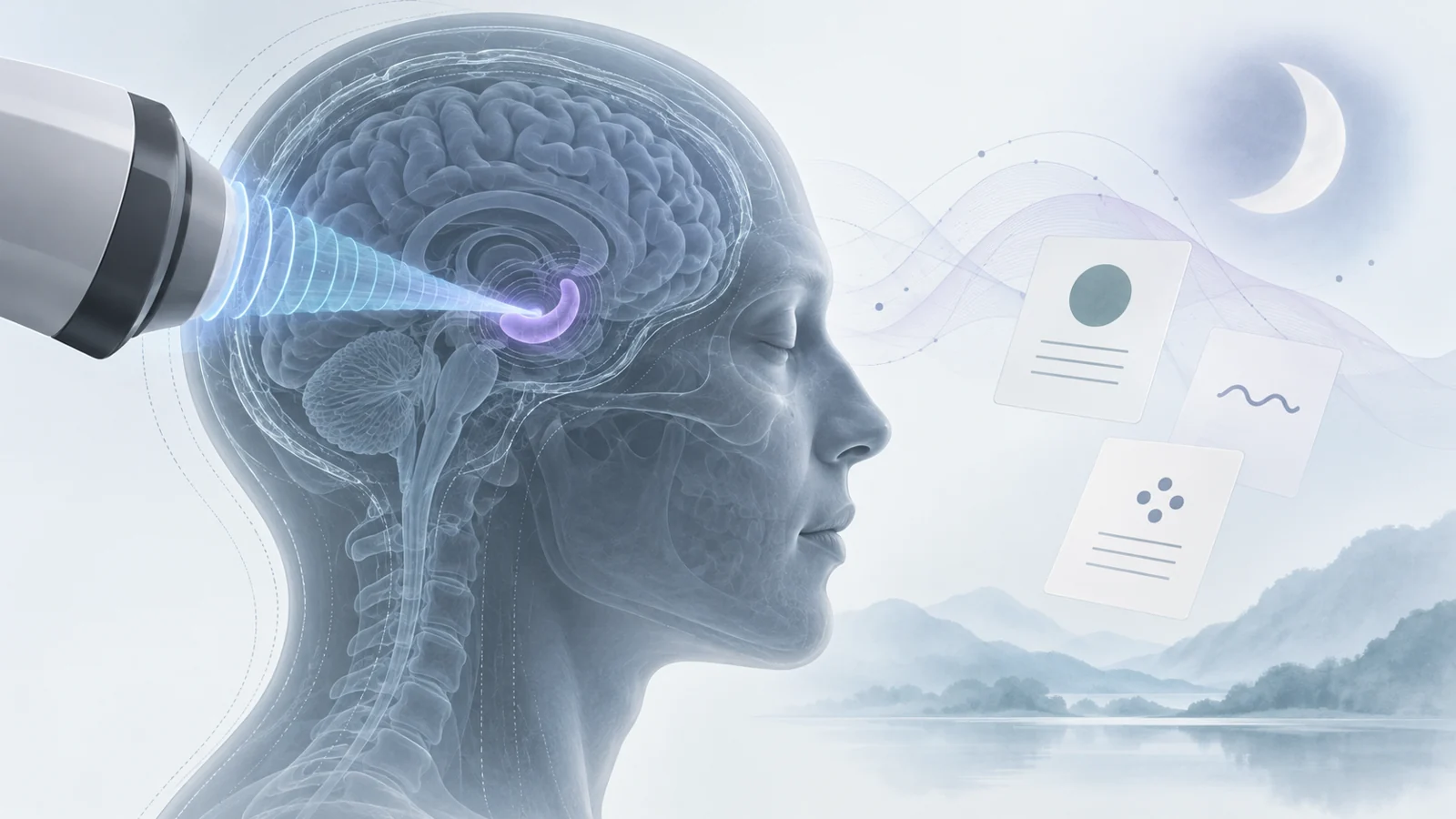
Transcranial ultrasound stimulation sends low-intensity sound waves through the skull toward a selected brain region. In this study, the intended target is the hippocampus, a deeper structure named in the protocol. Before treatment, the team plans to use each participant’s T1-weighted MRI scan to construct an individual head model. That preparation is meant to support the planned targeting approach, but the record does not provide participant-level evidence that the ultrasound reached its intended location with a particular accuracy or produced a biological effect.
The active arm specifies a 500 kHz stimulation setting. The sham arm is described as using the same settings while the power is turned off. Keeping the session structure similar gives investigators a way to compare changes associated with active stimulation against changes that might arise from participating in a treatment procedure, repeated assessments or expectations about receiving an intervention.
Sleep and recall are measured separately
The main sleep measure is the Pittsburgh Sleep Quality Index, a questionnaire covering several aspects of a person’s reported sleep over the previous month. A higher score indicates worse reported sleep quality. The study also plans to use actigraphy to record sleep-wake patterns objectively during the treatment period. These measures address related but different questions: one captures a person’s reported experience, while the other records patterns of movement and rest.
Memory is represented by delayed recall of words from a word-list learning test. Participants are presented with 16 semantically unrelated words over three immediate-recall trials, followed by a 20-minute delayed recall. Improvement on this task would be evidence about performance on that measure, not proof of broad cognitive recovery or restored day-to-day memory.
The registry also lists blood measurements involving amyloid beta, including Aβ42, Aβ40 and their ratio, along with plasma tau measures. These tests are intended to examine biological measurements alongside sleep and memory outcomes. They do not, by themselves, establish that the intervention reduced Alzheimer’s disease pathology or changed the course of disease.
The assessment schedule includes baseline, the second week, the sixth week and the tenth week. The record separately specifies objective sleep quality through actigraphy at two weeks, while the principal sleep and recall outcomes are listed with a 10-week timeframe. Reporting the schedule this way preserves what the registry specifies without assuming that every visit represents the same interval after the final treatment session.
What the registry can and cannot tell us
The population is described conservatively as older Chinese, right-handed adults with sleep disturbances and cognitive concerns. The investigators use the term “preclinical Alzheimer’s disease,” but the supplied material does not establish biomarker-confirmed eligibility criteria. It also contains two age descriptions: the methods say 60 to 90 years, while the structured eligibility summary lists 60 to 85 years. That difference is a reason to retain the registry’s wording rather than silently choose one range.
The estimated enrollment number is a target, not a participant count. It does not tell us how many people had been screened, treated or followed up. Because the current record lists no results, there are no reported participant outcomes here showing improved sleep, better delayed recall, changed amyloid or tau measures, or acceptable tolerability.
The most informative next step within this research direction would be a larger controlled evaluation if the small study establishes that the intervention and assessments are workable. Such a study would need enough participants and follow-up to separate a reproducible treatment effect from normal variation, expectation effects and measurement noise, while also giving safety and adherence findings more weight.
What this could mean for older adults with sleep and memory difficulties
The longer-term possibility is a non-drug intervention that could help older adults manage co-occurring sleep and memory difficulties through a focused treatment delivered over a limited course. That possibility depends on meaningful benefits surviving larger controlled studies, with acceptable safety, tolerability and treatment adherence. The registered experiment is an early test of whether that research path is feasible; it is not a claim that ultrasound can prevent Alzheimer’s disease or reverse cognitive decline.
Key Sources
- Primary source: Low-intensity Hippocampal Transcranial Ultrasound Stimulation for Managing Cognitive and Sleep Dysfunction in Preclinical Alzheimer's Disease
Government or Regulator · Clinical Trial · 2025-12-23
Keep exploring