
Research Signal – Source date 2021-03-24
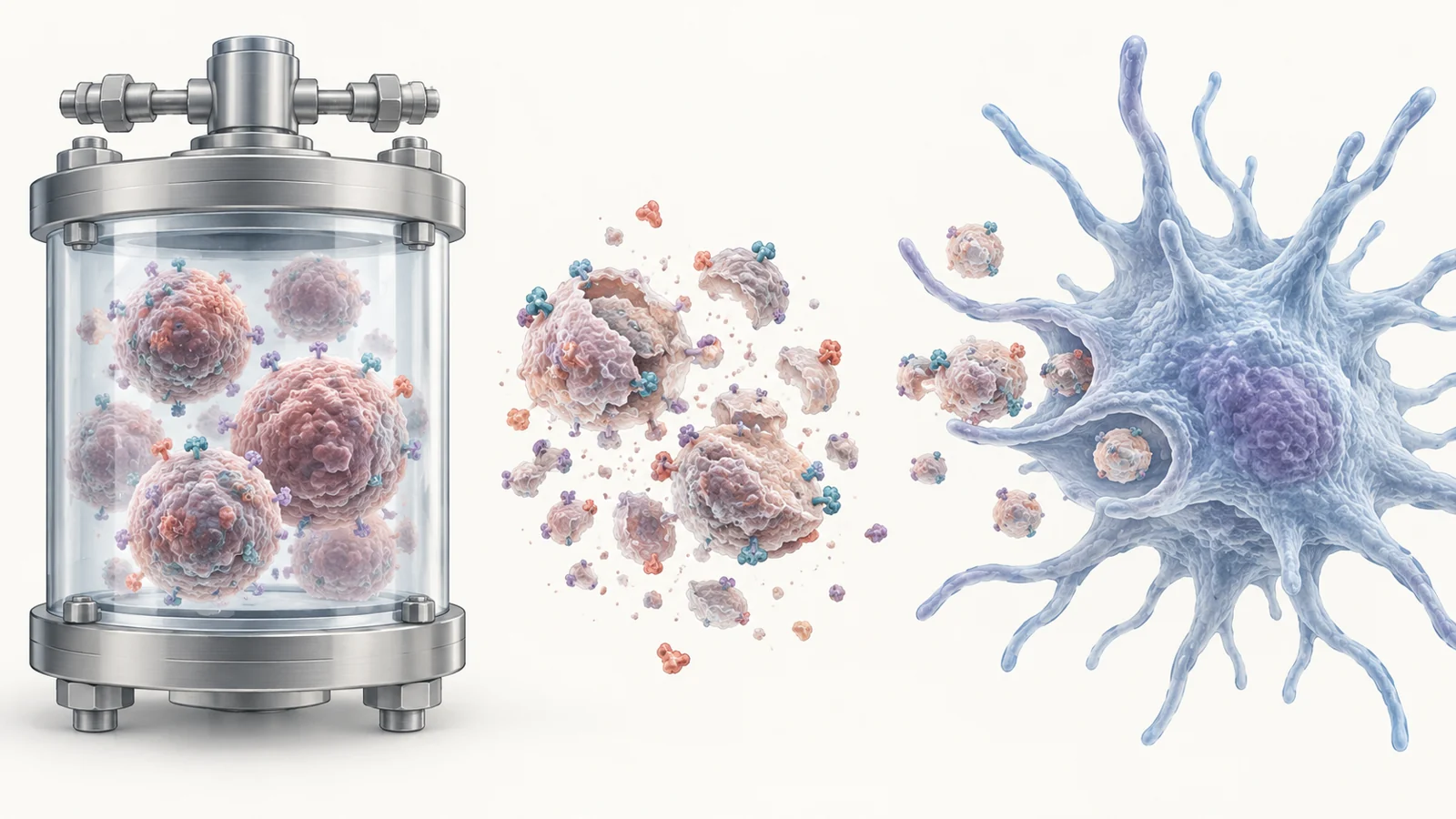
A tumor cell can be killed and still carry useful information about the tumor. A 2021 review describes experiments in which high hydrostatic pressure—pressure applied evenly to cells in a sealed environment—disabled tumor cells while preserving antigens and other features that could help alert the immune system. Researchers have explored using these treated cells to prepare cancer vaccines.
The idea depends on how cells die and what remains afterward. A vaccine made from treated tumor material could give immune cells many tumor targets to recognize. But the review’s evidence is from laboratory and animal research: it does not show that pressure-prepared vaccines prevent cancer recurrence or extend patients’ lives.
Pressure changes cells, but the setting matters
Researchers expose tumor cells suspended in a nontoxic medium to high pressure. Pressure travels through the medium and flexible packaging, reaching the sample throughout. The treatment can be controlled by changing both pressure and exposure time, but the response depends on the cell type and conditions.
The review describes a broad range of effects. In some studies, pressure below 100 megapascals (MPa) caused reversible changes, while higher levels could impair cell viability or kill cells. Around 200 MPa, studies often reported apoptosis; above 300 MPa, they reported necrosis. These are different patterns of cell death, but the name alone does not show whether the treated cells will prompt a useful immune response. These ranges are not a recipe that applies to every tumor. The response varies with the cells and treatment, and researchers need to test the intended preparation directly.
One melanoma experiment illustrates why both variables matter. Researchers treated B16-F10 melanoma cells at different pressures, each at least 50 MPa, and for different durations, each at least one minute. The review reports that the results suggested pressure of at least 200 MPa for at least 30 minutes could be effective for preparing a melanoma vaccine. Those exact conditions belong to that experiment; they should not be read as a universal setting for other tumors.
A whole tumor cell carries many possible targets
A tumor contains multiple antigens—molecules the immune system can learn to recognize. Using whole tumor cells as vaccine material can preserve a broad mix of these targets, rather than requiring researchers to select a single antigen in advance. That range could matter because tumors may evade immune attack when a vaccine focuses on too few targets.
Using a patient’s own tumor cells could provide antigens matched to that person’s cancer. Yet the review notes a practical obstacle: a tumor may be inoperable, or a biopsy or resection may yield too few cells to prepare doses for repeated vaccination. HHP-treated tumor cell lines offer a possible source of abundant tumor-associated antigens for research, though they do not solve every question about how a vaccine would work for an individual patient.
The handoff from dying cell to immune response
Dead cells do not all prompt the same response. The review describes immunogenic cell death as cell death accompanied by signals that alert immune defenses. Pressure-treated tumor cells displayed or released several such signals in laboratory studies, but their presence does not by itself show lasting protection.
Dendritic cells help connect that material to a targeted immune response. They collect and process tumor material, then present pieces of it to T cells. In experiments summarized by the review, dendritic cells took up HHP-treated tumor cells and showed signs of maturation, including production of inflammatory signals. In laboratory tests, human dendritic cells loaded with treated tumor material stimulated T cells, a sign that the material had been processed and presented to them. A separate laboratory study used dendritic cells prepared from people with non-small-cell lung cancer; after loading them with pressure-treated tumor material, researchers observed T cells that recognized tumor antigens.
These observations make the proposed sequence concrete: pressure-treated cells provide tumor material and danger cues; dendritic cells collect and process it; and T cells respond to the presented antigens. Laboratory immune activation is an important step in studying a vaccine, but it does not establish that the response will persist or control a person’s cancer.
Two ways to prepare the vaccine material
A whole-cell vaccine uses tumor cells after pressure treatment has inactivated them. In a dendritic-cell vaccine, the treated tumor material is instead loaded into dendritic cells, which are then used to present tumor antigens to T cells. The approaches share a starting point, but the second adds a cell-processing step designed to focus the handoff to the immune system.
Either route depends on consistent preparation. Tumor cells must be fully inactivated, while retaining features that make their material useful to immune cells. The review describes pressure as a repeatable way to expose cells to a controlled physical treatment, and discusses its potential use in manufacturing. Repeatability can support quality control; it does not, on its own, establish clinical safety or benefit. Preparation would also need to meet applicable manufacturing and legal requirements.
The evidence is still preclinical
The 2021 review, published on March 24, brings together earlier work on pressure effects in cells, immune-cell responses, and tumor models. It reports that pressure-treated cells can retain immunogenic features and that dendritic cells respond to this material in laboratory experiments; one cited mouse study found reduced tumor growth when a dendritic-cell vaccine was combined with chemotherapy. The underlying experiments varied in tumor type, pressure, duration, vaccine design, and measured immune response.
The authors describe both pressure-prepared whole-cell and dendritic-cell vaccines as preclinical. The review also discusses other dendritic-cell immunotherapy research, including clinical work, but those reports are not evidence that vaccines prepared with high pressure improve outcomes for patients. The central question—whether these preparations can safely produce durable immune control in people—remained open in the review.
What pressure-treated cells could change for cancer vaccines
A reliable way to inactivate tumor material while keeping a broad set of antigens available could give clinicians another route to prepare whole-cell or dendritic-cell vaccines. If safe preparation and durable benefit are demonstrated in patients, that route could help researchers pursue lasting immune control of disease that might otherwise recur. The experiments summarized in the review establish a rationale to investigate that possibility, not a treatment benefit in people.
Key Sources
- Primary source: Research and application of hydrostatic high pressure in tumor vaccines (Review).
DOI or Journal Page · Review or Meta-Analysis · 2021-03-24
Keep exploring