
Research Signal – Source date 2026-06-13
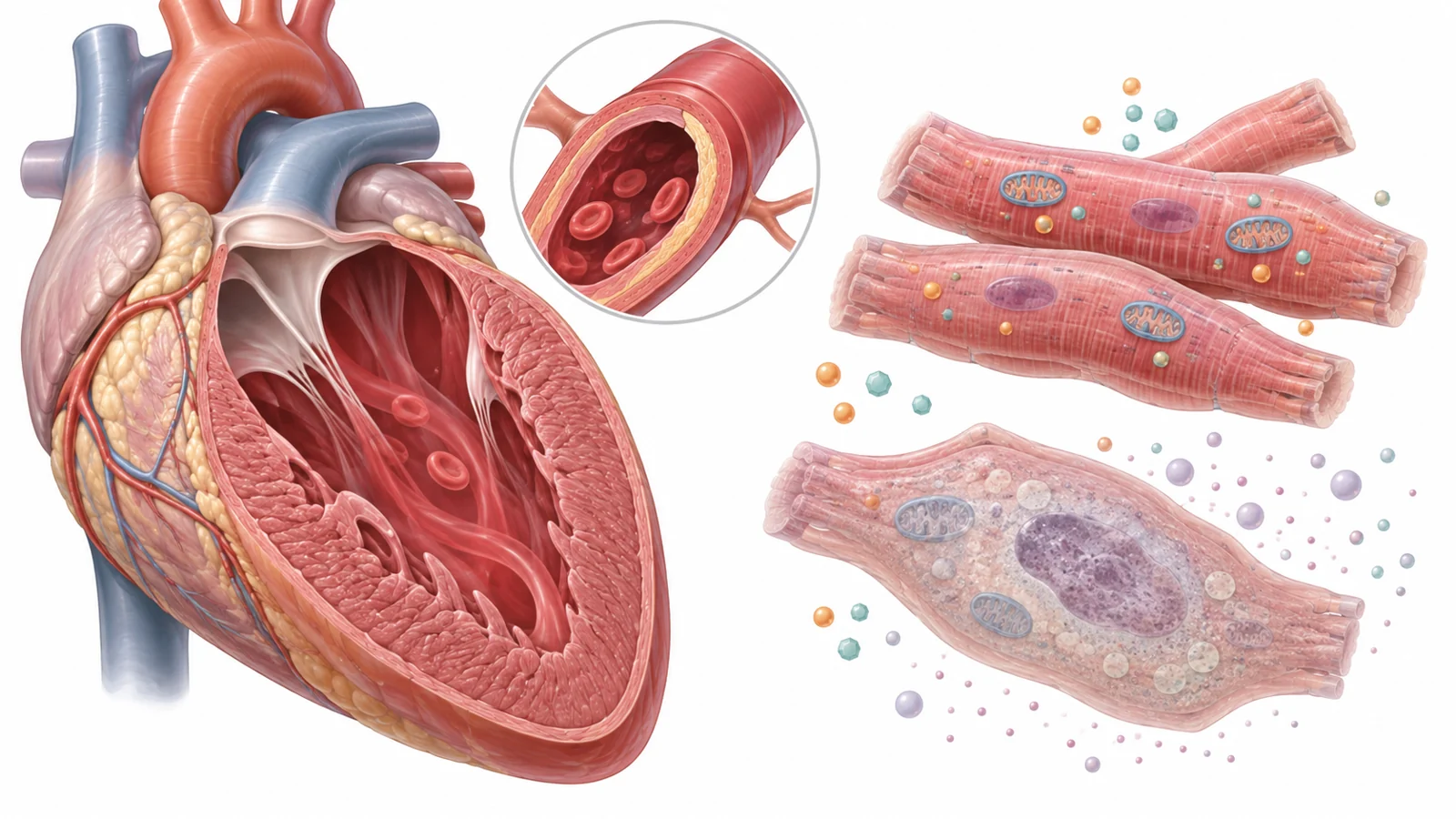
Heart failure can persist even when the heart pumps out a normal share of the blood it contains. In heart failure with preserved ejection fraction, or HFpEF, the left ventricle’s ejection fraction is at least 50%, yet pressure inside the heart is elevated as it fills. The heart’s squeeze can look preserved while its ability to relax and accept blood is impaired.
The diagnosis also covers people with different combinations of obesity, diabetes, high blood pressure, kidney disease, and aging. Those conditions can affect the heart and the rest of the body in different ways. A June 2026 review in the Journal of Translational Internal Medicine brings together research on how inflammation, fuel handling, and aging-related changes may intersect in HFpEF. It offers a way to connect findings across those areas, while leaving open which processes matter most in any one person.
Small vessels may affect how the heart relaxes
The heart muscle receives blood through tiny coronary vessels. In HFpEF, impaired function of these vessels is common: the review cites the PROMIS-HFpEF study, in which about three quarters of participants had coronary microvascular dysfunction. That finding was based on reduced coronary flow reserve and raised markers of endothelial dysfunction. In patient studies, microvascular problems have also been associated with subtle heart-muscle injury, impaired filling, and cardiovascular risk. An association does not by itself show which problem came first.
The vessel lining, or endothelium, helps regulate blood flow and sends signals to nearby heart cells. The review describes human heart-tissue analyses showing increased expression of genes for molecules that help immune cells attach to and move through vessel walls. Inflammation can impair endothelial function and reduce signaling through the nitric oxide–cGMP–PKG pathway. In this chain, nitric oxide helps start a signal that ultimately activates PKG, an enzyme involved in keeping heart muscle and blood vessels functioning normally.
Lower PKG activity can alter titin, a large protein inside heart-muscle cells that helps set their elasticity. Titin’s spring-like properties affect how much tension the muscle develops as it relaxes. Findings in people with HFpEF include changes in titin phosphorylation associated with greater passive tension. Oxidative stress may also modify titin’s spring elements. Together, these observations provide a plausible route from changes in small vessels to a stiffer heart muscle, but the review does not show that this sequence starts every case.
The evidence comes from different kinds of studies. In mouse models, removing the inflammatory adhesion protein ICAM-1 reduced immune-cell infiltration and fibrosis and was associated with lower inflammatory signals. That intervention supports a possible causal role for endothelial inflammation in those models. It is not the same as showing that blocking ICAM-1 will treat patients.
Fuel use may not follow one pattern in HFpEF
A flexible heart can shift among fuels as the body’s needs and conditions change. The review describes this ability as disrupted in HFpEF, but the tissue findings do not fit a simple story in which the heart merely runs out of energy.
In heart tissue from patients with severe obesity and HFpEF, proteomic studies found impaired fatty-acid uptake and oxidation alongside lipid-droplet accumulation. Other analyses report lower levels of fatty-acid metabolism products, citric-acid-cycle intermediates, ketone bodies, and branched-chain amino-acid metabolites. Some studies found increased expression of genes involved in mitochondrial energy production, while other measures suggested inefficient fuel processing. Taken together, these findings point to difficulty using available fuels effectively, not a single uniform metabolic failure.
Different conditions show different patterns of cardiac fuel use. In obesity, excess circulating fatty acids can contribute to lipid accumulation and mitochondrial problems. The review also describes disrupted fatty-acid oxidation and glucose uptake that is not matched by efficient oxidation in pressure-overload or ischemic heart failure; diabetic cardiomyopathy shows a different pattern, with reduced glucose use and increased fatty-acid oxidation. These comparisons illustrate metabolic heterogeneity, but they do not show that every pattern occurs in HFpEF.
Aging can add a lasting source of inflammatory signals
Cellular senescence is a state in which stressed cells stop dividing and begin releasing signals that influence nearby tissue. The review connects this process to aging and HFpEF, including through the senescence-associated secretory phenotype, a mix of signaling molecules and tissue-remodeling substances. These signals can sustain inflammation and may encourage neighboring cells to adopt similar changes.
Older age is strongly associated with HFpEF risk. The review also describes experimental mechanisms that could help explain the connection: oxidative stress can damage DNA and push cells toward senescence; damaged mitochondria may release DNA that activates innate immune pathways; and impaired cellular cleanup may allow this stress to persist. These mechanisms offer ways for aging-related changes and inflammation to interact, but age associations in patients are different from experiments that manipulate a pathway in cells or animals.
Senescence may involve several heart cell types. In mouse models, markers of endothelial senescence have appeared alongside inflammation and impaired filling. Senescent endothelial cells can release signals that affect fibroblasts, which make collagen, and cardiomyocytes, the contracting heart cells. In laboratory experiments, interferon gamma induced senescence-related markers in cardiomyocytes; empagliflozin reversed those effects in that experimental setting. This is not evidence that the drug reverses senescence in people with HFpEF.
Inflammation is not the only path to scarring. The review describes gene-expression findings consistent with fibrosis even when inflammatory activity is not prominent, and experimental work in which changing fibroblast regulation reduced fibrosis. This matters because it keeps the account from collapsing into one cause: overlapping processes may contribute, and some may proceed partly independently.
Symptom relief and longer life are different outcomes
Treatment results need to be read by the outcome measured. Some therapies have improved symptoms, exercise tolerance, quality of life, or the rate of worsening heart-failure events. Those changes can matter to patients, but they are not interchangeable with evidence that a treatment helps people live longer.
For obesity-related HFpEF, the review reports that the STEP-HFpEF trial found semaglutide improved symptoms and exercise tolerance and reduced inflammatory burden. It also describes tirzepatide as associated with lower cardiovascular risk in obesity-related HFpEF, with the benefit driven mainly by fewer worsening heart-failure events rather than fewer cardiovascular deaths. These results concern a group defined by obesity-related HFpEF; they should not be assumed to apply equally to every person with the syndrome.
The finerenone result involved a broader ejection-fraction population: people with HFpEF and mildly reduced ejection fraction. In FINEARTS-HF, finerenone lowered the combined rate of worsening heart-failure events and cardiovascular death by 16%, with the reduction largely driven by 18% fewer worsening heart-failure events. The trial did not show a significant reduction in cardiovascular mortality. A composite outcome can improve because one component changes even when another does not.
Other plausible targets have produced neutral or inconsistent trial results. Attempts to boost nitric oxide–cGMP–PKG signaling have faced challenges including oxidative stress, how signals are compartmentalized inside heart cells, and blood-pressure-lowering effects. A pathway can make biological sense and still prove difficult to target in a way that improves clinical outcomes. The review reports that no treatment has yet shown a consistent reduction in cardiovascular or all-cause mortality across HFpEF.
What the review can and cannot settle
Published June 13, 2026, this paper synthesizes earlier research. Its authors describe a targeted PubMed search for HFpEF combined with inflammation, metabolism, or aging, supplemented by screening reference lists. The article brings together patient observations, human tissue studies, clinical trial reports, animal models, and a heart-on-a-chip experiment. These forms of evidence answer different questions: tissue findings can reveal altered biology, animal experiments can test mechanisms, and clinical trials can measure outcomes in people.
The combined inflammation–metabolism–aging account is an interpretation of this body of work, not a new patient trial testing the whole explanation or a treatment built around it. The processes may reinforce one another, but the review does not establish that one is always the starting point, or that the same combination explains every patient. It also highlights intrinsic heart-cell stress and routes to fibrosis that may not depend on active inflammation.
Experimental senolytic approaches, which aim to remove senescent cells, have reduced fibrosis and other disease features in some preclinical models. A heart-on-a-chip experiment reported improved relaxation with dasatinib and quercetin. Those results are early evidence from experimental systems; they do not establish long-term safety or benefit for people with HFpEF.
What tailored treatment could change for patients
If researchers can validate biomarkers that reliably identify the dominant disease process in a particular patient, clinicians could eventually match that person to a treatment aimed at inflammation, metabolism, or senescence. Such matching could make care more useful for a syndrome whose patients can arrive at impaired filling through different combinations of biology and comorbidities.
That possibility depends on both accurate patient stratification and treatments shown to be safe and beneficial in the groups selected for them. The review points toward that goal; it does not present a clinically validated biomarker system for assigning these therapies today.
Key Sources
- Primary source: Inflammation, metabolism, and aging in heart failure with preserved ejection fraction: Mechanisms and treatment perspectives.
DOI or Journal Page · Peer-Reviewed Paper · 2026-06-13
Keep exploring