
Research Signal – Source date 2022-06-25
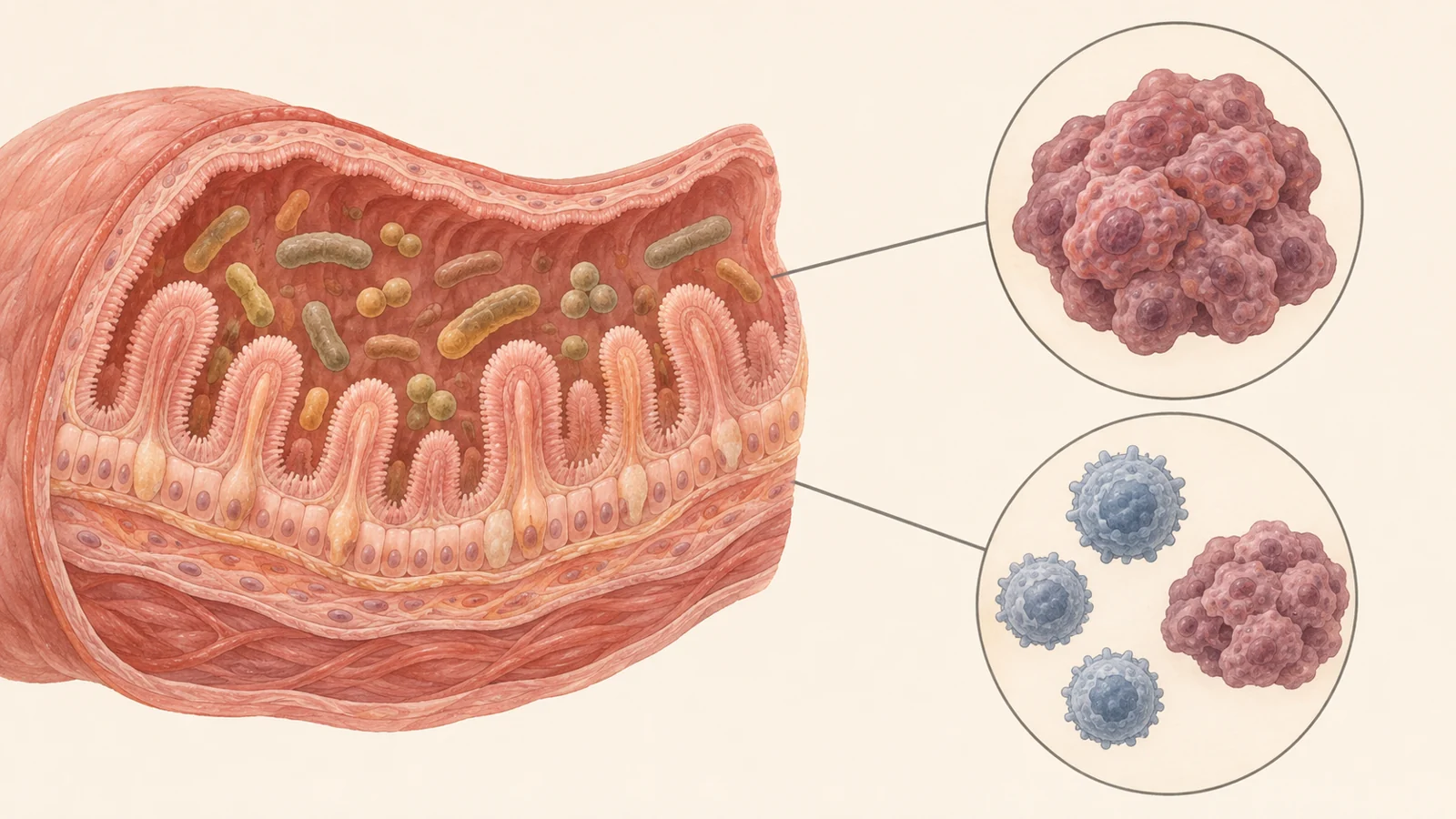
A 2022 review considers intestinal microbes in two cancer contexts: how tumors arise and develop, and how they might relate to treatment. It pays particular attention to immune checkpoint therapy.
The connection is worth examining, but the questions are not interchangeable. A role in tumor biology would not automatically show whether a treatment will work for a patient. And a possible link to treatment response would not, by itself, show that changing gut microbes can improve that response.
Cancer biology and treatment ask different questions
The review considers intestinal microbiota—the community of microorganisms in the intestine—in relation to tumor occurrence and development. That places microbes in a broad discussion of the processes surrounding cancer, from its beginnings to changes as it develops.
Treatment raises a separate question. The review gives special attention to immune checkpoint therapy, which aims to help immune cells attack tumors. It considers how gut microbes might relate to that therapy, but does not establish that they can predict whether a particular patient will benefit.
Could changing the community help treatment?
The authors also summarize approaches intended to enhance tumor therapy by regulating intestinal microbiota. This shifts the question from whether microbes and cancer are related to whether deliberately altering the community could become part of a treatment strategy.
That is a proposed direction for research. The review’s publication is not itself a trial showing patient benefit or a validated clinical tool, and the evidence described here does not establish that changing the microbiota improves checkpoint therapy outcomes in people. The review also discusses challenges and future perspectives, placing the therapeutic idea within an evolving research area.
What this could make possible
If future research establishes reliable ways to measure a patient’s gut microbiota and shows that those measurements can guide treatment, an oncology visit could eventually include that information when clinicians consider immunotherapy. A proven way to regulate the microbiota might also become useful in care. Getting from a biological question to either capability would require dependable measurement, accurate prediction and clinical testing.
One meaningful test would be a controlled human study showing that a defined microbiota-regulating approach reproducibly improves an outcome of immune checkpoint therapy. That would help establish whether the proposed connection can support a treatment decision. It is a milestone to test, not an outcome reported by this review.
Key Sources
- Primary source: [The role of intestinal microbiota in tumor occurrence, development and immunotherapy: a review].
DOI or Journal Page · Review or Meta-Analysis · 2022-06-25
Keep exploring