
Research Signal – Source date 2021-12-18
Bacteria and dietary fiber can influence inflammatory activity. Could those changes also affect how skin ages? Answering that question requires following the biology beyond the gut, into skin cells that have stopped dividing but remain active. These cells can keep releasing substances that change the tissue around them.
A review published in Nutrients on December 18, 2021, proposes a connection among the gut microbiome, this cellular state—called senescence—and skin health. It brings together human observations, cell experiments and animal studies that examine different parts of the relationship. The contribution is a biological explanation worth testing; it does not establish that probiotics or prebiotics reverse human skin aging or extend human lifespan.
The central puzzle is how a change in intestinal microbes might alter the behavior of cells in a distant tissue. The authors focus on microbial products, the intestinal barrier and the chemical signals released by senescent cells.
Cells that stop dividing can still change their surroundings
Cellular senescence is a lasting arrest of cell division that can follow damage or other stresses. A senescent cell remains metabolically active. It can release inflammatory signals, growth factors and enzymes that remodel the material around neighboring cells. This collection of secretions is called the senescence-associated secretory phenotype, or SASP.
For a limited period, that response can be useful. Secreted signals help recruit immune cells, coordinate tissue repair and support the removal of damaged cells. Stopping a damaged cell from multiplying can also help suppress tumor formation. Senescence therefore has protective functions as well as harmful ones.
The problem arises when senescent cells persist and accumulate. Their continued secretions can sustain inflammation, disrupt tissue maintenance and encourage nearby cells to become senescent. If immune clearance cannot keep pace, a response that helps resolve a short-lived injury can become a continuing source of disturbance.
That distinction matters for treatment. The biological target is more specific than inflammation in general: it includes which cells remain in a tissue, how long they remain and what they release. The review also notes that no single biomarker reliably identifies every senescent cell, making those questions harder to answer with one laboratory measurement.
From intestinal microbes to skin exposure
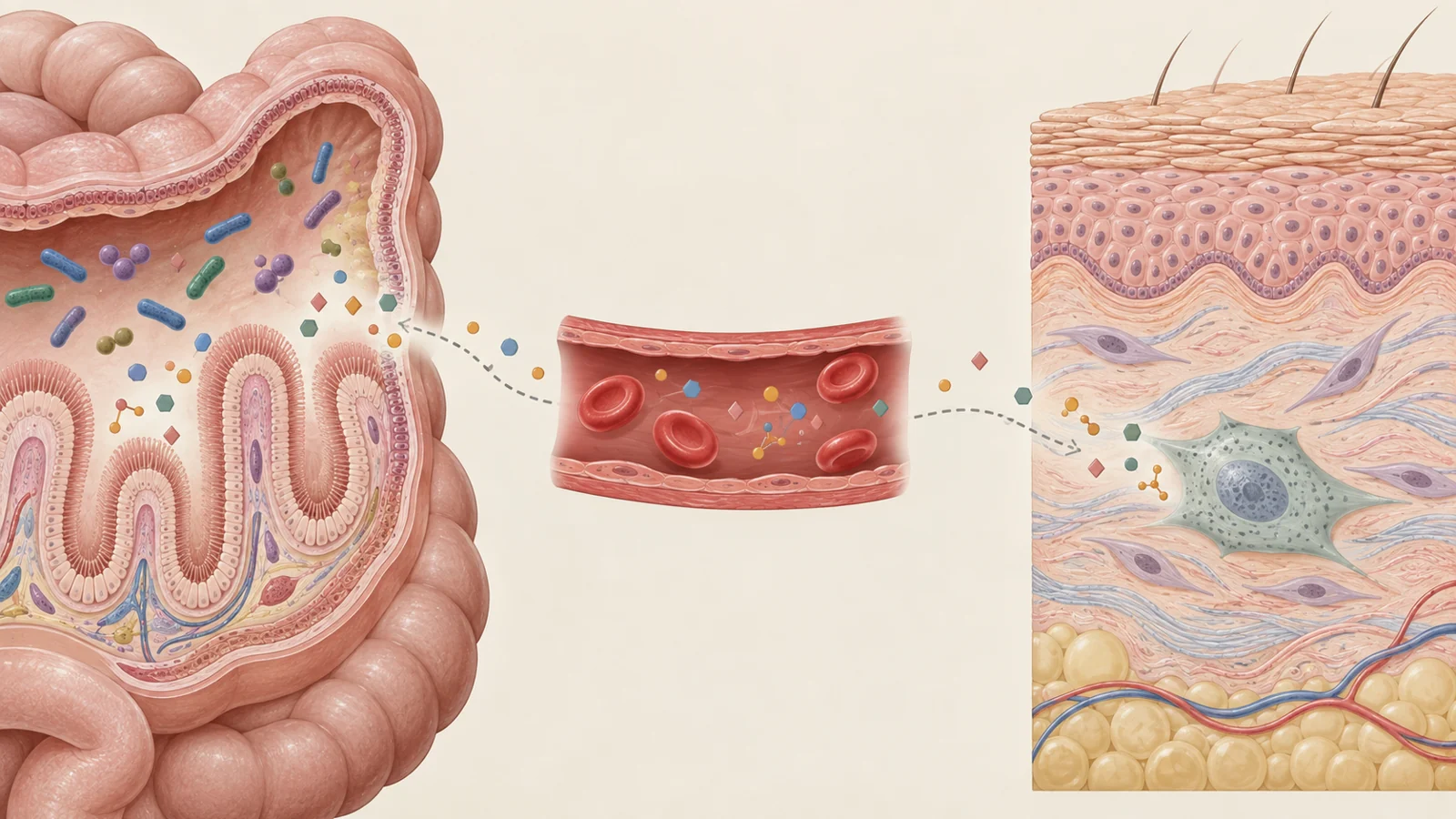
The proposed connection begins with changes in the gut microbial community and the intestinal barrier. Microbial imbalance, often called dysbiosis, can alter the substances microbes produce. When intestinal permeability increases, bacterial products such as lipopolysaccharides can pass into circulation and stimulate inflammatory responses. The authors connect these responses to pathways involved in senescent-cell signaling and immune clearance.
Circulation offers a route by which intestinal changes could affect distant tissues. The review describes microbial metabolites reaching skin and discusses evidence linking some of these substances, including phenols produced from amino acids, to disrupted skin-cell development and barrier integrity. This communication is part of the gut–skin axis, a term for interactions between intestinal biology and skin.
The identity of a chemical alone does not determine its effect. Concentration, destination and dietary context matter. Short-chain fatty acids, produced when gut microbes ferment dietary fiber, participate in maintaining the intestinal barrier and regulating inflammation. Butyrate is one example. Bile acids, which microbes also modify, help with fat absorption and metabolic signaling, yet high concentrations can contribute to cellular stress and damage.
The useful question is therefore what a microbial change makes available to the body, in what amount and where. A shift in bacterial abundance is only one part of that chain. Exposure in the relevant tissue connects microbial activity to a possible effect on skin cells.
Skin aging involves renewal and tissue structure
Skin depends on both a renewing surface and a supporting structure beneath it. Keratinocytes, the main cells of the outer epidermis, help maintain its protective barrier. When these cells become senescent and stop dividing, their ability to replenish the tissue is impaired. The review discusses experiments in which ultraviolet exposure and DNA damage induce this state.
Deeper in the skin, fibroblasts maintain the extracellular matrix—the scaffold that includes collagen and elastin. Senescence can alter that maintenance. Some SASP enzymes belong to a family called matrix metalloproteinases, which break down matrix proteins. Controlled breakdown is necessary for normal remodeling and repair. Persistent excess can disturb the scaffold that gives skin its strength and elasticity.
These mechanisms extend the question beyond wrinkles. A tissue with impaired renewal and disrupted structural maintenance may struggle to preserve its barrier or repair an injury. The review describes senescent fibroblasts in chronic wounds, where prolonged inflammatory signaling is associated with incomplete healing. Skin offers a way to investigate how cell behavior, tissue structure and repair function fit together.
What bacterial compounds and fiber actually changed
The authors distinguish two direct approaches to senescence. Senolytic treatments aim to selectively kill senescent cells. Senostatic treatments aim to modify their secretory activity, including inflammatory signaling. Changing microbial inputs through probiotics or prebiotics is a different proposed route, acting through organisms or the substances they produce.
Probiotics are live microorganisms used for a health benefit; prebiotics provide substrates that beneficial microbes can use. The review’s examples show why the exact intervention and measured outcome matter.
In one experiment it describes, cultured human intestinal cells known as Caco-2 cells received an exopolysaccharide, a sugar-based compound produced by Lactobacillus plantarum HY7714. The reported changes included reduced expression of the inflammatory cytokines IL-6 and IL-1β, along with matrix metalloproteinases. This was an experiment with a bacterial-derived compound acting on intestinal cells. It was not a demonstration that swallowing the bacterium clears senescent cells from human skin.
A second example involved aged mice fed a diet containing 5% inulin, a fermentable fiber, for four weeks. As reported in the review, their gut microbial community changed, and levels of butyrate, acetate and total short-chain fatty acids increased. The study also found lower expression of several inflammatory markers and a more anti-inflammatory profile in microglia, immune cells of the brain, compared with mice fed a low-fiber diet.
These are different interventions, biological settings and outcomes. Together they support investigating whether microbial compounds or fermentable fiber can influence pathways relevant to aging. Reduced inflammatory activity does not by itself demonstrate a smaller burden of senescent cells, younger skin or longer life. Neither example establishes a human treatment dose, a generally effective bacterial formulation or a skin-treatment outcome. The authors’ interest in microbial alternatives also leaves their comparative safety to be demonstrated.
The missing connection is inside the tissue
A separate strand of evidence links microbial composition with senescence markers. The review describes an aged-mouse study in which particular microbial groups correlated with markers such as p16, p21 and inflammatory SASP factors in intestinal tissues. Those associations help identify relationships to investigate, but they cannot determine whether microbes drive senescence, senescence changes the microbial environment, or other processes influence both.
To connect an intervention to a skin effect, researchers would need to follow several linked changes. Did the intervention alter microbial activity? Did that change the chemicals reaching skin? Did those exposures alter senescent-cell abundance or behavior, and did skin function improve? Observations made in different tissues and experiments cannot simply be joined as though one study had demonstrated the entire sequence.
The authors propose metabolomics, the measurement of small molecules in biological samples, as one way to examine the chemical links. Skin contains compounds associated with sweat, sebum, protein breakdown and the fluid between cells, as well as substances arriving from elsewhere in the body. Sampling methods discussed in the review include biopsies, suction blisters and tape strips.
Comparing those chemical measurements with senescence markers and tissue function could help distinguish exposure from biological response. It would also help reveal variation between individuals that a single average might conceal. A changed metabolite profile would still need an interpretation: it could show that a pathway was affected without demonstrating that wound closure or barrier function improved.
What this could change
If researchers can establish how microbial inputs influence persistent senescence in skin, the eventual benefit could reach people whose wounds heal poorly. A treatment that changes damaging secretions or selectively addresses problematic cells could help restore the conditions needed for skin renewal, wound repair and a functioning barrier. The gut–skin connection offers possible intervention points, provided they produce relevant effects in the tissue.
The review also proposes exploring localized treatments, including topical approaches. Effective delivery to an affected area could make it possible to concentrate treatment where repair is failing while limiting unwanted exposure elsewhere. That capability would depend on demonstrating both benefit and safety, including preservation of the temporary senescence responses that assist normal healing. Local application alone does not guarantee either. The practical promise is a more precisely targeted way to recover skin function, contingent on resolving those biological and delivery challenges.
Key Sources
- Primary source: Microbiome and Human Aging: Probiotic and Prebiotic Potentials in Longevity, Skin Health and Cellular Senescence.
DOI or Journal Page · Peer-Reviewed Paper · 2021-12-18
Keep exploring