
Research Signal – Source date 2023-12-21
A membrane made from a flexible polymer separated carbon dioxide from nitrogen more selectively after researchers added porous particles arranged on thin graphene oxide sheets. But the improvement depended on the recipe: the strongest result came at one filler loading, and adding more could bring aggregation or defects that worked against separation.
In pure-gas laboratory tests, the favored membrane reached a CO₂/N₂ selectivity of 76.96, about 197% higher than the unfilled polymer membrane. That is a comparison between fabricated materials, not a measurement of carbon capture from industrial exhaust. The study, published on December 21, 2023, offers a specific design lesson: where particles sit inside a membrane can matter, and more of them is not automatically better.
A polymer membrane with two kinds of filler
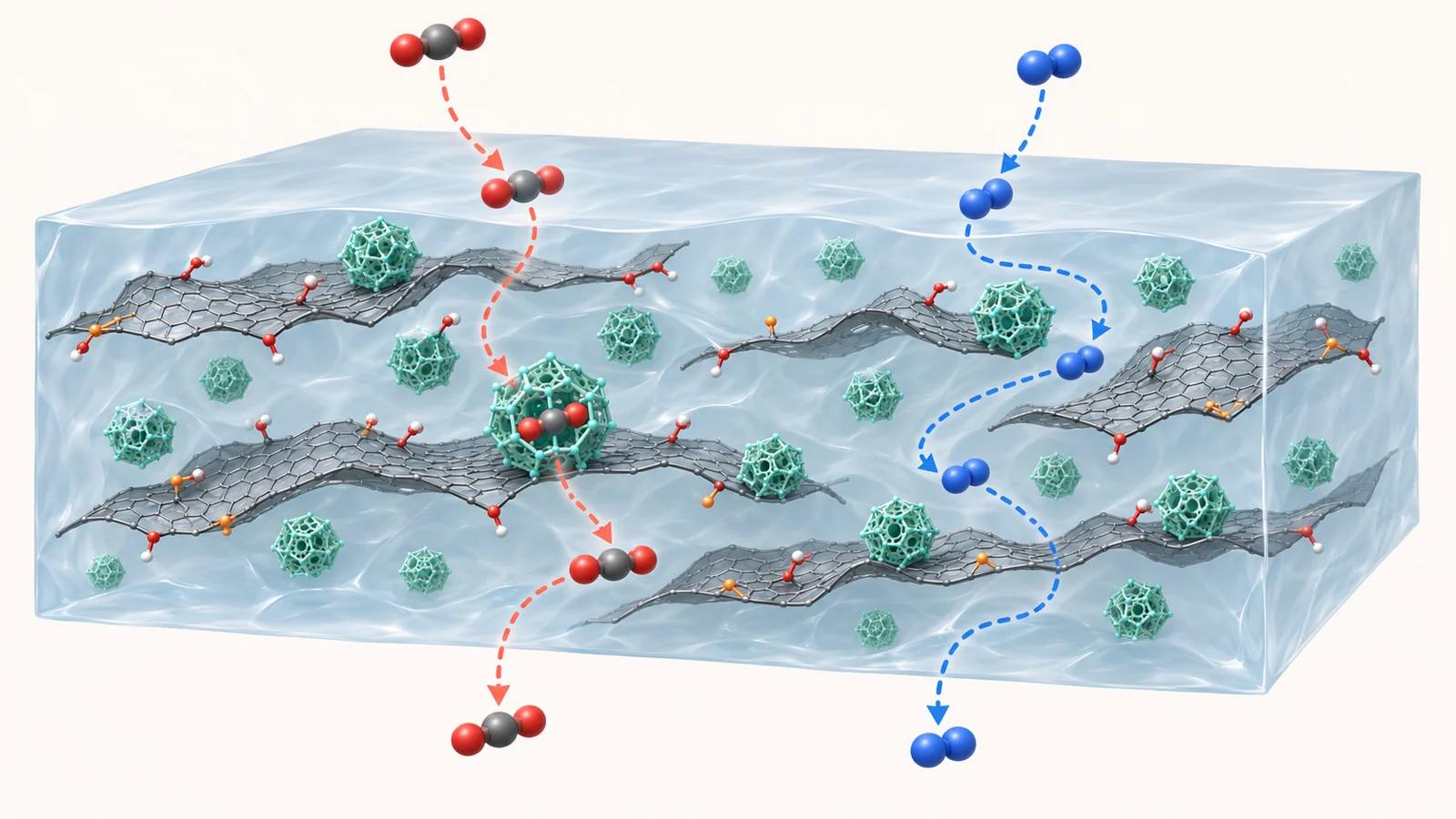
The base material was Pebax 1657, a polymer used to form the membrane. Researchers mixed it with MOF-74(Ni), a porous nickel-based metal-organic framework. A metal-organic framework, or MOF, is a material built with metal-containing nodes and connecting molecules that leave pores. In this study, the pores and exposed metal sites were relevant because they can interact with carbon dioxide.
The team also grew MOF-74(Ni) on graphene oxide, abbreviated GO. Graphene oxide consists of thin, oxygen-bearing carbon sheets. The sheets served as a support for the porous particles before the combined filler was blended into Pebax. The researchers varied the amounts of MOF and GO, then compared the resulting mixed-matrix membranes with unfilled Pebax and membranes containing MOF alone.
That unfilled reference helps show what changed when particles were introduced. Comparing different filler formulations also reveals whether the benefit came from the porous MOF alone or from how the MOF was arranged with GO. The reported best formulation, called MOF-74(Ni)@GO-2, contained 10 wt% filler in the Pebax membrane. Here, 10 wt% means that the filler made up 10% of the membrane mixture by weight.
Sheets helped keep particles spread through the polymer
A porous filler can offer useful sites for gas transport, but clumps and gaps at the boundary between filler and polymer can undermine a membrane. In microscopy, MOF particles added without GO showed signs of aggregation. With the GO-supported material at 10 wt% loading, the membrane appeared more uniform, with no evidence of the same aggregation or defects in the reported images.
The researchers linked this pattern to the way MOF-74(Ni) formed on the layered GO support. They observed smaller, more evenly distributed MOF crystallites in the favored composite. Interactions between the MOF metal sites and oxygen-bearing groups on GO were proposed to help start crystal growth and limit clumping. GO-2 also had the smallest crystal size and highest measured surface area among the GO composites studied.
The practical point is about placement. Dispersed particles can make more of the filler accessible within the polymer, while a poorly integrated boundary can create routes that do not help distinguish one gas from another. The images support a more uniform structure in the favored formulation; they do not by themselves prove exactly how each gas molecule traveled through it.
Carbon dioxide had a more favorable route
The team measured the permeation of pure carbon dioxide and pure nitrogen through the membranes at 25 °C and 2 bar. Selectivity is a ratio describing how much more readily a membrane passes one gas than another. In these tests, a higher CO₂/N₂ selectivity meant the membrane favored carbon dioxide over nitrogen more strongly.
The authors interpret the result through a dissolution–diffusion process: gases first enter the membrane material, then move through it. MOF-74(Ni)’s pores and open metal sites can favor carbon dioxide, while GO’s polar oxygen-bearing groups can interact with it. The porous structure can support transport, and the reported analysis attributed part of the improved selectivity to carbon dioxide dissolving more readily and nitrogen diffusion being restricted. The composite also creates more winding paths through the membrane, which can hinder gas movement; the authors suggest this obstacle affected the larger nitrogen molecules more strongly than carbon dioxide in the favored formulation.
The measurements showed that, as filler content rose across formulations, carbon dioxide permeability generally increased while nitrogen permeability decreased. Those two changes can work together to improve selectivity. Yet the formulation with the highest GO loading had lower carbon dioxide permeability than neat Pebax, which the authors attributed to increased path complexity. The balance between a route that helps carbon dioxide pass and one that obstructs gas movement depends on the membrane’s composition and structure.
The gain had a formulation limit
The 10 wt% MOF-74(Ni)@GO-2 membrane recorded the study’s highest CO₂/N₂ selectivity, 76.96. Compared with neat Pebax, that was a 197.26% increase. The figure is a relative improvement in selectivity, not a percentage of carbon dioxide removed from a gas stream.
Increasing the amount of composite beyond the favorable range did not guarantee a better membrane. The researchers associated loadings above 15% with more aggregation or defects that could reduce selectivity. Separately, the composite made with the highest GO loading had the lowest measured surface area among the GO composites, a result they linked to GO agglomeration and structural distortion. Too much supporting sheet material could therefore compromise the accessible porous structure, while excess composite in the polymer could make the membrane less uniform.
The best membrane approached the paper’s plotted 2008 Robeson upper bound, a cited benchmark for comparing gas-separation membrane performance, but did not surpass it. That gives the result context: the formulation improved on the unfilled Pebax control, while remaining short of the benchmark shown in the study.
What the laboratory tests leave open
The reported permeation tests used pure gases at a fixed temperature and pressure. An exhaust stream contains a mixture, and the supplied measurements do not show how this membrane would perform when carbon dioxide and nitrogen compete in a mixed feed. Nor do they establish how well a larger membrane module would retain its separation performance over time or under dusty operating conditions.
Selectivity in a small membrane comparison also does not determine the energy use, cost, or emissions of a complete capture system. Those outcomes depend on the whole process, beyond the material result measured here. The study demonstrates a promising laboratory formulation and a design principle to investigate; it does not establish a dependable capture module or commercial readiness.
How this could shape the future
A dependable membrane module based on this design could one day help separate carbon dioxide from nitrogen in an exhaust-gas stream before the carbon dioxide is collected. The study’s pure-gas selectivity result and its comparison of filler formulations provide a starting point for that possibility: the supported MOF arrangement favored carbon dioxide in the tested membranes, and the best performance depended on keeping the filler in a useful range. If that advantage holds in a real mixed stream and survives scale-up, the membrane could make that separation more selective than the unfilled Pebax used as the study’s control. It would still take further development to establish reliable operation, and the material result alone says nothing about whether a full capture process would be cheaper or lower-emission.
A meaningful next milestone would be a larger membrane that retains its selectivity and permeability advantage over unfilled Pebax during mixed-gas testing under relevant operating conditions. That would connect this carefully controlled material comparison to the practical job a capture membrane would need to perform.
Key Sources
- Primary source: Graphene-Oxide-Modified Metal-Organic Frameworks Embedded in Mixed-Matrix Membranes for Highly Efficient CO<sub>2</sub>/N<sub>2</sub> Separation.
DOI or Journal Page · Peer-Reviewed Paper · 2023-12-21
Keep exploring