
Research Signal – Source date 2022-05-06
A thin carbon sheet can do more than support a growing crystal. Chemical groups attached to its surface can offer places for the crystal to begin forming, while the sheet itself can restrict the space available for growth. For porous crystals being developed as gas-separation membranes, those influences could help produce a continuous layer with a useful internal arrangement. In other combinations, the added sheet can interfere with the crystal’s assembly and reduce its porosity.
A mini review published on May 6, 2022, examines this relationship between metal-organic frameworks and graphene oxide. Metal-organic frameworks, or MOFs, are porous crystals assembled from metal units and organic linkers. Graphene oxide, or GO, consists of carbon sheets bearing oxygen-containing chemical groups. Those groups give the sheets several ways to interact with the metal-containing structures as they form.
The review brings together earlier studies to ask what determines the outcome. Its examples suggest that attachment chemistry, the framework’s own geometry, and the space available for growth all matter. They also show why adding the same broad class of carbon material does not guarantee the same result across different crystals.
Where a crystal meets the sheet
A graphene oxide sheet is chemically uneven. Its broad faces can carry epoxy and hydroxyl groups, while carboxylic groups occur at its edges. These are different arrangements of atoms containing oxygen, and their interactions with a framework’s metal sites need not be equivalent.
That difference gives attachment a physical location. A growing framework that binds mainly to groups on the sheet’s face encounters a different arrangement of contacts from one that attaches mainly around its edges. Those contacts can influence nucleation—the beginning of a crystal—and its subsequent growth.
The amount of graphene oxide also matters. The review describes systems in which interactions with epoxy groups on the sheet face were important at low or moderate GO loading, while contacts with edge carboxylic groups could become dominant at higher loading. This is a proposed behavior in particular material combinations, rather than a universal recipe for adjusting crystal growth.
The practical implication is that “add graphene oxide” leaves much of the synthesis unspecified. The types of groups available, where they sit, and how much sheet material is present can change the contact between the two components. A composite’s structure therefore depends on more than simply whether carbon sheets were included.
When attachment obstructs assembly
The crystal contributes its own constraints. Metal units have particular bonding arrangements and occupy particular positions in the structure. A sheet attaching to those units must fit into that geometry if the framework is to continue assembling regularly.
For the zinc-based framework MOF-5, the review discusses a relatively uniform coordination environment around the metal centers. In the proposed explanation, this regularity allows different oxygen-containing groups on graphene oxide to interact with the framework while preserving an orderly crystal structure. By comparison, the copper-based HKUST-1 offers nonequivalent attachment positions, which the reviewed work associates with a more disordered composite.
A sharper counterexample comes from MIL-100, a framework with a cage-based structure. The review describes reduced crystallinity and porosity in a MIL-100/GO composite. Its proposed explanation is that the sheets can attach to the framework units in several arrangements, obstructing the assembly of cages into the larger structure.
The distinction matters. Chemical contact between two ingredients can occur even when that contact makes the desired porous architecture harder to build. Here, the observed loss of order and pore space is the result to explain; interference with cage assembly is the suggested mechanism. At very low GO content, the reviewed work did not observe the same detrimental effect, consistent with a reduced chance of multiple sheets obstructing assembly.
These examples make the framework’s geometry part of the design problem. Strong or plentiful attachment is useful only when the growing structure can accommodate it.
Building a membrane beneath a guiding layer
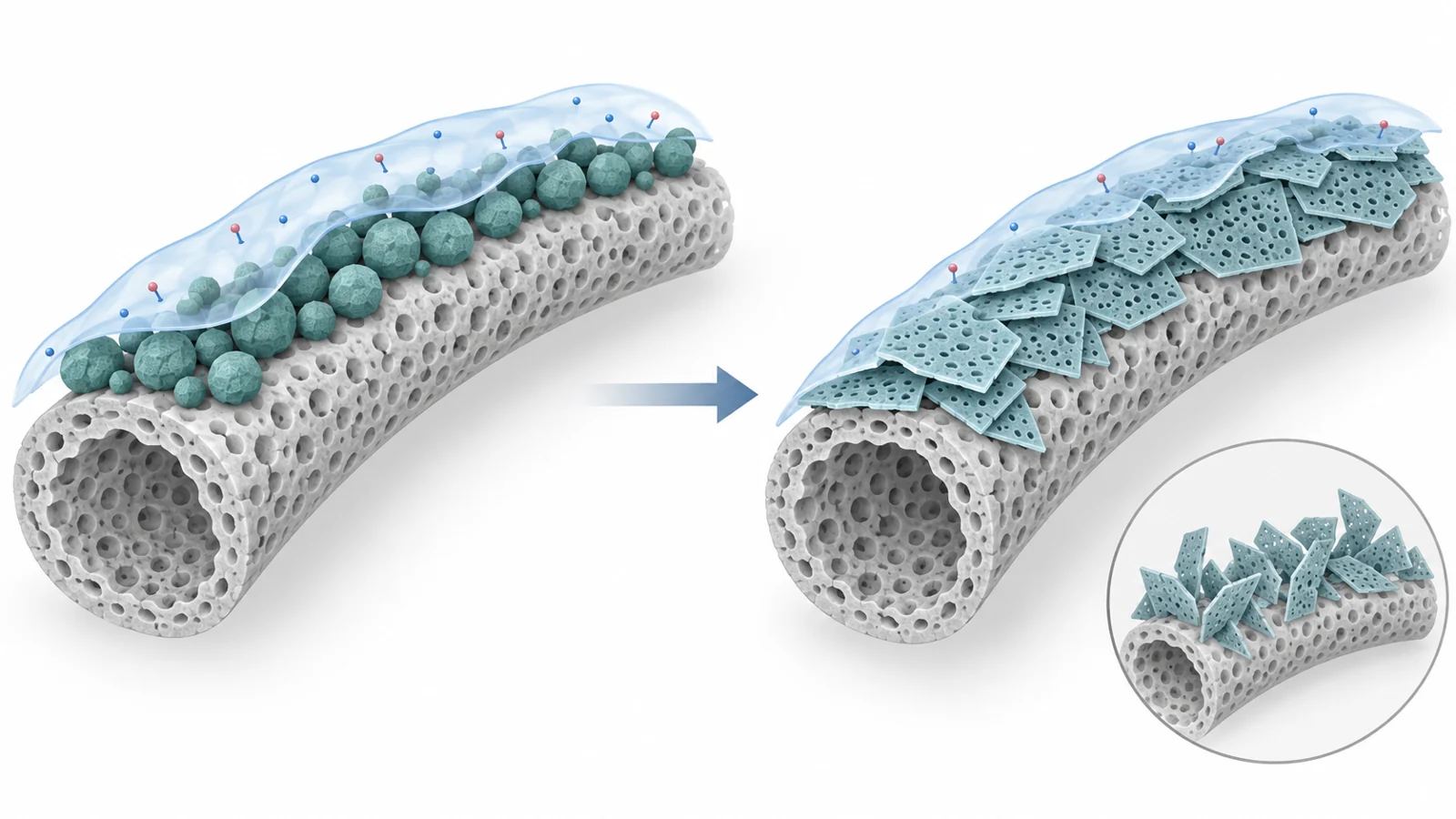
One fabrication route makes the spatial role of graphene oxide especially clear. The review describes a process that begins with a porous tubular support coated with zinc-oxide nanoparticles. These particles provide the precursor material from which the framework will grow.
An ultrathin graphene oxide layer is placed over the particles. The zinc oxide now occupies a narrow region between the support below and the carbon sheet above. Exposure to a solution containing organic linkers converts the precursor into framework nanosheets, which grow together into a continuous membrane.
In the proposed growth sequence, the earliest nanosheets form at the interface between graphene oxide and the upper part of the zinc-oxide layer. Oxygen-containing groups on GO interact with zinc-containing species and linker molecules. The first framework sheets then act as templates as more of the underlying precursor converts.
The restricted space helps explain why the arrangement differs from an unconstrained synthesis. Growth begins beneath a covering layer and proceeds within that confined region, rather than extending freely in many directions. The resulting nanosheets share a preferred crystallographic orientation and intergrow to form the membrane.
The comparison described in the review is revealing. Without the GO covering, zinc-oxide conversion produces randomly oriented nanosheets. With it, the reported membrane is highly oriented. This supports a role for the guiding layer, although the detailed sequence of interface reactions remains a mechanistic interpretation.
The review also raises the possibility that graphene oxide becomes interwoven with the framework sheets and helps remedy some defects between them. That possibility concerns the contacts within the finished membrane as well as the direction in which its crystals initially grow.
Letting hydrogen through while distinguishing it from carbon dioxide
A useful separation membrane has to satisfy two different demands. It must let enough gas pass through to be useful, and it must favor one gas over another. A membrane that strongly discriminates between gases but allows very little passage poses a different problem from one that passes gas readily with little discrimination.
For the GO-guided membrane example, the review reports a hydrogen permeance of 1.4 × 10⁻⁷ mol m⁻² s⁻¹ Pa⁻¹ and a hydrogen/carbon-dioxide separation selectivity of 106.
Permeance describes how much gas crosses a given membrane area per unit time for a given pressure difference. Selectivity describes the membrane’s relative preference for hydrogen over carbon dioxide under the reported test conditions. The selectivity value is not a percentage purity and does not imply that carbon dioxide is completely excluded.
The reviewed study attributes the favorable hydrogen passage to a thin membrane layer of preferentially intergrown crystals, with few defects and fewer pinholes. Those features matter together. The measurements do not isolate crystal orientation as the sole cause of performance, independently of thickness, chemistry, and the quality of the joins between crystals.
The review further describes a 400-hour thermal-stability test involving feed-gas temperatures from 30 to 150 °C, with negligible structural degradation reported. That is a bounded demonstration of stability. It cannot establish an indefinite service life or performance across every mixture and operating condition an industrial membrane might encounter.
Understanding growth and repeating the result
Two separate difficulties remain. One is identifying which mechanism dominates in a particular composite. Surface bonding, metal coordination, and physical confinement may operate together, and their relative importance can change with the materials and synthesis conditions.
The review calls for closer examination of the local interface between graphene oxide and the framework. That is where proposed attachment events must be connected to the structure that actually develops. Detailed interface imaging and characterization could help distinguish competing explanations that lead to similar-looking finished materials. A successful separation test, by itself, does not reveal the full crystallization pathway.
The other difficulty is making intact membranes consistently. A distinct route discussed in the review used ammonia to help regulate the formation of roughly 50-nanometer-thick framework nanosheets with a preferred orientation. Yet some nanosheets had defects and cracks, and the authors highlighted synthesis complexity and concerns about reproducibility.
That example shows why achieving a preferred orientation is only one fabrication goal. Crystals must also join into a sound layer, and the process must produce that layer repeatedly. The separate studies summarized by the review used different materials and methods; their outcomes are not a single standardized comparison of competing membrane recipes.
What this could change
If researchers can reliably combine suitable surface chemistry, compatible crystal geometry, and controlled growth space, these composites could become tailored membranes for separating hydrogen from carbon dioxide in industrial gas processing. Operators handling mixtures of the two gases could use such a membrane to preferentially pass hydrogen into a separate stream.
The path to that capability runs through reproducible fabrication of continuous membranes and sustained separation performance under the intended operating conditions. From the May 2022 perspective, the reported membrane provides a concrete example of the separation behavior that this approach can achieve. Making that behavior dependable beyond a particular preparation and test would turn control over crystal growth into a useful gas-processing capability.
Key Sources
- Primary source: The Growth of Metal-Organic Frameworks in the Presence of Graphene Oxide: A Mini Review.
DOI or Journal Page · Review or Meta-Analysis · 2022-05-06
Keep exploring