
Research Signal – Source date 2025-04-03
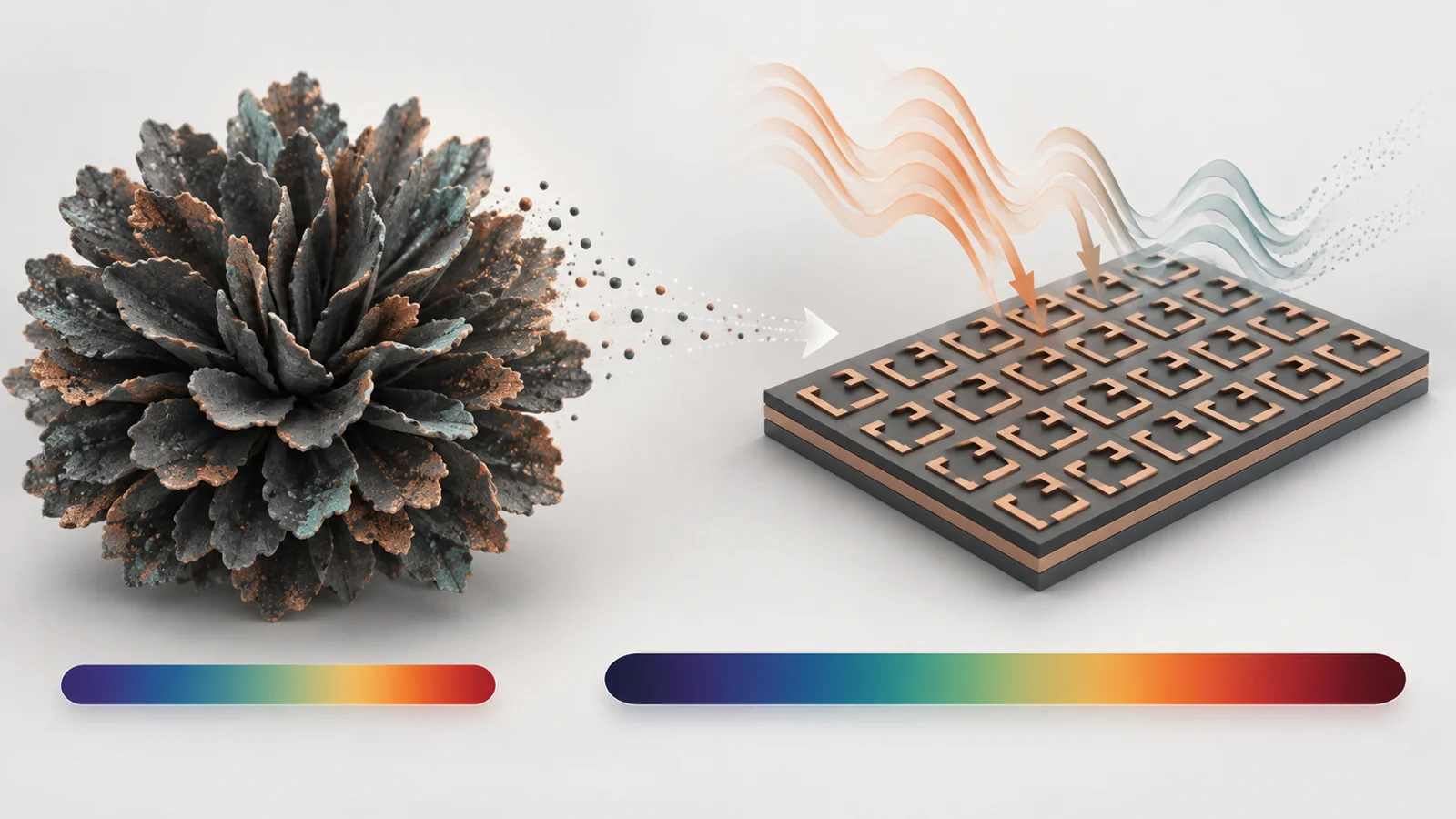
A prepared carbon-based composite and a computer-optimized structure built around it produced two strikingly different microwave bandwidth figures. The flower-like graphdiyne–copper oxide specimen had a reported effective absorption bandwidth of 6.1 GHz at a matched thickness of 2.2 mm. A millimeter-scale metamaterial using that composite was reported to span 34.1 GHz in 3D electromagnetic simulations across the 2–40 GHz range. The latter is a modeled design result, not a second physical test of the specimen.
A carbon material shaped into nanowalls
Graphdiyne is a member of the carbon material family. The researchers combined it with copper oxide to make a flower-like composite with a nanowall structure, using a one-step microemulsion method. The design draws on graphdiyne’s chemical bonds, extended conjugated systems and charge-carrier mobility, features the authors identify as promising for microwave absorption.
The reported performance belongs to the composite specimen labeled GDY@Cu2O-700. Its effective absorption bandwidth was 6.1 GHz at a matched thickness of 2.2 mm. Separately, the specimen’s minimum reflection loss was −49.9 dB at 17.7 GHz. That minimum is a value at one frequency; it is not another bandwidth measurement.
The proposed role of heat and polarization
The authors attribute the absorption behavior to two effects working together: temperature-mediated enhancement of electron transport and induced multipolarization. In their explanation, better electron transport and polarization responses help the material interact with incoming microwaves. The abstract presents this as the proposed performance mechanism; it does not provide enough detail here to quantify each effect’s contribution separately.
The specimen measurements and the later design step concern different objects. The 6.1 GHz figure describes the prepared composite under a stated matched thickness. For the broader result, the researchers used the composite as the functional absorbing component in a millimeter-scale metamaterial, then optimized the structure with 3D electromagnetic simulation software. The simulated design showed a 34.1 GHz effective absorption bandwidth within 2–40 GHz.
What the broader result can establish
The 34.1 GHz span indicates that the modeled arrangement could produce a broad response in simulation. It does not show that a fabricated version physically absorbs across that range. The supplied abstract does not establish a physical absorption test of the patterned metamaterial corresponding to the simulated result.
Nor can the difference between 6.1 and 34.1 GHz be assigned to patterning alone: the numbers describe a prepared specimen and a separately simulated structure, evaluated in different contexts. The abstract also does not establish durability, manufacturability or performance in an operating product. Physical validation of the patterned design would be needed before treating its modeled bandwidth as demonstrated absorber performance.
What a wider microwave absorber could enable
If a fabricated and physically tested design preserves the broad response predicted in simulation, one engineered absorbing surface could help designers manage unwanted microwave reflections across multiple frequency bands. That capability could simplify some designs that need to address a wide span of frequencies, but the practical benefit depends on the modeled result holding up in a real structure.
Key Sources
- Primary source: Multidimensional Co-Design and Performance-Mechanism Study of Novel Graphdiyne Composites with Microwave Absorbing Structures.
DOI or Journal Page · Peer-Reviewed Paper · 2025-04-03
Keep exploring