
Research Signal – Source date 2021-07-27
Cancer immunotherapy depends on getting the immune system to recognize and attack malignant cells. The medicines involved can be powerful, but they may also be difficult to control once they enter the body. The review published on July 27, 2021, in the International Journal of Molecular Sciences describes instability, rapid clearance, loss of biological activity during circulation and unwanted immune effects as reasons researchers are investigating delivery carriers.
Gold nanoparticles, or GNPs, are tiny engineered gold particles that can carry molecules on or within a designed surface. Their appeal is not simply that they are small. Researchers can vary their size, shape, surface charge and coating, attach different biological cargoes, and in some designs use their interaction with light. The goal is to influence where an immune-active treatment travels, how long it remains available and which cells encounter it. Each of those choices also changes how the body handles the carrier itself.
Why an immune treatment might need a carrier
An adjuvant is an immune-response enhancer that helps increase the strength, onset or duration of a response to an antigen. An antigen is a molecular target that immune cells can learn to recognize. In a cancer vaccine, for example, the antigen provides information about what to attack while the adjuvant helps create the conditions for a stronger response.
Administering those components directly can create practical problems. A cargo may degrade before it reaches the relevant immune cells, disappear from circulation quickly or produce effects in places where they are not wanted. A particle can be designed to keep an antigen and an adjuvant together and bring them to the same antigen-presenting cell. It can also provide a surface for several molecules or be modified to favor interaction with particular tissues or cells.
That makes delivery a biological problem, not merely a transport problem. Depositing a drug in a tumor does not automatically mean that the immune system has received the right signal. The cargo must remain usable, reach an appropriate cell, and participate in a sequence of uptake, processing and recognition. The review presents GNPs as one way to engineer that sequence, while also describing why the carrier may add new variables of its own.
From a gold surface to a T cell
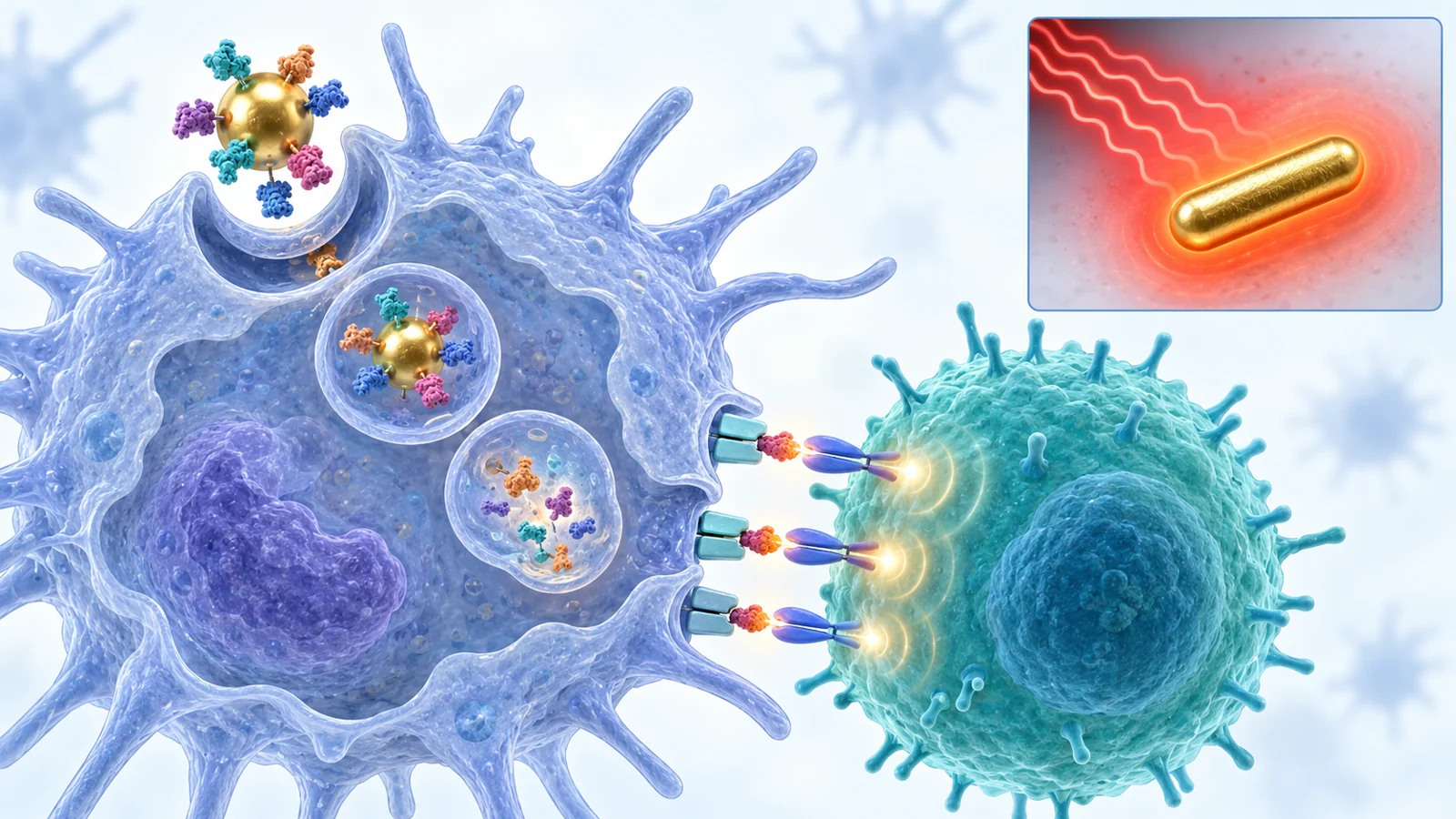
The reviewed gold nanovaccine experiments illustrate the intended chain of events. Tumor-related peptide antigens can be attached at high density to a gold particle. A dendritic cell can take up the particle, process the peptide cargo and present antigen-associated information through its immune machinery. That presentation can help activate cytotoxic T cells, which are the immune cells expected to recognize and kill cells displaying the relevant target.
One reported formulation used particles smaller than 80 nanometers and achieved about 90 percent peptide conjugation. In the experiments described by the review, dendritic cells ingested the particles with low toxicity, processed the vaccine peptides and triggered cytotoxic T-cell responses. The high-density presentation activated those T cells faster than free peptides in the cited work. These findings make the particle surface part of the vaccine design: it can determine how much antigen is presented together and how immune cells encounter it.
Other designs combine an antigen with a material that helps direct uptake. The review describes a gold-particle vaccine containing hyaluronic acid and ovalbumin. Chemical interactions with the gold surface supported uptake by dendritic cells through receptor-mediated endocytosis. Near-infrared irradiation was then used to help regulate cytosolic antigen delivery. The formulation was associated with antigen-specific CD8-positive T-cell responses in the reported experimental setting.
Those examples are not interchangeable demonstrations of one universal platform. They involve different cargoes, surface chemistries and experimental systems. Their common idea is narrower and more useful: a gold particle can be built to place immune information in the path of an antigen-presenting cell, where delivery and immune activation can be studied as connected steps.
When light becomes part of the treatment
Some gold structures absorb near-infrared light and convert part of that energy into heat. Gold nanostars are highlighted in the review because their branched geometry can increase light absorption and photon-to-heat conversion. Nanorods and other gold structures are also discussed in systems that use irradiation as an external trigger.
Light can therefore add a timing or location control to an experimental formulation. In the hyaluronic-acid and ovalbumin example, near-infrared exposure was used alongside antigen delivery. In another study summarized by the review, bovine-serum-albumin-coated gold nanorods were taken up by breast tumor cells and irradiated with a near-infrared laser. The particles converted light efficiently and ablated tumor cells under the reported cell-culture conditions.
Heat-induced killing and immune activation are related possibilities, but they are not the same measurement. Destroying tumor cells with heat may release material that immune cells can encounter, yet the observation of cell death alone does not show that a durable, tumor-directed immune response has followed. Likewise, an antigen-delivery system that activates T cells in an experiment does not automatically establish that an externally illuminated version will work in a patient. The light source, particle design, cargo and biological setting all remain part of the result.
The separate roles matter because a single illustration of a gold particle, immune cargo and laser can easily suggest one integrated treatment that the reviewed studies did not test as one standardized formulation. The review instead assembles several approaches in which delivery, heating, imaging and immune stimulation may be combined in different ways.
An image can show delivery before it shows benefit
A reviewed colon-cancer mouse study shows why imaging can be attractive in this field. Researchers attached an anti-PD-L1 antibody to gold nanoparticles and used non-invasive measurements to observe how much of the particle material accumulated in tumors. The review reports that this imaging information helped predict treatment response within 48 hours of treatment in that mouse model. It also reports that the antibody-bearing particles inhibited tumor growth at one-fifth of the standard treatment dose in the described experiment.
These are three related but distinct observations. Imaging showed where the particles accumulated. The accumulation pattern was used as an early indicator associated with response. The tumor-growth result was a separate treatment outcome in mice. Keeping those observations apart prevents a useful imaging capability from being mistaken for proof that every particle reaching a tumor has produced effective immune activation.
The study is valuable as an example of a carrier that may be visible while it is being used. A clinician could eventually want to know not only whether a treatment was administered, but whether a formulation reached the intended tissue and whether that delivery pattern is associated with a response. In the evidence summarized here, however, the observation belongs to the reviewed colon-cancer mouse experiment. It does not establish a general result for gold-bound checkpoint treatments or for patients.
Clinical results for conventional checkpoint medicines mentioned in the review cannot supply that missing evidence. A formulation that places an antibody on a gold particle may behave differently from the unbound antibody, and results from one mouse model cannot settle questions about human dosing, durability or safety.
The carrier is part of the biology
A gold nanoparticle is not an invisible container. Its size, shape, charge and coating can influence blood clearance and organ accumulation. The review notes that gold particles unavoidably accumulate at high concentrations in the liver and spleen in many in-vivo settings, making their interactions with the immune system an important part of the design problem.
The effects may also vary with particle size. The review describes experiments in which gold nanoparticles stimulated pro-inflammatory cytokine expression in macrophages in a size-dependent manner. Other studies identified effects that could block interleukin-1-mediated inflammation or Toll-like receptor 9 responses, also depending on size. These observations do not point to a simple rule that gold is either immune-neutral or inherently immune-stimulating. They show that the formulation can influence the immune environment alongside the cargo it carries.
This creates a tradeoff for engineering. A coating might improve circulation or help a particle interact with a target cell, while changing how the liver, spleen or immune cells recognize it. A shape that absorbs light efficiently may be useful for localized heating, while its distribution and clearance still require evaluation. A high payload may make antigen presentation more efficient in one experiment without resolving what happens to the rest of the formulation after administration.
The review concludes that particle–immune-cell interactions, stability, biocompatibility and dose selection require further investigation. It also emphasizes the challenge of directing conjugates toward tumors while minimizing accumulation in the reticuloendothelial system. These are not minor refinements after the main treatment has been proven; they help determine whether the intended delivery mechanism remains useful in a living body.
What gold carriers could change in cancer treatment
From the July 2021 perspective, gold carriers could eventually make immune treatment more coordinated at the cells where it is needed. A formulation might deliver an antigen, adjuvant or checkpoint-related cargo more selectively, while imaging could help reveal delivery and localized heating could be added where the design and treatment setting support it. The potential patient benefit would depend on achieving useful tumor targeting, manageable accumulation in organs such as the liver and spleen, stable formulations and demonstrated benefit in patients. The reviewed laboratory and mouse findings describe promising capabilities, but they leave those conditions open rather than resolved.
Key Sources
- Primary source: Design and Encapsulation of Immunomodulators onto Gold Nanoparticles in Cancer Immunotherapy.
DOI or Journal Page · Review or Meta-Analysis · 2021-07-27
Keep exploring