
Research Signal – Source date 2022-03-31
Breast cancer treatment can remove or damage a visible tumor, but recurrence remains a central challenge. Immunotherapy adds a different ambition: help the immune system recognize cancer well enough to respond again later. A mini review published on March 31, 2022, described how gold nanoparticle platforms might support both goals. The review summarizes laboratory and animal research; it does not report a patient outcome showing that these approaches prevent recurrence or create durable clinical protection.
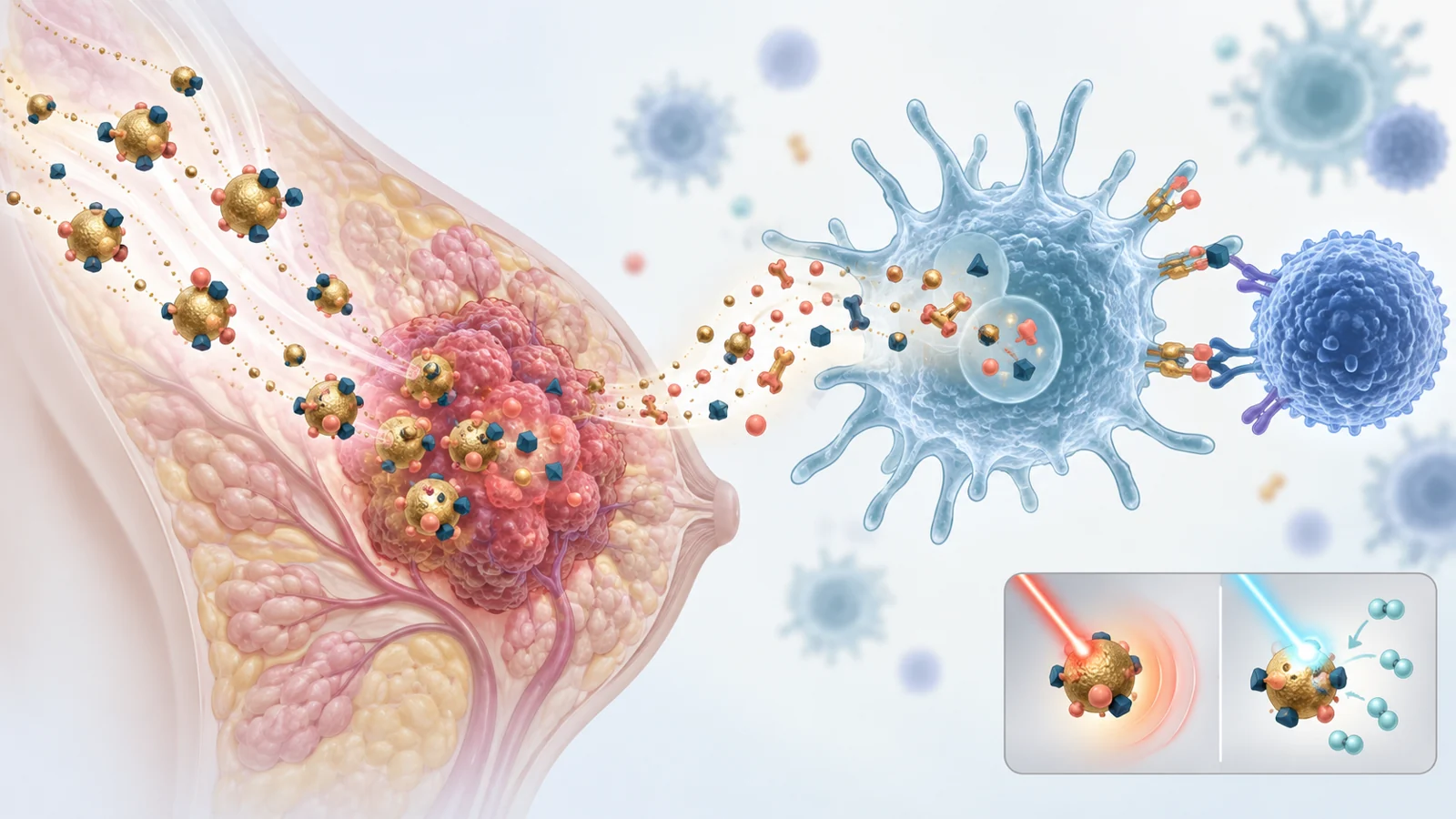
Gold nanoparticles are particles measured in billionths of a meter. Their surfaces can be modified so they carry therapeutic molecules, while their physical properties can also be used during radiation or light-based treatment. These are related but distinct roles. In one, gold acts mainly as a delivery vehicle. In the other, damage to tumor cells may release material that gives immune cells something to recognize.
Gold can change what a treatment cargo does
A nanoparticle can provide a surface to which a drug, peptide, genetic material, or other compound is attached. The review describes this as useful for cargo that is unstable, rapidly cleared, or otherwise difficult to keep available in the body. Surface modifications can also influence where the particle and its cargo distribute, although the biological behavior depends on the details of the formulation.
One example involved Ganoderma lucidum polysaccharide, or GLP, which the review describes as having immune-modulating effects on dendritic cells. Free GLP was limited by low prescribed doses and rapid clearance in the context discussed. When gold nanoparticles carried the polysaccharide, the formulation extended its half-life in blood and increased its accumulation in immune organs in the reported study. In laboratory testing, the gold-carried GLP produced stronger dendritic-cell activation and T-cell responses than free GLP.
The same research also examined the formulation with doxorubicin in a 4T1 mouse tumor model. The combination with gold-carried GLP produced stronger inhibition of tumor growth and pulmonary metastasis than the corresponding combination with free GLP. That result links cargo persistence and immune-cell activity with a tumor outcome in a particular experimental setting. It does not isolate gold as the sole cause, establish that the same effect would occur in people, or turn the example into a general estimate of benefit.
How damaged tumor cells can become more visible
Immunogenic cell death means cell death that can provoke immune recognition. The relevant question is not only whether a treatment kills tumor cells, but also what biological information becomes available as those cells die.
The review describes radiation and some light-based treatments with gold nanoparticles as ways to increase this kind of signal. Dying tumor cells can release tumor antigens along with danger-associated signals such as ATP and HMGB1, while calreticulin can appear in a way that helps mark the cells for uptake. Antigen-presenting cells, including dendritic cells and macrophages, can respond to these signals, take up tumor material, and present antigens to T cells. The resulting sequence is a proposed route from local tumor damage to broader immune recognition.
This immune contribution is different from direct tumor killing. It is also different from the carrier function described above. A gold particle may help deliver an immune-active cargo, or a treatment involving the particle may damage tumor cells in a way that engages antigen-presenting cells. In some strategies both functions are combined, but the immune pathway still depends on what happens in the tumor and how the host immune system responds.
Three ways gold can amplify physical treatment
Radiation, photodynamic therapy, and photothermal therapy use different physical routes.
With radiation, gold can act as a radiosensitizer. The review links this effect to gold’s high atomic number and describes research in which gold formulations increased local radiation effects and reactive oxygen species. In one reported example, attaching trastuzumab to polyethylene-glycol-coated gold nanoparticles enabled uptake into SK-BR-3 breast cancer cells and produced more DNA double-strand breaks than radiation alone or radiation with the coated particles without the targeting attachment. The review also describes a mouse study in which 14-nanometer gold nanoparticles enhanced radiation efficacy and were associated with immunogenic cell death and greater macrophage infiltration in an MDA-MB-231 model.
Photodynamic therapy uses light, a photosensitizing system, and oxygen to generate reactive oxygen species that can damage nearby tumor cells. Oxygen availability is therefore a concrete boundary for this route. The review notes that a hypoxic tumor environment can reduce photodynamic effectiveness and suppress immune activity. It describes an oxygen-generating gold nanocage with a manganese dioxide shell studied in a 4T1 mouse model. Under the acidic conditions described for that tumor setting, the shell could produce oxygen and support an immunogenic photodynamic effect. This is an illustrative mouse result, not evidence that the oxygen problem has been solved for breast cancer patients.
Photothermal therapy follows a different path. Gold nanoparticles absorb near-infrared light and convert the absorbed energy into heat, which can destroy nearby tumor cells. The review describes the possibility that heat shock proteins released during this process may associate with tumor peptides and support their uptake and presentation by antigen-presenting cells. The proposed immune benefit again follows the treatment-induced damage, rather than arising simply because gold is present.
More targeting molecules can produce a worse design
Gold surfaces can be linked to antibodies such as trastuzumab to encourage attachment to breast tumor cells. A reviewed experiment showed why surface engineering cannot be judged by counting targeting molecules alone. In laboratory tests, particles carrying two antibodies appeared to have higher targeting efficiency. In the mouse study, however, particles carrying one antibody per particle produced the best tumor homing and longer therapeutic effect.
The review proposes steric hindrance as one explanation: a crowded particle surface may make it harder for an antibody to reach its target. The example does not identify a universally optimal antibody density. It shows that a design that performs well in cells can behave differently in an animal, and that additional targeting molecules may interfere with access rather than improve it. Particle size, shape, charge, coating, and surface chemistry can all alter biological behavior, so targeting has to be optimized for the particular formulation and setting.
Favorable properties still leave a safety question
Gold is attractive for these platforms because it is durable under physiological conditions, can be modified in many ways, and offers optical and physical properties useful for delivery and treatment. Those advantages do not make every gold nanoparticle interchangeable or automatically safe.
The review discusses conflicting toxicity findings and connects biological effects to formulation features including size, shape, surface charge, coating, surface chemistry, and contaminants. A modification that improves delivery or targeting may also change how the body handles the particle. Each added component therefore requires renewed pharmacological and toxicological assessment. This is a substantive translation issue, alongside the challenge of producing an immune response that remains useful beyond the treated tumor.
The reviewed examples come from different particles, cargoes, therapies, models, comparators, and endpoints. Their results cannot be combined into one efficacy estimate. Laboratory immune activation and tumor effects in mice are encouraging signs of feasibility, but they do not establish patient survival, recurrence prevention, or durable clinically useful immune memory. Nor do approved nanomedicines or unmodified trastuzumab establish readiness for the gold combinations described here.
What this could mean for breast cancer recurrence
The potential patient benefit is a treatment that attacks an existing breast tumor while also helping immune cells recognize cancer that remains or returns. Gold particles could contribute by carrying an immune-active therapy, by concentrating or protecting its cargo, by amplifying tumor damage, or by helping that damage produce signals for antigen presentation.
That possibility depends on two conditions that the 2022 research direction had not yet resolved: the immune recognition would need to become durable and clinically useful, and the particular gold formulation would need to show acceptable safety. The mini review supports a scientifically plausible route toward those goals, not an observed reduction in recurrence or a prediction that protection will follow on a set timetable.
Key Sources
- Primary source: Harnessing the Immunogenic Potential of Gold Nanoparticle-Based Platforms as a Therapeutic Strategy in Breast Cancer Immunotherapy: A Mini Review.
DOI or Journal Page · Review or Meta-Analysis · 2022-03-31
Keep exploring