
Research Signal – Source date 2026-06-18
A sugar-chain particle can do more than carry a drug. Depending on its structure, it may also be recognized by immune cells—or be modified to deliver cargo to them. That combination has drawn interest in cancer research, where tumors can evade immune attack and treatments that stimulate immunity may also cause unwanted effects elsewhere in the body.
A review published on June 18, 2026, surveys how glucan-based nanoparticles are designed to deliver tumor antigens, immune stimulants, and drugs, and how researchers hope to use them to reshape the immune environment around tumors. Its central materials have different jobs: β-glucan can engage immune-recognition receptors, while dextran is often used as a chemically adaptable carrier. The distinction matters when interpreting the evidence, which ranges from cell and animal studies to clinical uses of glucan formulations that were developed for other purposes.
One family of materials, two different starting points
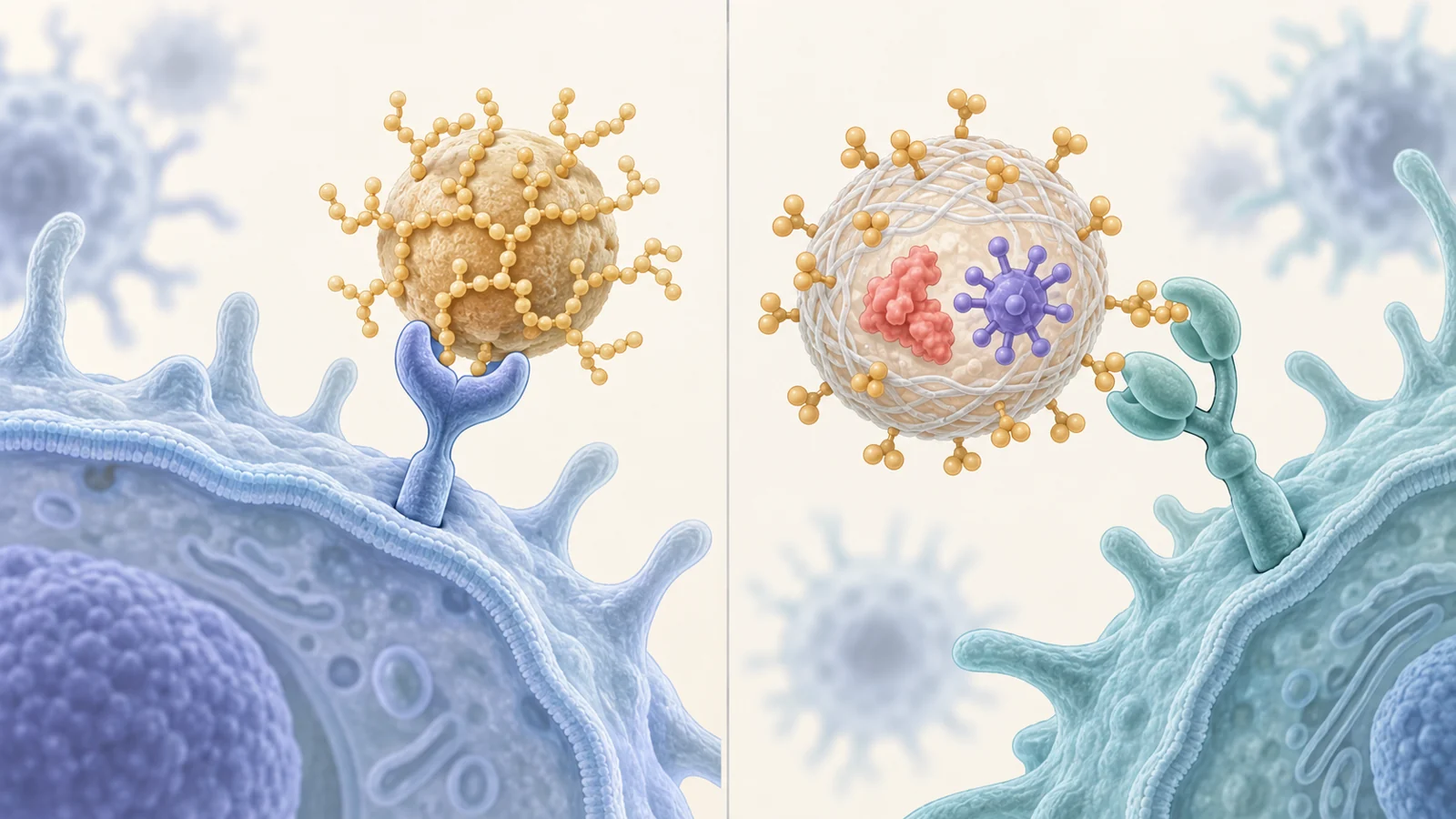
Glucans are chains of sugar molecules. β-glucan and dextran are both glucans, but their immune behavior is not interchangeable. β-glucan can bind receptors such as Dectin-1 on macrophages and dendritic cells. These cells help detect threats and coordinate immune responses. Receptor engagement can activate signaling that prompts immune cells to release inflammatory messenger molecules.
The response may also leave a longer-lived imprint on innate immune cells. The review describes research in which β-glucan exposure changes how immune-related genes are organized and expressed, a process called trained immunity. The term refers to a memory-like change in innate cells, which are generally understood to respond quickly rather than recognize a specific tumor target in the way T cells can. Particle size can affect receptor engagement, so the material’s name alone does not predict how a particular formulation will behave.
Dextran, an α-glucan, is generally a more chemically modifiable scaffold. Native dextran does not bind Dectin-1 in the way β-glucan does, and antigen-presenting cells can take it up through general cellular uptake. Engineers can attach other molecules to change where it goes. For example, adding mannose can direct modified dextran toward CD206, a mannose-recognizing receptor found on some antigen-presenting cells. In this design, the targeting cue comes from the added mannose, not from dextran acting like β-glucan.
Getting antigen and immune cues into the same cell
An antigen is a molecular feature that immune cells can learn to recognize. For a T cell to respond to a tumor antigen, an antigen-presenting cell—often a dendritic cell—must process and display it. Delivery particles offer a way to bring an antigen and an immune stimulant into the same cell, so the recognition cue and the activation cue arrive together.
Some reviewed designs aim to promote cross-presentation: the display of delivered material through a pathway that can activate CD8-positive T cells, which can recognize and kill cells displaying a matching target. At the same time, an adjuvant carried in the particle may activate pathways such as Toll-like receptor or STING signaling in the antigen-presenting cell. In research systems, that coordinated delivery can increase signals needed for T-cell activation. It is a design strategy for improving the handoff from antigen capture to a targeted immune response, not evidence that every antigen or adjuvant combination will work in people.
Particle structure can also determine when cargo is released. One approach uses chemical bonds that are more likely to break in acidic conditions. Tumor tissue can be mildly acidic, and intracellular compartments such as lysosomes are more acidic still. An acid-sensitive carrier may therefore release a drug or immune cue after reaching a target tissue or cell. But acidity is not unique to tumors, and a formulation that releases cargo too early could lose its selectivity or safety margin.
Other designs respond to enzymes in the tumor environment. Their usefulness depends in part on whether the relevant enzyme is present at the needed level, which can vary among tumors and patients. Combining multiple triggers may improve control in principle, but it also makes it important to understand how those triggers interact and whether the particle remains stable while circulating.
Delivery has to contend with local immune suppression
Even a well-delivered antigen may not be enough if the tumor environment keeps immune cells switched into suppressive roles. Tumor-associated macrophages, or TAMs, are one part of this local network. Some TAMs can support tumor growth and dampen immune activity; regulatory T cells, or Tregs, can also restrain immune responses.
The review describes approaches intended to shift macrophages away from an M2-like suppressive state toward an M1-like inflammatory state. In the studies discussed, M1-like macrophages can produce signals such as IL-12 and TNF-α that support effector T-cell activity. Changing macrophage behavior may also weaken signals that help recruit or sustain Tregs, including CCL22, IL-10, and TGF-β. The aim is to alter the local conditions in which T cells operate, alongside delivering antigens or drugs.
These are interacting parts of a tumor’s immune environment, not a single switch. A carrier may deliver a useful combination and still face differences in tumor biology, immune-cell composition, or material behavior. This is one reason a promising mechanism in a model does not by itself predict a reliable response across patients.
What animal results can—and cannot—show
The review summarizes varied animal studies in which dextran-based particles improved drug delivery or tumor control. One specific comparison used epirubicin-loaded dextran nanoparticles in a patient-derived ovarian cancer xenograft model in mice. Five days after treatment, the reported tumor growth inhibition was 70% with the particle formulation and 40% with free epirubicin.
That is a result from a mouse model, not a clinical outcome. It suggests that changing how a drug is carried can affect its performance in a tumor model, including one derived from a patient’s tumor. It does not establish a dose for people, the size or durability of a human benefit, or whether the same formulation would work across ovarian cancers.
Safety also belongs in the same assessment as efficacy. The review notes animal studies that found no significant weight loss or major-organ tissue damage with some glucan-based formulations. It also describes an epirubicin-loaded dextran study that ended early because of severe adverse effects. A carrier may alter drug distribution and improve an experimental result without removing the drug’s systemic risks. The material, its chemical modifications, the cargo, and how the formulation behaves in the body all matter.
Clinical uses answer different questions
The human studies surveyed in the review include two categories that should not be conflated with engineered nanoparticles designed to reprogram tumor immunity. Some investigate oral β-glucan as an immune adjunct—for example, in combination with anti-GD2 therapy in high-risk neuroblastoma or as part of vaccine approaches. These studies address whether an immune-stimulating preparation can be used alongside another intervention and what immune or clinical observations follow. One reported rise in anti-GD2 antibody levels did not translate into significant progression-free or overall survival benefits.
A separate group of clinical applications uses dextran-based agents for lymph-node tracing. Tc-99m tilmanocept, for instance, is a dextran backbone modified with mannose and a chelating group. It is designed to help identify lymph nodes by targeting cells that take up the tracer. The trials summarized in the review focus on tasks such as sentinel lymph-node detection, imaging, and procedural feasibility—not on treating a tumor by delivering an immune-stimulating payload.
These uses show that β-glucan preparations and dextran-based tracers have reached clinical settings for distinct reasons. They do not establish that a newly engineered glucan nanoparticle can safely deliver antigen and adjuvant, remodel a tumor’s immune environment, or improve cancer outcomes. The clinical examples are relevant context for the materials, but their purposes and endpoints differ from those of an immune-delivery therapy.
The engineering challenge is consistency in the body and at scale
A particle must retain its structure long enough to reach the intended place, release cargo at the right time, and avoid harmful effects from the material or its payload. Surface coatings such as polyethylene glycol can reduce unwanted recognition and clearance, but too much coating may also interfere with targeting or immune activity. Crosslinking can strengthen a particle, while some crosslinking agents or excessive crosslinking may create toxicity or slow degradation.
Manufacturing adds another constraint. Dextran’s properties can vary with its source, purity, molecular weight, branching, and particle size. Chemical attachment can also be difficult to control consistently because parts of the sugar chain react differently. A formulation that performs well in a small laboratory batch may be hard to reproduce at larger scale. Long-term safety and the standards used to characterize and regulate complex formulations also remain part of the translation challenge.
Finally, animal physiology does not reproduce the human tumor environment or drug-clearance patterns exactly. A particle’s distribution, breakdown, and immune effects in mice cannot simply be carried over to people. Progress therefore depends on showing that the material can be made consistently, behaves predictably in the body, and produces useful immune effects without unacceptable toxicity.
How glucan particles could sharpen cancer immunotherapy
If those challenges can be solved, glucan-based particles could give cancer researchers a way to coordinate several steps that are often difficult to control together: delivering tumor-recognition material, activating the cells that present it, and changing suppressive signals near the tumor. For patients, the potential payoff would be more precisely targeted immune treatments that work with a tumor’s biology while limiting unwanted effects elsewhere. The review describes a research direction toward that capability; the clinical examples it surveys do not yet demonstrate that an engineered glucan immunotherapy delivers it.
Key Sources
- Primary source: Glucan-Based Nanoparticles Empower Precision Cancer Immunotherapy: Design Strategies, Immune Reprogramming Mechanisms, and Clinical Translation Prospects.
DOI or Journal Page · Review or Meta-Analysis · 2026-06-18
Keep exploring