
Evidence date · 2021-08-02 · Research note 1 of 2
1 2
See current Track status →
A mouse can carry the genetic disruption behind a severe childhood disorder and still perform many laboratory tasks much like an unaffected mouse. For researchers studying guanidinoacetate methyltransferase deficiency, or GAMT deficiency, that creates a difficult question. How much can an animal reveal about a developing brain when its most obvious problems differ from those described in children?
A review published in Genes on August 2, 2021, examines this puzzle. In reported human cases, GAMT deficiency can involve severe developmental delay, intellectual disability, epilepsy, movement disorders, and especially pronounced difficulties with language. Mice whose GAMT gene has been disabled reproduce the characteristic chemical disturbance, yet the behavioral studies discussed report comparatively mild and selective changes.
The paper brings together existing mouse experiments and clinical reports. Its contribution is an assessment of what has actually been measured and what remains unexplored. That distinction matters for treatment research. A useful model must offer researchers a way to interpret whether changing a biological process could improve an outcome that matters to patients.
A blocked step in the brain’s energy buffer
GAMT is an enzyme that converts guanidinoacetic acid, usually shortened to GAA, into creatine. When the enzyme is missing, its starting material accumulates while creatine becomes depleted. The resulting disorder therefore has two linked features—too much GAA and too little creatine. GAA accumulation is also implicated in harmful effects on the nervous system.
Creatine helps cells manage energy through its partnership with phosphocreatine and the enzyme creatine kinase. This system buffers and transfers high-energy phosphate groups, helping regenerate ATP, the molecule cells use to power their work. In the brain, that support contributes to the energy demands of development and everyday functioning.
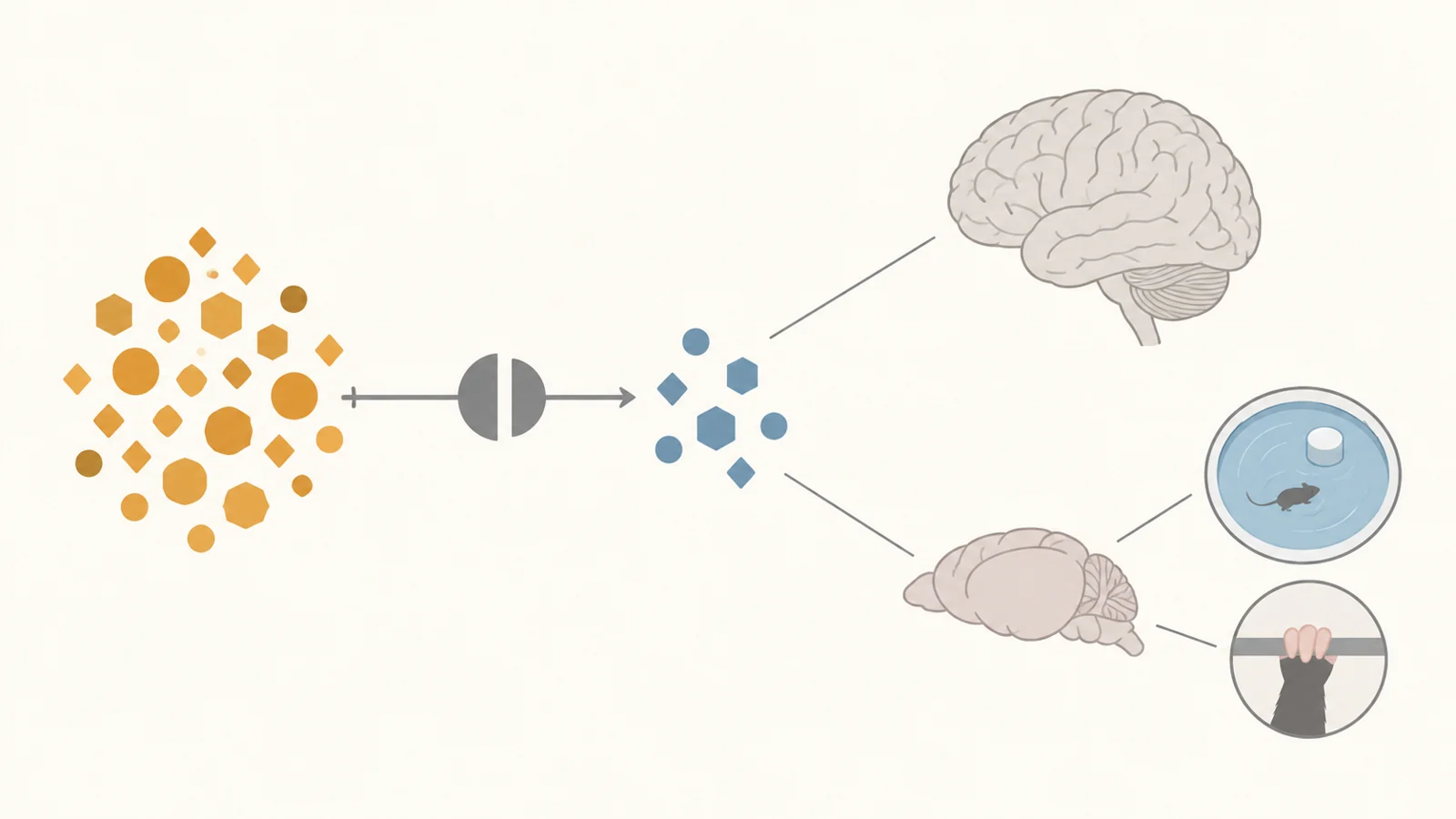
The knockout mouse gives researchers a defined way to disturb this system. Disabling the mouse GAMT gene removes the enzyme’s activity, and the studies summarized in the review find increased GAA and reduced creatine in the brain, bodily fluids, and other tissues. This is a specific inherited failure of creatine synthesis. Describing it simply as a dietary shortage would miss both the blocked conversion and the buildup upstream.
It also creates a useful experimental question. Researchers can investigate what happens when they alter the accumulated substrate, the depleted product, or both. To interpret those changes, however, they need to know which functions are affected and how to measure them.
Learning a location and remembering where to search
The behavioral results become more informative when separated into the tasks the mice performed.
In a study summarized in the review, male mice began a battery of tests at six months of age. One was the Morris water maze. Mice swim through opaque water to find a hidden escape platform, using cues around the pool to learn its position. Across training, reaching the platform more quickly provides a measure of learning.
The knockout mice did not differ from comparison groups during that training phase. But in a later probe trial, they spent significantly less time in the quadrant where the platform had been located. Swimming speed and the frequency of entering that quadrant did not differ between groups.
Those observations address different parts of performance. Learning to reach a platform during repeated training and concentrating a later search around its remembered location are related abilities, but one result does not stand in for the other. The reduced time in the target quadrant suggests a selective difference in spatial memory performance. It does not establish a broad inability to learn. A separate passive-avoidance task, which tests whether mice avoid a compartment associated with a mild foot shock, found no significant group differences.
Movement tests were similarly uneven. Grip-force measurements showed reduced strength in knockout mice. Yet an accelerating rotarod, used to assess balance and motor coordination, did not reveal a genotype effect. Several measures of spontaneous movement and voluntary wheel running also showed little or no difference. In one forced treadmill setting, knockout mice actually ran farther and gained more vertical distance than controls.
Strength, coordination, spontaneous activity, and performance under forced exercise each place different demands on an animal. Calling the mice either broadly impaired or behaviorally normal would discard the information these tests provide. The pattern needs to be understood function by function.
Low creatine leaves an unanswered ATP question
The brain measurements introduce another distinction that is easy to overlook. A depleted energy buffer does not, by itself, tell researchers how much ATP remains available.
The review describes a substantial reduction in the brain’s creatine-related magnetic resonance signal. It also reports an approximately 80% increase in mitochondrial ATP-synthase activity in one study. ATP synthase is part of the machinery that produces ATP. The increase remained significant when the investigators normalized the measurement to another mitochondrial enzyme, citrate synthase.
That finding raises the possibility of a metabolic adjustment to the disrupted creatine system. But enzyme activity measured in an assay cannot establish that ATP supply is adequate throughout the living brain, particularly as demand changes. Nor does it demonstrate that this adjustment protects cognition.
Some spectroscopy results were expressed as ratios of phosphocreatine or phosphorylated GAA to ATP. The review also discusses metabolite concentrations estimated using an assumed ATP concentration. A ratio describes one signal relative to another; an estimate based on an assumed value does not independently measure that value. The authors explicitly state that total ATP content in GAMT knockout mouse brains is unknown.
Phosphorylated GAA has been proposed as a possible substitute for some of phosphocreatine’s energy-transfer functions. Even that possibility does not settle why neurological effects differ between species, because increased phosphorylated GAA has also been reported in people with GAMT deficiency. The available findings offer candidates for explanation, without demonstrating a protective mechanism in mice.
The missing developmental observations
The largest gaps concern the period and abilities most relevant to a childhood developmental disorder.
The behavioral literature discussed in the review concentrates on adult animals. Differences in body weight were observed from the first weeks of life, but early postnatal behavioral development had not been characterized. Measurements of growth cannot establish when a mouse acquires movement skills, recognizes familiar objects or animals, or develops patterns of communication.
An adult test result therefore leaves much of the developmental course unresolved. It cannot show whether a skill emerged on time, whether an early difficulty later became less apparent, or whether an untested function remained affected. Following developmental milestones would address questions that a single adult testing period cannot answer.
Communication is a particularly consequential omission because language is so strongly affected in human GAMT deficiency. The review identifies mouse ultrasonic vocalizations as one possible experimental approach. Pups use these calls in interactions involving maternal care, and older mice vocalize in other social situations. Measuring calls could help investigate aspects of mouse communication. It would not recreate human language or establish the presence or absence of human language disability.
There are also practical limits to comparing the existing studies. The authors note discrepancies in biochemical measurements and identify diet, breeding conditions, sample timing, analytical methods, sex, and age as factors needing examination.
Taken together, the evidence supports the model’s genetic basis and its reproduction of key metabolic changes. Its resemblance to the neurological course in children, and its ability to predict human treatment response, remain unsettled. Limited adult behavioral findings cannot resolve either question, and normalizing mouse metabolites cannot yet be read as a prediction of restored human cognition or language.
What this could change
If researchers can connect changes in creatine and GAA to meaningful developmental outcomes in mice, and establish how those relationships translate to people, this model could help develop treatments aimed at protecting neurological development in children with GAMT deficiency. The causal path would run from correcting the metabolic disturbance to preserving developing functions, with evidence needed at each step.
There is already a clinical reason to focus on timing. The review describes benefits when treatment begins before symptoms appear, using approaches intended to restore creatine and reduce GAA accumulation. It also reports that later treatment can improve seizure control while having limited effects on established neurological deficits. These clinical observations are separate from the mouse model’s still-unresolved predictive value.
A better-characterized model could make treatment development more informative by showing whether an approach reaches beyond a biochemical measurement to support development. From the August 2021 perspective, the potential payoff is a stronger experimental basis for interventions delivered early enough to protect children’s emerging abilities.
Key Sources
- Primary source: Intellectual Disability and Brain Creatine Deficit: Phenotyping of the Genetic Mouse Model for GAMT Deficiency.
DOI or Journal Page · Review or Meta-Analysis · 2021-08-02