
Research Signal – Source date 2025-07-26
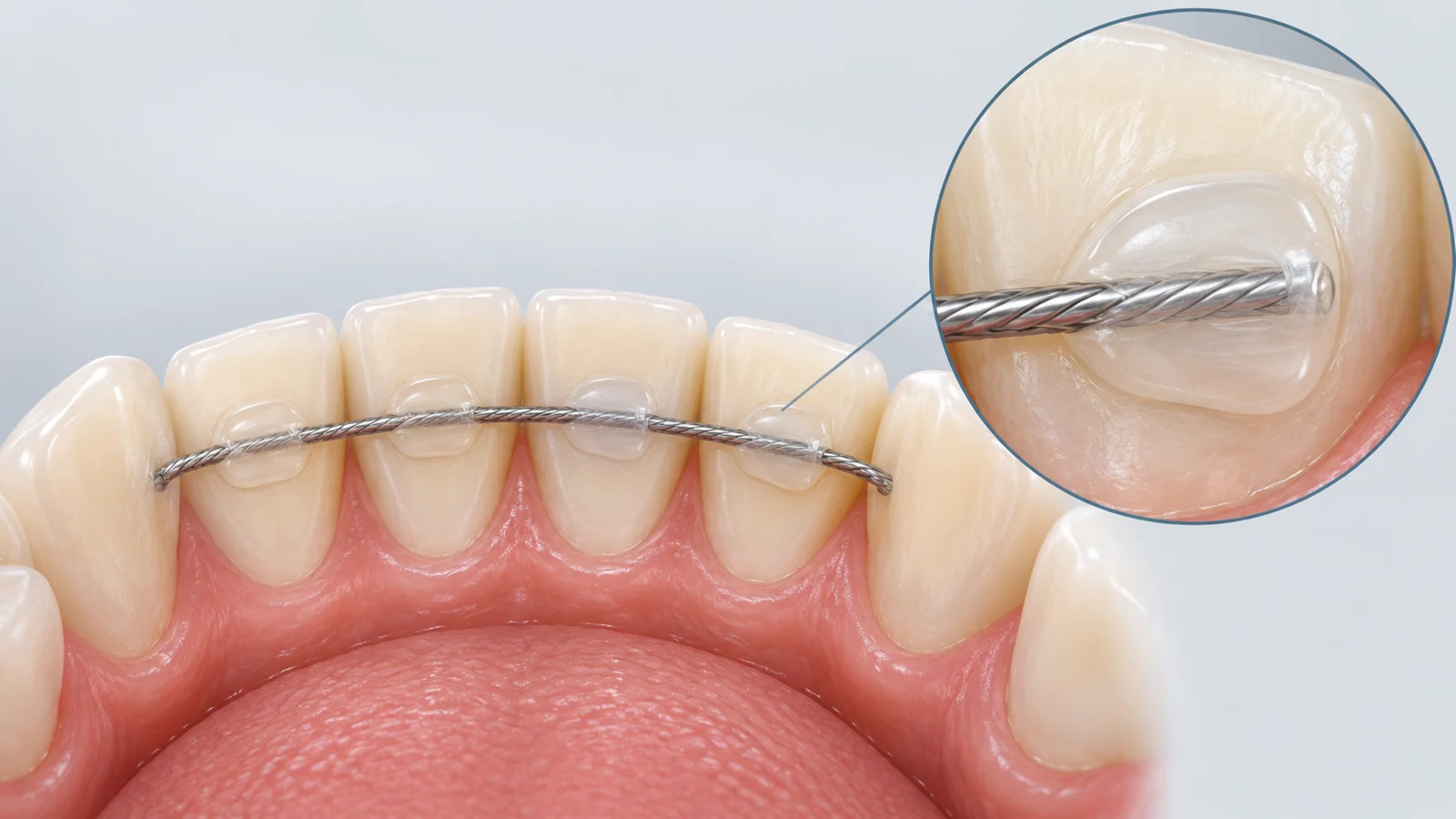
A fixed orthodontic retainer is a thin wire bonded to the backs of the teeth. It can still come loose because a single test of how much force a resin bond withstands does not capture every way that attachment can weaken. A bond may resist a sideways pull yet allow more leakage along its edges, or its resin may wear under repeated contact.
A systematic review published on July 26, 2025, brought together 39 laboratory studies of the materials and bonding methods used for fixed retainers. Its comparisons point to several features that affect lab measurements, from bonding steps to resin composition and the size of each attachment pad. But the studies differed too much for the authors to combine their results into one estimate of how much a particular choice changes failure risk in patients.
A strong score answers only one question
Shear bond strength measures how much sideways force an attachment can withstand before it fails. It is a useful way to compare samples under a defined test. Microleakage measures something different: how far material or fluid can penetrate along a bonded interface. The review considered both because resistance to a pull and the quality of a seal are not interchangeable measures.
One included comparison illustrates the difference. A self-adhesive flowable composite had shear bond strength similar to a conventional composite, yet showed more microleakage at both the tooth-resin and wire-resin interfaces. The wire type did not significantly change that leakage in the experiment. So a comparable strength score did not mean the two materials behaved identically at the boundaries holding the wire in place.
This matters for a retainer meant to stay attached over time. Laboratory tests can reveal a weak point in a particular property, but a result on one measure cannot stand in for every aspect of durability. The review also considered wear, hardness, surface properties and other measurements, each reflecting a different part of how samples behaved under test.
Bonding steps shape the seal
In the included studies, etch-and-rinse bonding, or the additional use of a primer resin, was generally associated with stronger adhesion and less microleakage than self-adhesive approaches. Self-adhesive composites can have similar shear bond strength to conventional materials in some comparisons, but the review describes higher leakage in one comparison and greater vulnerability to aging after thermocycling in another.
That leaves a trade-off to investigate, rather than a simple ranking based on convenience or one strength value. A simpler application may produce a similar reading in a force test while differing in leakage or in how adhesion changes during laboratory aging. These findings describe the tested materials and protocols; they do not show that one method reliably prevents detachment over years for typical patients.
Resin has to withstand wear, too
The resin pad is exposed to mechanical stress and abrasion. Across the reviewed comparisons, composites with more filler tended to show greater resistance to mechanical stress and wear. Resin chemistry also mattered in the reported results: composites containing urethane dimethacrylate, or UDMA, were associated with better adhesion and resistance to external factors.
The pattern was not simply “flowable is weaker.” Some highly filled flowable composites showed strength or pull-out results similar to firmer, condensable composites. In one comparison, combining a flowable base layer with an outer layer of condensable composite increased adhesion relative to either type used alone. Because the studies varied in both material and procedure, the review cannot isolate one ingredient as the cause of a result across all composites.
The size of each pad changes the test
A retainer wire is held by small spots of resin, often called bonding pads or islets. The review concluded that pads should be at least about 4 to 4.5 millimeters wide and 1 millimeter thick to optimize the laboratory outcomes it considered. Smaller pads were associated with less resistance to debonding forces in some experiments.
Individual studies show why the review’s dimension is a guide to tested conditions, not a universal clinical cutoff. One experiment found increasing detachment force as pad diameter increased from 1.5 to 4.5 millimeters. Another found the highest debonding force at 4 millimeters for two wire designs, with lower force at 2 millimeters. Those results make pad geometry a meaningful part of the attachment, while also showing that the measured effect depends on the specific wire, resin and test.
Curing depends on more than lamp power
The resin must harden under a curing light, but the review found no simple direct relationship between lamp power and the rate of resin conversion. Different combinations of resin and light source produced different conversion results. In one study, shorter curing with a more powerful source was associated with more leakage at the wire-resin interface, even though leakage at the tooth-resin interface did not differ among the groups.
So the light cannot be judged by its power alone. The material and curing conditions both matter, and a result at one interface does not automatically describe the other. These laboratory comparisons do not establish a single curing schedule that ensures long-term clinical performance.
What the laboratory evidence can tell us
The authors searched five databases for eligible laboratory studies. They found 927 records, removed 504 duplicates, and included 39 studies in a qualitative synthesis. The authors did not pool the results because materials, bonding procedures, test designs and conditions varied widely. They also describe clinical studies as scarce.
That evidence can identify properties worth testing together: a resin’s resistance to force, its seal at both interfaces, its wear behavior, pad dimensions and curing conditions. It cannot provide a single failure-rate estimate or establish that the laboratory differences predict which retainer will stay attached for a particular patient. Confirming that link requires clinical evidence that measures real detachment alongside the properties observed in the lab.
Where this research could lead
If the laboratory patterns hold up in clinical comparisons, a better-matched combination of resin, bonding steps and pad dimensions could make fixed retainers less prone to detachment. Fewer failures could mean fewer rebonding visits and less interruption to the job of holding teeth in position. The key bridge is evidence that the lab measures—especially leakage and wear, alongside bond strength—predict fewer detachments in patients over time. That would turn useful material comparisons into a dependable way to choose attachments for lasting retention.
Key Sources
- Primary source: Impact of bonding protocols and physical-mechanical properties of composite on durability and failure rate of fixed orthodontic retainers: a systematic review of laboratory studies.
DOI or Journal Page · Review or Meta-Analysis · 2025-07-26
Keep exploring