
Research Signal – Source date 2021-08-30
Does fisetin help people undergoing hip surgery, or is it being tested as a possibility? The ClinicalTrials.gov entry dated August 30, 2021 describes a proposed pilot study, not a reported treatment result. It concerns people planning hip arthroscopy for femoroacetabular impingement and/or a labral tear. The proposed participants would already receive platelet-rich plasma and losartan as part of their surgical care, while investigators study whether fisetin could add a benefit.
Why investigators propose adding fisetin
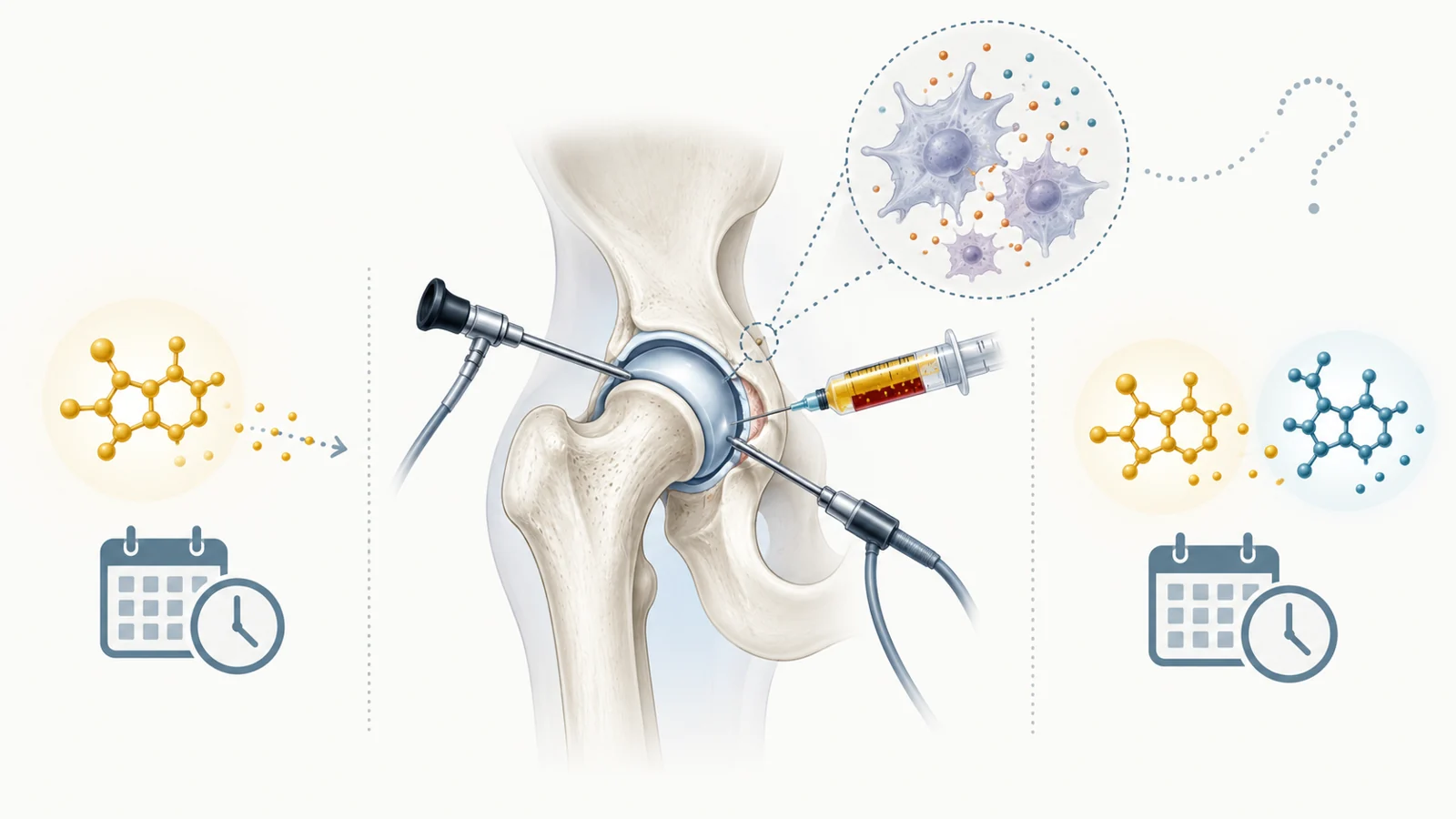
The registry describes fisetin as a senolytic agent intended to eliminate senescent cells. The investigators also propose targeting the secretions associated with those cells, which they refer to as the senescence-associated secretory phenotype, or SASP.
The researchers hypothesize that senescent cells and SASP are present in platelet-rich plasma. Their proposed mechanism is that giving fisetin to target them could improve the benefit of platelet-rich plasma after hip surgery. That biological explanation belongs to the study rationale. It is not evidence that fisetin cleared cells, changed the contents of a treatment, or improved recovery in patients.
How the proposed treatment sequence would work
The planned sequence places fisetin before and after surgery. During hip arthroscopy, patients would receive an intraoperative platelet-rich plasma injection. Losartan would be administered after the operation. The study would therefore examine fisetin as an addition to a combination of surgery, platelet-rich plasma, and losartan rather than as a replacement for any of them.
The registry describes a prospective, randomized, double-blind, placebo-controlled pilot trial. In practical terms, the planned comparison would give patients the same underlying surgical treatment and associated platelet-rich plasma and losartan, while the randomized groups differ in whether fisetin or a placebo is added. Blinding is intended to keep expectations from shaping the comparison. The proposal was to recruit patients from the clinical practice of the principal clinical investigator or their designee at The Steadman Clinic, but the supplied description does not establish that recruitment, treatment administration, or study completion had occurred.
Three questions the pilot would ask
The central clinical question is whether adding fisetin improves the benefit of platelet-rich plasma when the latter is used with hip arthroscopy for femoroacetabular impingement and/or a labral tear. The placebo comparison is important because any difference between groups would be more informative about fisetin’s added contribution than a result from the combined treatment alone.
Safety is a separate objective. The investigators plan to examine whether pre- and postoperative fisetin administration is associated with adverse events. A treatment that changes a biological pathway would still need to show an acceptable safety profile before its use could be considered useful around surgery.
The study also proposes measuring systemic senescence, serum SASP, and fibrosis-related markers. Those measurements could help test whether the investigators’ biological rationale is reflected in the body. They would not, by themselves, establish improved patient outcomes or acceptable safety. A change in a blood marker is not the same as demonstrated improvement in the experience or result of hip surgery.
The August 30, 2021 registry entry therefore supports a clear interpretation: researchers planned to investigate a possible added role for fisetin in a defined surgical setting. It does not establish that patients benefited, that fisetin was safe, that senescent cells were eliminated, or that the proposed markers decreased. The proposal also does not support claims about fisetin as a general anti-aging treatment, use in other patient groups, or routine clinical care.
What this could change
For patients facing hip arthroscopy, the practical payoff would be an additional treatment option that could make the existing combination of surgery, platelet-rich plasma, and losartan more beneficial. That possibility depends on a randomized comparison showing clinically meaningful added benefit alongside acceptable safety; biological-marker changes could support the explanation but could not replace that patient-centered evidence. If those conditions were met, fisetin could become a more credible component of care for this narrowly defined surgical problem. At the registry stage described here, it remained a question under investigation.
Key Sources
- Primary source: Senolytic Agent Improve the Benefit of Platelet-Rich Plasma and Losartan
Government or Regulator · Clinical Trial · 2021-08-30
Keep exploring