
Research Signal – Source date 2021-03-24
By March 2021, one EZH2-blocking drug had an approved use in a rare cancer, yet results with the same general strategy varied across other cancers and drugs. A review of clinical experience and laboratory studies helps explain why: EZH2 can silence many genes, so blocking it may alter more than tumor growth. Those broader effects can make a tumor easier for one treatment to attack while creating conditions that blunt another.
The review describes tazemetostat’s approved use for adults and adolescents with locally advanced or metastatic epithelioid sarcoma. It also summarizes early patient responses in other settings. In a first-in-human study, durable objective responses were reported in 8 of 21 people with B-cell non-Hodgkin lymphoma and 2 of 43 with solid tumors. In a separate report involving relapsed or refractory follicular lymphoma, responses appeared more common among people whose tumors carried an EZH2 mutation than among those with wild-type EZH2.
These results were not shared by every inhibitor or cancer group. In a phase I study of GSK126 across several cancers, the review reports one partial response, in a person with a type of diffuse large B-cell lymphoma, while more than half of participants had progressive disease. Tazemetostat’s approved use and the responses reported in selected groups therefore did not make EZH2 blockade a reliably effective approach across cancers. The review turns to combinations as one possible way to address that unevenness.
A gene-silencing enzyme with effects beyond one target
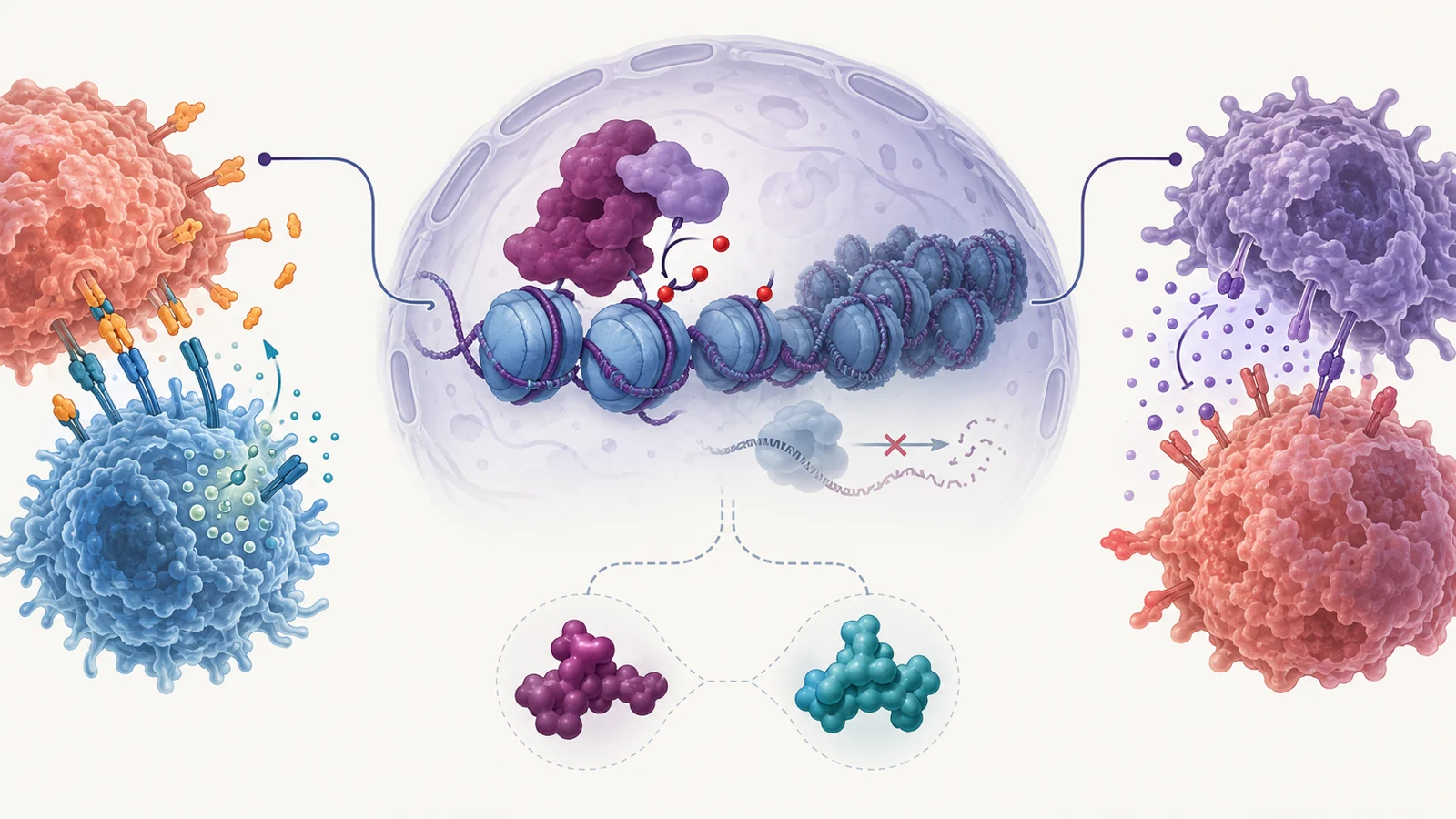
EZH2 is the working, catalytic part of a protein complex called PRC2. It adds a chemical mark, known as H3K27me3, to histones—the proteins around which DNA is organized. This mark helps compact regions of DNA and silence genes there. In some cancers, increased EZH2 activity or altered EZH2 is associated with tumor progression.
Many inhibitors discussed in the review compete with a molecule called SAM for a binding site on EZH2. SAM supplies the methyl groups that EZH2 uses to make its histone mark. By limiting that activity, these drugs can reduce gene silencing. That change may affect multiple genes and cell behaviors, rather than switching off only a single cancer-growth signal.
This breadth offers a possible advantage, but it also helps explain why the effect of blocking EZH2 can depend on the tumor and its surroundings. A treatment might restore a useful immune signal in one setting while changing the balance of immune cells in another. The combination studies in the review explore these competing effects, mostly in cells and mouse models.
Immune recognition can rise as immune suppression grows
In models of head and neck cancer resistant to anti-PD-1 treatment, adding an EZH2 inhibitor suppressed tumor growth. The reported experiments linked EZH2 inhibition to greater expression of MHC I, a molecule that helps cells display fragments of proteins for immune recognition. They also found increased proliferation and activity of tumor-targeting CD8 T cells. In lymphoma models, relieving EZH2-related gene silencing was associated with restored MHC expression and more T-cell infiltration.
But the immune response did not shift in a uniformly favorable direction. In mouse tumor models, treatment with the inhibitor GSK126 was associated with more myeloid-derived suppressor cells, or MDSCs, in tumors, alongside fewer CD4 T cells and fewer interferon-producing CD8 T cells. MDSCs can dampen immune activity. The review describes experiments pairing EZH2 inhibition with approaches that suppress these cells, including gemcitabine or 5-fluorouracil, as a way to address that countereffect.
The studies also suggest that EZH2 inhibition can increase PD-L1 on liver cancer cells in laboratory experiments, which could make blocking PD-L1 a relevant partner to investigate. Together, these findings show why “more immune activity” is too simple a summary: the effect depends on which immune signals and cells change, and whether another treatment can use or counter those changes. These are experimental rationales, not evidence that the combinations improve outcomes for patients.
Tumor genetics may shape chemotherapy response
The chemotherapy examples ask a different question: can EZH2 inhibition make cancer cells more vulnerable to damage from another drug? In non-small cell lung cancer cell lines, inhibiting EZH2 increased sensitivity to etoposide. The review highlights stronger combination effects in cells with inactivating changes in BRG1, also called SMARCA4, or activating changes in EGFR, compared with cells described as having wild-type versions of those genes. The work included cell and mouse models, so it points to tumor genetics as a possible factor in studying the pairing, not as a treatment rule for patients.
A separate laboratory example involved multiple myeloma cells. At concentrations described as minimally toxic, GSK126 intensified DNA-damage responses associated with cell death. Since drugs such as doxorubicin and melphalan act in part by damaging DNA, the finding offered a reason to investigate combinations with DNA-damaging chemotherapy in that setting.
These examples do not establish one general chemotherapy effect. They involve different cancers, drugs, and experimental systems. The proposed value of EZH2 inhibition rests on the particular vulnerability under study—such as altered tumor genetics or a stronger damage response—not on a demonstrated benefit across chemotherapy regimens.
Reopening an androgen pathway in resistant prostate cancer
The hormone-therapy example centers on enzalutamide, an anti-androgen used in prostate cancer. Some prostate tumors become resistant during treatment. In resistant prostate cancer cells and mouse tumor models, inhibiting or reducing EZH2 enhanced the effects of enzalutamide.
The proposed mechanism differs from the immune and chemotherapy examples. In the resistant cells described by the review, EZH2 occupied a control region of the androgen receptor (AR) gene and repressed genes regulated by AR. Inhibiting EZH2 could restore AR signaling, potentially making the resistant cells more susceptible to a drug that blocks that pathway. This is a model-based explanation for testing the pair, rather than a reported patient benefit.
By the review’s publication date, a clinical trial of tazemetostat with enzalutamide in castration-resistant prostate cancer had entered testing. Trial entry marked a move from laboratory rationale to patient study; it did not establish whether the combination worked or was safe.
Choosing a regimen means choosing a sequence
A drug pair is only part of the question. If EZH2 inhibition changes gene activity broadly, its timing could affect what the partner drug encounters. The review raises whether an inhibitor should be given first to prime a tumor, at intervals alongside another treatment, or in sequence. Those approaches could have different effects depending on the cancer and the mechanisms of both drugs.
The evidence also sits at different stages. The review reports an approved single-drug use and responses in patient cohorts, alongside combination experiments in cells and mice and a combination trial that had begun. Those are distinct kinds of evidence. Patient responses to an inhibitor alone do not show that a combination improves survival, and results in models cannot establish a safe or effective regimen for people. The review argues that the mechanisms and timing of each component need careful study; it does not identify one pair, dose, or sequence for all cancers.
How tailored combinations could help resistant tumors
If researchers can match an EZH2 inhibitor and a partner to the resistance mechanism in a particular tumor, the combination could make useful treatment possible for some patients whose cancer responds poorly to either approach alone. That would depend on demonstrating that the selected pair works safely in people and on finding a workable schedule. The review’s examples offer reasons to investigate that possibility, while leaving the patient benefit to be shown.
Key Sources
- Primary source: Finding an easy way to harmonize: a review of advances in clinical research and combination strategies of EZH2 inhibitors.
DOI or Journal Page · Review or Meta-Analysis · 2021-03-24
Keep exploring