
Research Signal – Source date 2021-01-10
Cancer treatments, including immunotherapy, have increased life expectancy for some people with cancer, according to a 2021 review of secondary ocular malignancies. That makes spread to the eye more consequential: eye specialists may need to identify it promptly, help preserve a patient’s visual potential, and connect eye care with treatment of the original cancer.
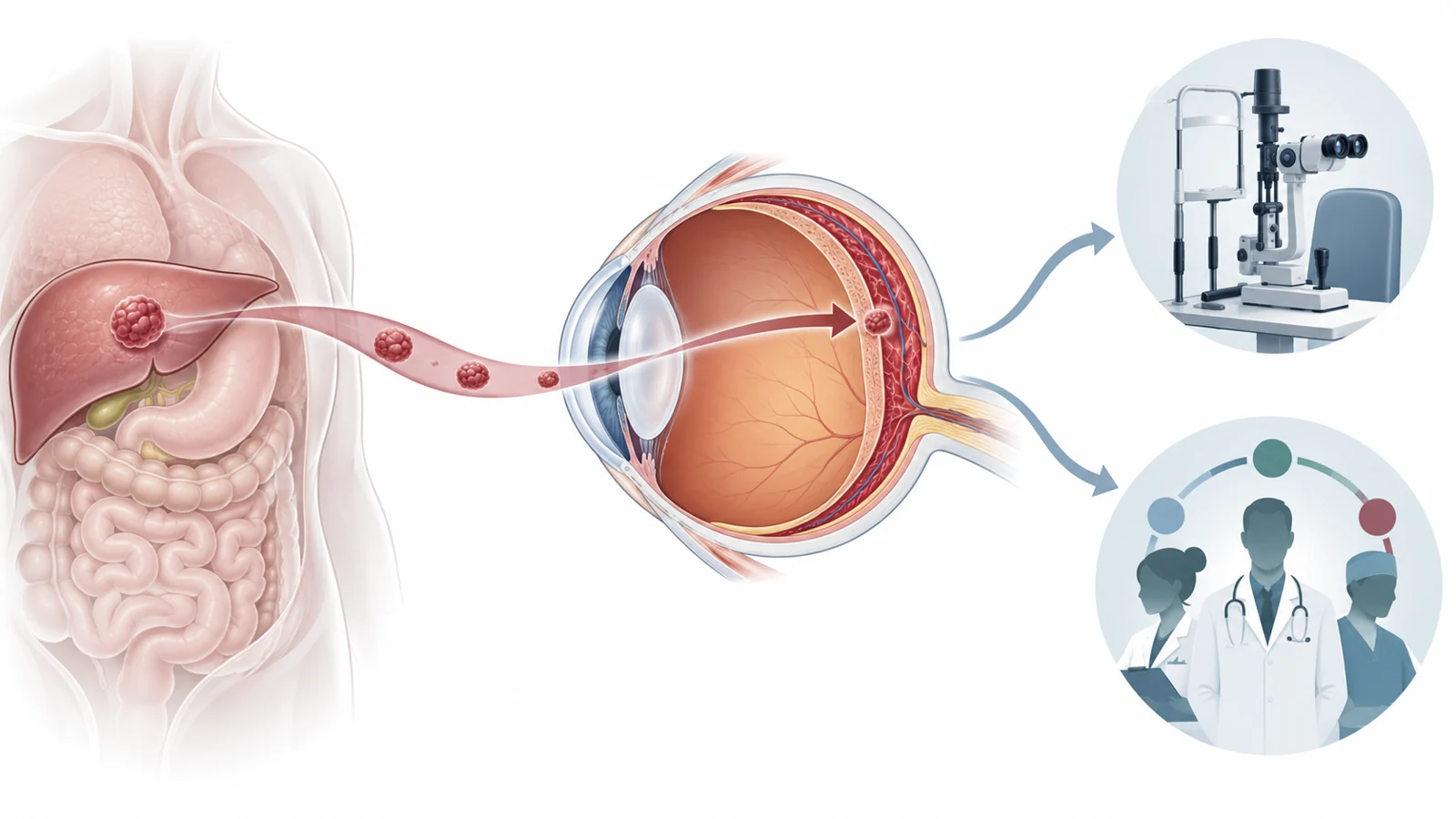
A secondary ocular malignancy is cancer that has spread to the eye from a cancer that began elsewhere in the body. The review identifies the choroid, an eye structure, as the most common site of this spread. Its abstract does not give a frequency, so it cannot show how often this complication occurs.
Why the eye and cancer teams both matter
The review describes two related clinical priorities. Ophthalmologists are urged to diagnose eye involvement in a timely way and offer treatment intended to maximize visual potential. Separately, referral to oncology colleagues can help optimize systemic treatment for the primary cancer—the cancer that began elsewhere.
These goals address different parts of a patient’s care. Eye specialists focus on the potential to retain useful sight; oncology colleagues manage treatment of the primary cancer throughout the body. The review connects them through referral, so that attention to the eye can sit alongside systemic cancer care.
The abstract does not identify a particular eye treatment or referral pathway, or establish how effective either is. Its point is the clinical rationale for recognizing eye involvement and coordinating care, rather than a comparison showing that one approach produces better outcomes.
Longer life expectancy is not a visual outcome
The review links newer cancer treatments, including immunotherapy, with increased life expectancy. It presents that change as a reason timely eye diagnosis matters: when people may live longer with their primary cancer, preserving vision can become an important part of their care.
That survival statement is not a measured estimate in the available abstract. It gives no amount of improvement, and it does not say that immunotherapy treats cancer in the eye or improves sight. Nor does the abstract report visual outcomes from a specific eye treatment. The evidence supplied here supports the review’s care priorities, but not a numerical estimate of their benefit.
What coordinated eye and cancer care could protect
Prompt recognition and a handoff between ophthalmology and oncology could help a person living longer with cancer retain useful sight while receiving systemic care for the primary cancer. That benefit depends on eye involvement being diagnosed in time and on treatment helping the individual patient; the review’s abstract offers a rationale for coordination, not proof of a particular outcome.
Key Sources
- Primary source: Secondary ocular malignancies: A review.
DOI or Journal Page · Review or Meta-Analysis · 2021-01-10
Keep exploring