
Research Signal – Source date 2025-12-10
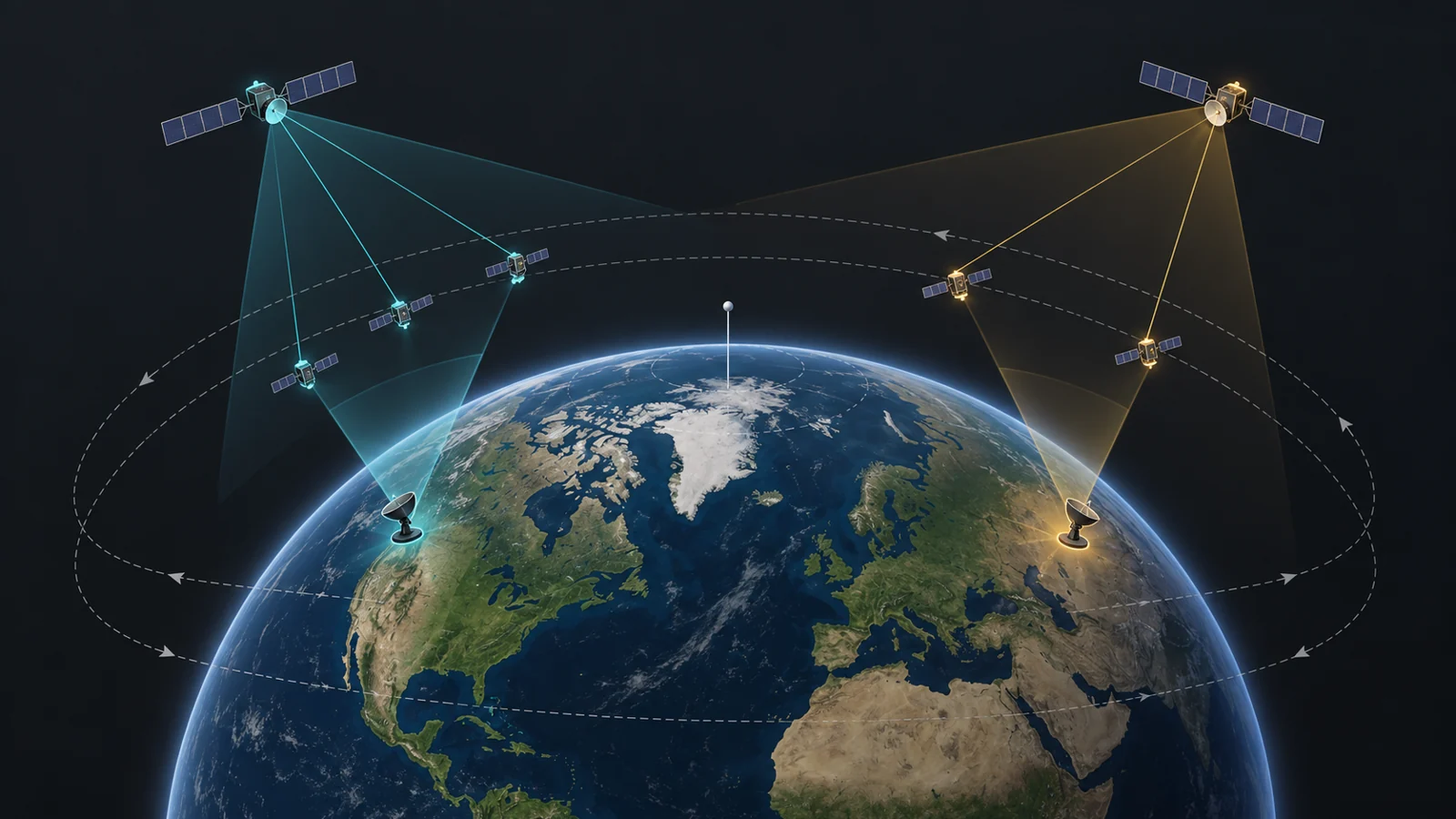
A satellite carrying internet traffic can need a conversation about where that traffic should go. In the network architecture studied by Eunomia, low-Earth-orbit satellites forward data using flow tables—stored instructions that tell them how to handle particular traffic. When an unfamiliar flow arrives, a satellite asks its assigned controller for instructions. That request creates a separate exchange of control messages before the satellite has the routing information it needs.
Putting controllers in orbit does not automatically make those exchanges straightforward. A controller has a limited field of view, meaning the region in which it can communicate directly with other satellites. If a satellite remains assigned to a controller outside that region, its request needs relay steps through the network. Responsibility on an assignment list does not guarantee a direct connection in space.
Eunomia, introduced in a December 10, 2025 arXiv preprint, proposes organizing those assignments around visibility, orbital movement and traffic relationships. Its controllers sit at ground stations and on medium-Earth-orbit satellites; low-Earth-orbit satellites execute their forwarding instructions. The authors evaluate the proposal on the Plotinus emulation platform using realistic constellation parameters. The immediate research question is how to coordinate a moving network efficiently, with consumer internet performance several steps beyond what this evaluation establishes.
A visible satellite is also a moving satellite
Each controller manages a domain, a group of low-Earth-orbit satellites for which it maintains network information and makes routing decisions. Choosing those groups requires more than taking a snapshot of which satellites a controller can currently see.
Consider satellites traveling northward and southward through a visible region. Their positions may make them look like suitable neighbors at one instant, but their different directions matter to how that grouping changes. A partition based only on present geometry overlooks information about their subsequent movement. In the authors’ account, that omission contributes to fragmented control topology, repeated reconfiguration and unstable domain boundaries.
Eunomia uses predictable orbital motion in its visibility-aware segmentation. Northbound and southbound movement help determine how the network is divided within the combined ground-station and medium-Earth-orbit control architecture. The aim is to form workable domains with movement already taken into account, instead of repeatedly discovering that a geometrically convenient grouping has become awkward to maintain.
Within the proposed design, the visibility constraint keeps assigned satellites reachable through direct control links. This is the meaning of single-hop signaling here: a forwarding satellite can exchange control messages directly with its controller. User data can still travel through multiple satellites on its way to a destination. A shorter conversation about routing does not establish an equivalent reduction in the time required to deliver a webpage or video.
Choosing groups also means choosing coordination costs
Visibility defines which assignments can work, but it does not settle which assignments are economical. A domain can be reachable and still create a heavy coordination burden. Eunomia therefore models three kinds of overhead, expressing each in time so that they can enter a common calculation.
Flow-table updates are the work needed to supply forwarding instructions when a satellite encounters an unknown flow. The model distinguishes requests whose source and destination belong to the same domain from those crossing domain boundaries. Domain synchronization accounts for the exchange of network state between domains. Controller migration accounts for the cost of changing control responsibility as the network evolves.
These costs can compete. Keeping communicating satellites together can reduce the need for coordination across boundaries, but grouping by traffic alone may produce an uneven load or assignments that are difficult to maintain. Moving a satellite to another controller may improve an assignment while also adding migration work. The useful objective is the combined burden, rather than making any single category as small as possible.
To organize these relationships, Eunomia builds a Control Overhead Relationship Graph. A graph here is a mathematical representation of satellites and the control costs connecting them. The framework applies spectral clustering, a method that uses the graph’s mathematical structure to identify groups. In practical terms, it groups satellites using their control-overhead relationships while seeking to balance traffic load. This adds information that distance and visibility alone cannot provide.
A subsequent step uses the Kuhn-Munkres algorithm to assign controllers to the resulting domains. That separates the question of which satellites belong together from the question of which controller should manage each group. The assignment step solves a defined matching problem within Eunomia; its use does not establish a global optimum for every aspect of a changing satellite network.
What the emulation can establish
The Plotinus implementation gives the proposal an executable evaluation setting. With realistic constellation parameters, the authors can examine how the partitioning approach behaves in an emulated network and compare its measured costs with other approaches. This is evidence about an implemented control method under modeled conditions, rather than an orbital deployment.
The abstract reports reductions of up to 58.3% in request loss and up to 50.3% in control overhead, alongside a 77.7% reduction in algorithm execution time. These are reported experimental comparisons. The headline figures alone do not show how results vary across workloads, how sensitive they are to comparator configurations or how consistent they are across repeated runs. They therefore cannot establish typical service improvements. In particular, request loss in this evaluation should not be read as an equivalent reduction in a household’s internet outages.
Two input assumptions are especially useful for understanding where the method’s performance may depend on its operating conditions. Eunomia divides time into slots during which network topology—the arrangement of connections—is treated as stable. This makes it possible to calculate a partition for a bounded interval, even though the satellites keep moving. Predictable trajectories support that approach, but its usefulness still depends on whether the chosen intervals adequately represent changes that matter to control decisions.
Traffic presents a different problem. The traffic distribution for the current slot is not yet known, so the framework uses the preceding slot’s distribution as input. The authors motivate this choice through traffic continuity. When demand changes gradually, a recent observation can be a useful guide to what comes next.
A sudden shift in demand could make that guide less representative. That is a dependency of the method, not a demonstrated failure in the supplied results. Orbital predictability cannot, by itself, establish traffic predictability. Assessing robustness therefore requires attention both to changes in connectivity and to how well recent demand represents the traffic that a new partition will actually serve.
The December preprint provides an initial emulation result. It does not establish independent replication or operation in a deployed constellation. Translating the measured savings into operational performance also depends on handovers and implementation constraints that a headline percentage cannot resolve.
What this could change
If Eunomia’s coordination savings survive changing traffic, controller handovers and practical implementation limits, constellation operators could gain more room to expand the networks they manage. Reducing the work spent updating instructions, sharing state and transferring control could allow larger populations of moving satellites to be coordinated without a corresponding escalation in control-message burden.
That could help routing decisions remain responsive as satellites move between controllers, supporting continuity of connectivity across a changing network. The causal path runs through the control system’s ability to keep forwarding instructions useful and current. For future satellite communications infrastructure, the potential payoff is a more manageable network at scale—one whose coordination demands remain tractable as the number of moving participants grows.
Key Sources
- Primary source: Eunomia: A Multicontroller Domain Partitioning Framework in Hierarchical Satellite Network
arXiv · Preprint · 2025-12-10
Keep exploring