
Research Signal – Source date 2021-05-07
An enzyme can help make a polymer without making that polymer biodegradable. The catalyst, the material’s feedstock and the finished material’s behavior are separate parts of the story. A polymer made with an enzyme may come from renewable ingredients, but whether it breaks down depends on its chemical structure and the conditions it encounters.
A 2021 review by researchers examining recent work in polymer chemistry describes enzymes acting at several stages: preparing the small molecules that become building blocks, linking those blocks into chains, and modifying polymers that already exist. The examples point to useful ways of making materials under relatively mild conditions or with precise chemical control. They also show why “enzyme-made” is not a shortcut to predicting how a material will behave in use or after disposal.
An enzyme can enter the process at three different points
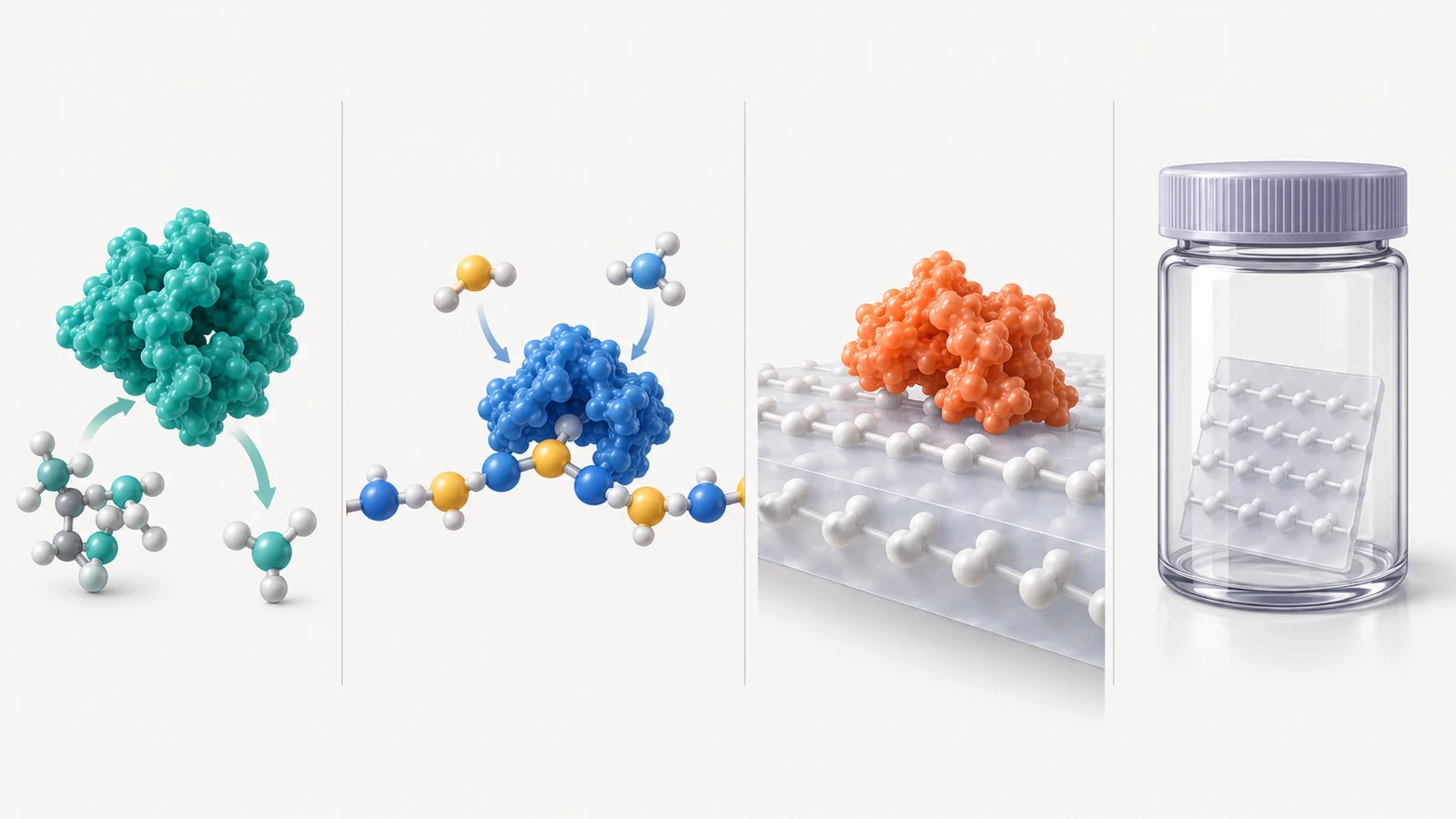
Some enzymes help prepare a monomer, the small molecule used to build a polymer. Others catalyze the formation of bonds that link monomers or short chains. Still others alter functional groups on a polymer that has already been made, changing properties at or near its surface.
These roles matter because “biocatalysis” describes how a reaction is helped along; it does not name one kind of material or one guaranteed end result. The same broad approach can be used to make a building block, produce a polymer chain or adjust an existing material. The outcome depends on the molecules and reaction involved.
The review highlights lipases, enzymes commonly associated with breaking down fats, as useful catalysts in polymer chemistry. In suitable conditions, enzymes in a group called hydrolases can help form bonds as well as break them. Hydrolases act on bonds by using water, but their reactions can also transfer a chemical group to another molecule. At high concentrations of reactants, and with conditions chosen to favor synthesis, some reactions can run toward bond formation. The enzyme’s selectivity can help control which parts of a molecule react.
That selectivity is useful when a synthesis needs to distinguish among similar chemical groups or produce a more regular polymer structure. It also makes the process specific: a catalyst and set of conditions suited to one reaction may not work for another. Enzyme-based polymerization requires careful choices about the reaction mixture, temperature, acidity, solvent and form of the catalyst.
Mild reactions can help with sensitive building blocks
Conventional polyester production has produced valuable materials, but the review describes chemical routes that often use temperatures of about 150–280 °C and organic or metal-containing catalysts. High heat can make it harder to use monomers that are thermally or chemically unstable. For medical materials, catalyst residues can also be a concern because strict limits apply to heavy metals in the finished material, making purification important.
Enzyme-catalyzed polymerization offers another set of conditions. Lipases can work at relatively mild temperatures and can be used with renewable monomers, including examples derived through biological methods. The review discusses their use with building blocks such as succinic, adipic, itaconic and furandicarboxylic acids, as well as several alcohols. Those ingredients can be relevant to polyester synthesis, but their renewable origin alone says nothing about the finished polymer’s fate.
One example illustrates the separate role of enzymes in making a building block. The review describes a two-enzyme cascade that converted 5-hydroxymethylfurfural, a compound obtainable from sugars, into 2,5-furandicarboxylic acid. The reported product yield was 94%. The acid is of interest as a bio-based building block for polyesters. This is an example of preparing a monomer, not evidence that every polymer made from it will biodegrade or perform well in a particular application.
Enzymes can also modify polymers after chain formation. Natural polymers such as polysaccharides and proteins have chemical groups that can be altered, while enzymes can partly hydrolyze bonds at the surface of some synthetic polyamides and polyesters. Such changes can adjust material properties or add functions. They do not by themselves establish how the whole material will behave in a living body or in a disposal environment.
Making long chains creates a process problem
As polymer chains grow, the reaction mixture can become more viscous. A thick mixture is harder to handle and can make it more difficult for reactants and catalyst to interact. The enzyme may also need to be separated from the product, and each process needs conditions suited to its specific materials. The review reports that enzyme-made polymers rarely exceed about 30–40 kilodaltons in number-average molecular weight, a measure of average polymer chain mass. This is a pattern in the work reviewed, not an absolute ceiling.
Two process examples show how engineering can change that picture. In one, immobilized lipases—enzymes attached to a support—were used in a thin film under reduced pressure to make polyester from adipic and itaconic acids with 1,4-butanediol at 50 °C. The thin-film setup helped address viscosity; the enzyme could then be filtered from the liquid mixture of polymer products and unreacted ingredients.
In another example, an immobilized lipase helped turn ω-pentadecalactone into a polymer through reactive extrusion, which combines the reaction with vigorous mixing and heat. The review reports almost complete monomer conversion in 15 minutes and a polypentadecalactone molecular weight of 163 kilodaltons. The enzyme granules were separated after the polymer was dissolved in xylene. This case exceeded the typical chain-length range described in the review, showing that process design can matter alongside catalyst choice. It remains a specific reported example, not proof of routine large-scale production.
Combining catalysts can extend what each step does
An enzyme does not have to carry a material through every stage of synthesis. In a two-step example, a lipase first produced oligomers—short chains—from 1,4-butanediol and a succinate building block. The material was then heated to 90 °C for chemical post-polymerization. This combination produced biodegradable polybutylene succinate. The enzyme provided an initial reaction under milder conditions; conventional chemistry extended the chains.
The same division of labor can apply when an enzyme-made polymer or fragment needs later chemical modification. The review describes enzymatic polymerization followed by chemical changes to polyglycerol-based materials, for example, to give them properties such as amphiphilicity, meaning that parts of the material interact differently with water. Hybrid routes can make use of enzyme selectivity while relying on chemical steps to reach a different chain length or final set of properties.
This is a practical response to the limits of asking one catalyst to do everything. Enzymatic polymerization may need extensive optimization for each combination of ingredients and conditions, and chain growth can make processing harder. Combining steps can widen the range of materials that researchers can make, though the review’s examples do not establish a universal production recipe.
Biodegradability and medical use depend on the material
The word “bioplastic” can refer to a material made from renewable feedstock, a biodegradable material, or both. Those properties do not automatically travel together. Petroleum-derived plastics can contain bonds that are susceptible to enzymatic breakdown, while a material made from plant or other renewable carbon is not necessarily biodegradable under its intended disposal conditions.
Even “biodegradable” needs a defined setting. The review describes an ideal biodegradable plastic as one that microorganisms can convert completely, within a reasonable time, into simple products without leaving visible or toxic residues. To assess that behavior, the authors point to measuring the rate and degree of conversion, and the products formed, under specified conditions. The label alone does not tell a reader how quickly or completely a particular item will break down in a given environment.
Medical use raises another set of questions. The review discusses polyesters such as polylactides, polyglycolides, polycaprolactone and polybutylene succinate as materials of interest for biomedical applications. Some are considered for uses including surgery, vascular engineering or tissue engineering. Yet a polymer’s ability to degrade is only part of its suitability. The products released as it degrades matter too: the review notes that degradation of some polyesters can cause a local decrease in pH, and it stresses the need for breakdown products to be nontoxic, metabolized and excreted.
Those examples describe material research and possible applications; they do not establish clinical safety or benefit for a specific product. A selective enzyme reaction may help prepare or modify a polymer, but the material’s structure, its behavior over time and the surrounding conditions still shape what it can do.
What tailored polymers could make possible in medicine
If researchers can pair selective enzyme reactions with practical ways to manage viscosity, catalyst recovery and later chain extension, they could gain more options for making functional polymers from renewable building blocks or sensitive ingredients. For medicine, that could expand options for tailoring polymers intended for tissue engineering or controlled drug release while reducing reliance on metal-containing catalysts. Whether those materials become useful in a particular setting will depend on their production performance and on how the finished polymer behaves, including what it releases as it degrades.
Key Sources
- Primary source: Prospects of Using Biocatalysis for the Synthesis and Modification of Polymers.
DOI or Journal Page · Review or Meta-Analysis · 2021-05-07
Keep exploring