
Research Signal – Source date 2023-07-06
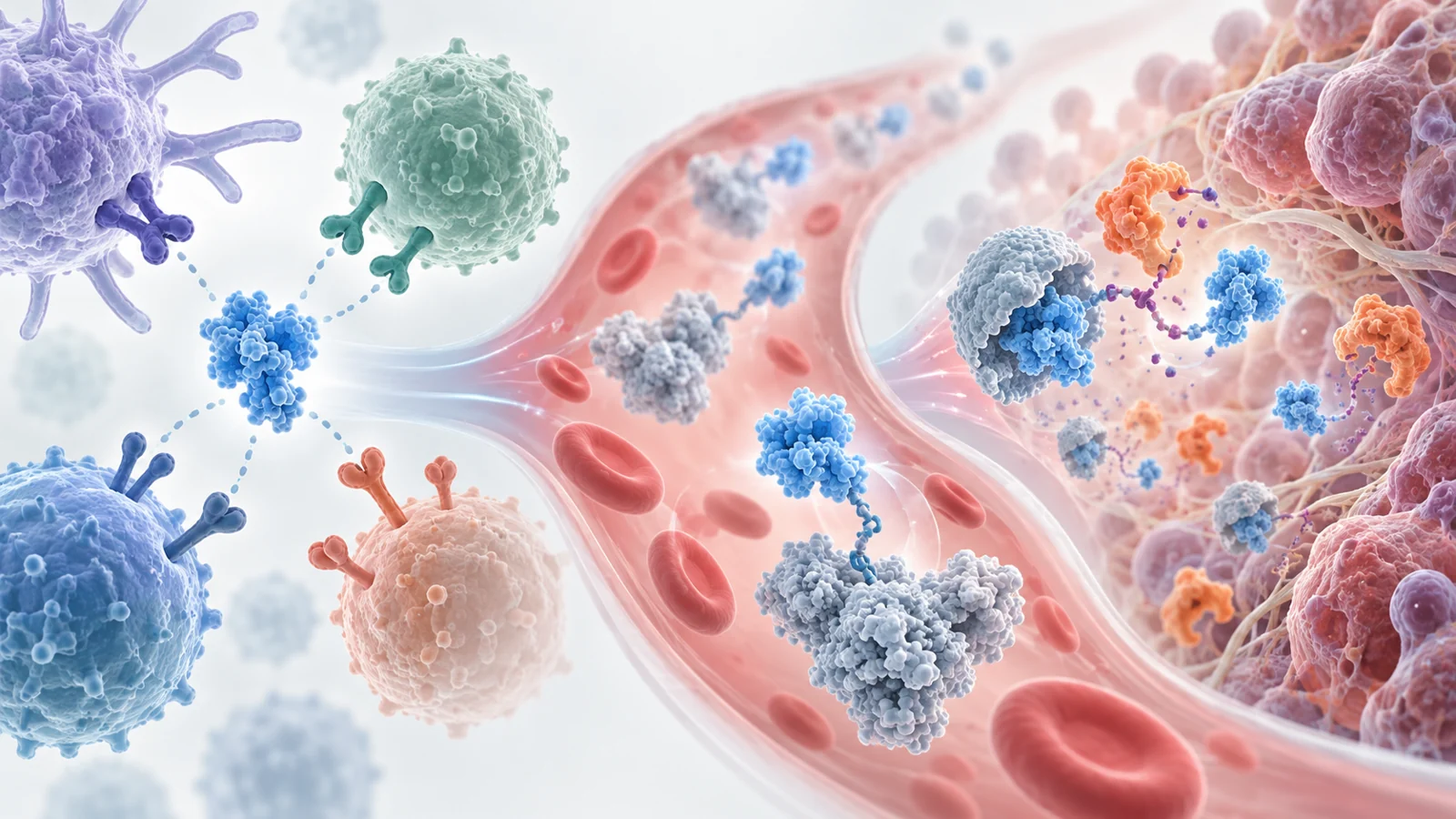
Cytokines are proteins through which cells communicate. In cancer, some can help expand or activate immune cells that attack tumors. Yet the same communication system creates a difficult medicine-design problem: a cytokine may act on several kinds of cells, while its small size can also make it leave the bloodstream quickly.
The review published on July 6, 2023, examines how researchers have tried to redesign these molecules. The goal is not simply to make an immune signal stronger. It is to change which cells receive the message, how long the message remains available, where it accumulates, and when it becomes active. Those are related engineering tasks, but they are not interchangeable measures of success.
The problem is not simply too little immune activity
Cytokines work by binding receptors on cell surfaces. Because different cell types can carry different receptor combinations, one cytokine can produce several effects at once. In the tumor microenvironment, altered cytokine production is involved in cancer development, progression and responses to treatment. That broad biological reach is part of the reason cytokines are attractive as cancer medicines, but it also makes their effects difficult to confine.
Pharmacology adds another constraint. Many cytokines are small proteins that can move out of blood vessels and undergo renal excretion rapidly. Traditional intravenous treatment may therefore require high or frequent doses to maintain exposure. Increasing the amount can intensify unwanted effects before it creates a useful concentration at a tumor.
Early clinical experience made the promise and the difficulty visible. Interferon alpha-2b was approved for hairy cell leukemia in 1986, and high-dose interleukin-2, or IL-2, was later authorized for metastatic renal cell carcinoma and metastatic melanoma. These examples showed that cytokines could become medicines, while their short half-lives, pleiotropic effects and dose-limiting toxicity restricted broader use.
The engineering question that follows is more precise than “How can this signal be amplified?” It is “Which part of the signal should be changed for the intended immune response?”
IL-2 shows why the recipient matters
IL-2 is a useful example because its receptor is not a single on-off switch. The receptor can contain IL-2Rα, IL-2Rβ and IL-2Rγ in different combinations. Intermediate-affinity IL-2 receptors are found primarily on memory T cells and a subset of natural killer cells. The high-affinity receptor is found on regulatory T cells, activated effector T cells and some other immune populations.
That distribution means that changing IL-2 binding can alter the balance of cellular recipients. A sequence mutation may increase or decrease affinity for a receptor component, giving the engineered molecule a different preference from natural IL-2. The desired result is not necessarily greater activity everywhere. It may be stronger engagement of immune cells with a useful antitumor role while reducing engagement of other populations or pathways.
Several IL-2 variants have been designed around this idea. The review describes Bay50-4798 as an early attempt to favor a receptor configuration, although its eventual clinical benefit was not better than traditional IL-2. The example is important because it separates a rational molecular design from a demonstrated patient advantage.
The same principle appears in the development of bempegaldesleukin, a PEGylated IL-2 designed to preferentially engage the IL-2Rβγ complex rather than IL-2Rα. In preclinical animal models, that bias was associated with expansion of effector T cells and inhibition of regulatory T-cell proliferation. Those findings supplied a biological rationale for testing the candidate, but they did not guarantee that the selected receptor preference would produce a better clinical outcome.
Making a cytokine last changes the exposure problem
A second design function is to keep the active molecule in circulation longer. The review describes attaching cytokines to larger carrier proteins such as human serum albumin, fusing them to an immunoglobulin Fc domain, or conjugating them to polymers such as PEG.
Albumin and Fc-based designs can reduce rapid kidney clearance and take advantage of recycling through the neonatal Fc receptor. The result is a longer circulating lifetime for the fusion protein. This changes how often a dose may need to be given and can increase the time available for the cytokine to encounter its receptor.
Longer circulation is not the same as tumor delivery. A molecule that remains in blood for more time may also remain available to healthy tissues. Persistence can therefore solve one limitation while leaving the location problem unresolved. Receptor preference and exposure duration may need to be designed together.
MDNA11 illustrates that combination. The review describes it as an albumin-fused IL-2 “Superkine” designed to extend half-life while preferentially binding CD122 and showing no affinity for CD25. An ongoing Phase I/II study was evaluating its safety, pharmacokinetics, pharmacodynamics and antitumor properties in advanced solid tumors at the time covered by the review. The study description reflects clinical evaluation, not established efficacy.
Location and activation are separate design problems
Some approaches add targeting components intended to concentrate cytokines near a tumor. Immunocytokines fuse cytokines with antibodies or other targeting components intended to influence localization in the tumor microenvironment. In principle, the added targeting element changes where the payload is concentrated. It does not by itself prove that activity is exclusive to tumor tissue.
A different strategy is conditional activation. Here, the cytokine is present but masked until a tumor-associated protease cuts a sensitive linker. The design depends on the intended tumor environment containing the right activating conditions; it is not a guarantee of perfectly restricted activation.
WTX-124 combines three functions in the review’s description. A wild-type IL-2 is attached to an inactivation domain, a tumor-protease-sensitive linker and a half-life-extension element. The inactivation domain is intended to limit activity in non-target tissue, the linker is intended to permit release in the tumor microenvironment, and the extension element is intended to improve exposure. Preclinical findings were described as favorable for antitumor activity, pharmacokinetics and tolerability, while a first-in-human Phase I study had begun enrolling people with advanced solid tumors.
XTX202 represents a related conditional concept with a different IL-2 design. It is described as a βγ-chain-biased molecule masked by a protein domain and activated through cleavage by tumor-microenvironment proteases. Its preclinical results and early clinical evaluation belong to a different development stage from a completed comparative patient study.
These designs illustrate why “targeted cytokine” can mean several things. One molecule may be engineered to recognize a preferred receptor. Another may be built to last longer. A third may be guided toward a location, while a fourth remains inactive until a molecular condition is met. The functions can be combined, but they should not be treated as the same intervention.
Bempegaldesleukin supplied a harder clinical test
Bempegaldesleukin provided the review’s clearest counterexample to assuming that an appealing mechanism will translate directly into benefit. Its PEG groups were designed to release gradually, extend exposure and favor IL-2Rβγ signaling. Preclinical work supported selective expansion of effector T cells and inhibition of regulatory T-cell proliferation.
The reported Phase III PIVOT IO-001 comparison tested bempegaldesleukin with nivolumab against nivolumab alone in metastatic melanoma. According to the review, the combination did not show key differences in progression-free survival or objective response rate on the reported primary endpoints. The review also reports that the companies decided to stop enrollment in the Phase III PIVOT-12 study and unblind that study.
This result does not explain why the regimen failed, and it does not show that every IL-2 engineering strategy must fail. It does show why receptor bias, longer exposure and encouraging preclinical immune effects are intermediate evidence rather than a substitute for comparative clinical results. A design can alter a molecule in the intended biochemical direction without producing a meaningful advantage for patients.
WTX-124 occupies a different evidentiary position. Its early enrollment and preclinical findings make it relevant to the engineering landscape, but they cannot be compared with the bempegaldesleukin trial as though both supplied the same kind of answer. The review brings together candidates at different stages to explain design possibilities, not to establish a ranking among them.
What controlled immune signaling could offer patients
Engineered cytokines could eventually add another way to expand and activate cancer-fighting immune cells, including for patients whose tumors respond inadequately to checkpoint blockade. That possibility depends on more than a clever molecular format. The engineered signal would need to produce meaningful clinical benefit at tolerable exposure, reach the relevant cells or tissue, and be manufactured reliably enough for clinical use.
From the review’s 2023 perspective, the most useful direction is controlled immune signaling: adjusting receptor engagement, persistence, localization and activation so that a cytokine’s biology becomes more usable as a treatment. Combinations with checkpoint blockade, cell therapy or gene therapy were identified as areas of interest, but their value remained a development possibility rather than a settled clinical conclusion.
Key Sources
- Primary source: Engineering cytokines for cancer immunotherapy: a systematic review.
DOI or Journal Page · Review or Meta-Analysis · 2023-07-06
Keep exploring