
Research Signal – Source date 2023-12-19
By the time this Perspective appeared in December 2023, engineered T cells were already approved treatments for some blood cancers. These CAR-T therapies are made by reprogramming a patient’s T cells to recognize cancer. They can move through the body, gather in tissue and multiply—qualities that make them more like living treatments than a fixed dose of a drug.
Those same qualities make “make the cells stronger” an incomplete answer to the field’s problems. A cell that attacks more forcefully could still recognize a marker on healthy tissue, cause dangerous inflammation, tire under prolonged stimulation or lose its target as a tumor changes. And a treatment built from one patient’s cells takes time to prepare. A 2023 Perspective on genome engineering describes ways researchers were trying to address these separate limits, from redesigned recognition circuits to donor-derived cells. The approaches were at different stages, and the Perspective did not test one new product against existing care.
Better aim starts with what the cell can recognize
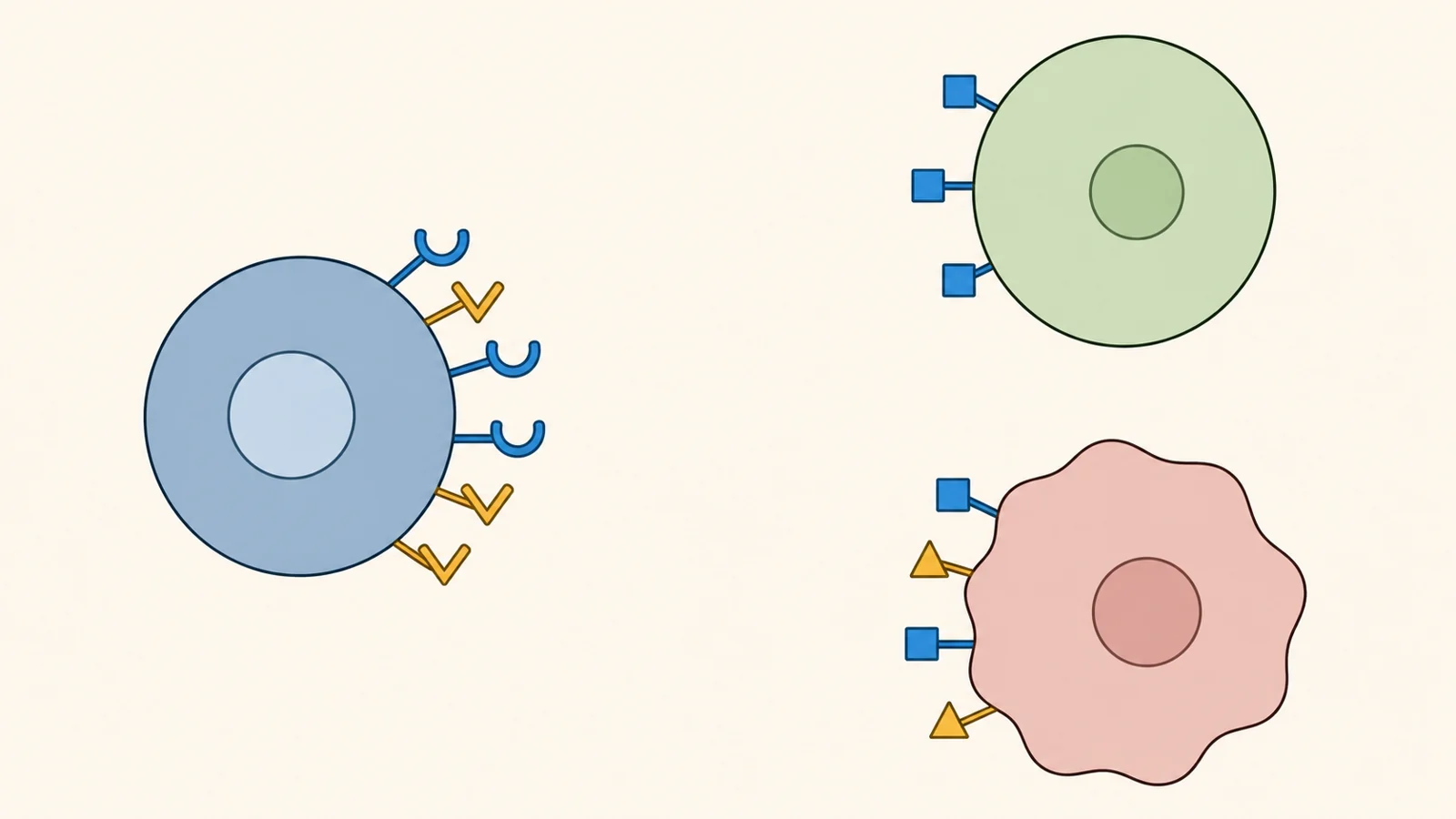
A CAR gives a T cell a new way to identify a target on a cell’s surface. The challenge is that a cancer marker may also appear on healthy cells. If an engineered T cell treats that shared marker as a sufficient instruction to attack, the tumor is not the only possible target. This is called an on-target, off-tumor effect: the recognition is working as designed, but the marker is not exclusive to cancer.
One proposed design puts a temporary mask over the CAR’s target-binding part. The mask is connected by a linker that can be cut by enzymes found in the tumor environment. In principle, the receptor stays blocked outside the tumor and becomes available where those enzymes are abundant. It is a way to make recognition depend partly on location; the Perspective describes the design, not proof that it prevents injury in patients.
Another approach asks for more than one identifying feature before a cell activates. In a two-signal “AND” design, separate receptors respond to different markers, with both signals needed for full activation. A related design called synNotch first detects one marker and then prompts the T cell to make a CAR that recognizes another. These circuits aim to distinguish a tumor bearing a particular combination from healthy tissue with only one of those markers. Their promise depends on the markers being sufficiently informative in real tissues; the examples reviewed do not establish that the designs reliably prevent harm in people.
A safety switch addresses a different danger
Selective recognition is about where a cell acts. It does not, by itself, solve what to do if the infused cells trigger an excessive response. One serious complication of CAR-T treatment is cytokine release syndrome, or CRS. Activated immune cells release signaling molecules called cytokines; when the response spreads through the body, it can cause high fever and low blood pressure and become life-threatening. The Perspective reports CRS in 42% to 93% of patients in the cited B-cell non-Hodgkin lymphoma treatment settings, with severe cases reported in 2% to 22%.
Steroids and drugs that block the cytokine IL-6 can help control CRS, but researchers have also explored ways to regulate the engineered cells themselves. A genetic control could, in principle, turn CAR activity down or eliminate the cells when a dangerous reaction occurs. Such control is especially relevant to donor-derived T cells, which can also attack a recipient’s tissues and cause graft-versus-host disease. These are proposed safeguards, not a guarantee that an adverse reaction can be stopped in time.
Keeping T cells functional takes more than activation
A T cell can lose effectiveness after prolonged stimulation. In exhaustion, its ability to kill weakens while inhibitory signals persist. The tumor environment can add further suppression, making it harder for an engineered cell to sustain its attack. More activation at the start does not necessarily mean useful activity will last.
The Perspective describes several attempts to preserve function. The Perspective reports that CAR-T cells making more c-Jun, a protein that helps control which genes a cell uses, resisted exhaustion. Other experiments disrupted inhibitory molecules such as LAG-3; one reported stronger tumor killing in laboratory and animal studies after LAG-3 was removed. These examples illustrate different routes toward sustained function, but they are not evidence that either change improves outcomes in patients.
Some designs try to counter suppression locally. The Perspective describes CAR-T cells engineered to release a small antibody fragment that blocks PD-1, an inhibitory signal. In mouse models, this approach improved CAR-T function, with results comparable to or better than combining CAR-T cells with a checkpoint-blocking drug. Keeping the blocker near the tumor could, in principle, limit exposure elsewhere. The evidence described is preclinical, so it does not show that the strategy is safer or more effective in people.
Tumors can change the target
Exhaustion is a problem with the T cell’s continuing ability to act. Antigen escape is different: cancer cells can reduce or lose the marker the treatment recognizes. A CAR-T cell may remain active and still have fewer targets to find.
The Perspective cites a follow-up observation in which 24% of patients who had initially achieved a complete response to CAR-T treatment for B-cell acute lymphoblastic leukemia later relapsed with cancer that had lost CD19, the targeted marker. The figure makes clear why a powerful response to one marker may not be enough if surviving cancer cells no longer display it.
Researchers have explored dual or tandem CAR designs that recognize two markers, as well as engineered cells that release a molecule capable of recruiting other T cells to a second target. The aim is to make it harder for a tumor to evade treatment by losing just one marker. The Perspective describes preliminary clinical findings for dual-target cells and stronger results in mouse models for other designs. Multi-targeting is a plausible response to tumor variation, but these examples do not establish that it prevents relapse reliably.
Donor cells could change how treatment is prepared
Approved CAR-T treatments described in the Perspective were made from each patient’s own cells. Those cells must be collected, engineered, expanded and returned to the patient; the source says this process takes about a month. Preparing cells individually can constrain how quickly a treatment is available and is part of the manufacturing burden.
A donor-derived, or allogeneic, approach would instead prepare batches in advance and store them for later use. That could change the manufacturing model, but donor cells bring a compatibility problem in both directions. Their native T-cell receptor can recognize the recipient’s tissues and cause graft-versus-host disease. Meanwhile, the recipient’s immune system may recognize the donor cells as foreign and eliminate them. The Perspective describes edits to remove the donor cells’ native receptor and reduce a key immune-recognition marker as ways researchers were attempting to address these risks.
The approach was still developing. The Perspective discusses donor-derived candidates in early clinical trials and a reported chromosomal abnormality that prompted a temporary hold in one trial before the hold was lifted. The episode underscores why editing many parts of a cell requires careful attention to unintended changes as well as intended ones. The evidence presented does not show that donor batches had resolved compatibility, long-term safety, cost or routine-access questions.
Screens can search for useful cell changes
Engineering choices need targets, and genetic screens offer a way to search for them. Researchers can introduce many gene changes across a pool of cells, expose the pool to a chosen test, then identify which changes are associated with a desired response, such as stronger tumor killing. Sequencing helps connect the surviving or selected cells back to the edits they carried.
The Perspective describes screens that identified candidate genes and pathways affecting CAR-T activity, including examples involving metabolism and tumor killing. A screen produces leads, not a ready-made treatment: results can vary, and the usefulness of a hit depends on the model and the accuracy of the test. Replication and validation in relevant biological settings matter, particularly when moving from laboratory systems toward living organisms.
The broader field also extends beyond CAR-T cells. T-cell receptor engineered therapies can recognize some targets inside cells, but they depend on a person’s HLA type—the tissue-matching markers used to present those targets—and can be affected when tumors reduce antigen presentation. Natural killer cells and macrophages are other immune cells being engineered to attack tumors. The Perspective describes CAR-NK approaches as potentially relevant to donor use and CAR macrophages as a possible way to act in solid tumors, with examples still largely preclinical. Different cell types bring different capabilities and constraints, so the same edits cannot simply be assumed to work across them.
What this could change
If recognition circuits become selective in real tissues, activity controls can be made dependable, and engineered cells can keep working despite tumor suppression and target changes, cell therapies could eventually attack cancer with fewer collateral effects and less risk of losing effectiveness. If donor-cell compatibility and manufacturing hurdles are also solved, prepared batches could make treatment less dependent on collecting and reprogramming each patient’s own cells. Those advances would need to hold up in clinical testing before they could change care.
The path from a promising edit to a useful living treatment runs through several distinct challenges: knowing where a cell should act, controlling what happens after infusion, sustaining its function, anticipating tumor change and ensuring the cells can safely coexist with the recipient. The Perspective’s examples—from laboratory and animal studies to preliminary human findings and early donor-cell trials—show why genome engineering offers a broad toolkit. They also show why no single edit makes a cell therapy simply “stronger” in every way that matters.
Key Sources
- Primary source: Genome Engineering for Next-Generation Cellular Immunotherapies.
DOI or Journal Page · Review or Meta-Analysis · 2023-12-19
Keep exploring