
Research Signal – Source date 2024-08-02
Cells are already built to move, respond and carry useful molecules. An Account, a research review published August 2, 2024, asks whether those existing abilities can be redirected toward cancer treatment. Its examples sound unrelated at first: a gel placed in a brain-tumor surgery cavity, platelets activated at injured tissue and bacteria drawn toward inflamed, low-oxygen regions. Each tries to make a different cellular behavior part of a treatment route.
The idea is appealing because living cells can perform several tasks at once, including carrying bioactive substances. Researchers can modify cells genetically, alter their surfaces, load them with drugs or combine membranes. But changing a cell for a therapeutic job also creates practical demands: cells may need to be isolated, modified and expanded, and producing them at scale can be difficult and costly. The authors describe engineered cells as one effort to exert more control over these living carriers.
Living cells offer functions that are hard to copy
A manufactured imitation, sometimes called a bionic cell, could in principle offer more control over production and design. The challenge is that a synthetic construction may not reproduce the range of functions a living cell carries naturally. The Account presents this as a design tradeoff: living cells are versatile, while making and handling them for therapy can be demanding; artificial versions may be easier to specify, but matching biological complexity is difficult.
The authors describe several ways to alter living cells, including gene transfer, surface modification, drug uptake and membrane fusion. These approaches give cells new components or cargo, or change how they interact with their surroundings. The examples in the Account focus on a more specific question: can an existing cell behavior help bring a therapeutic task to a tumor-related site?
A gel could send gene-editing instructions into a surgery cavity
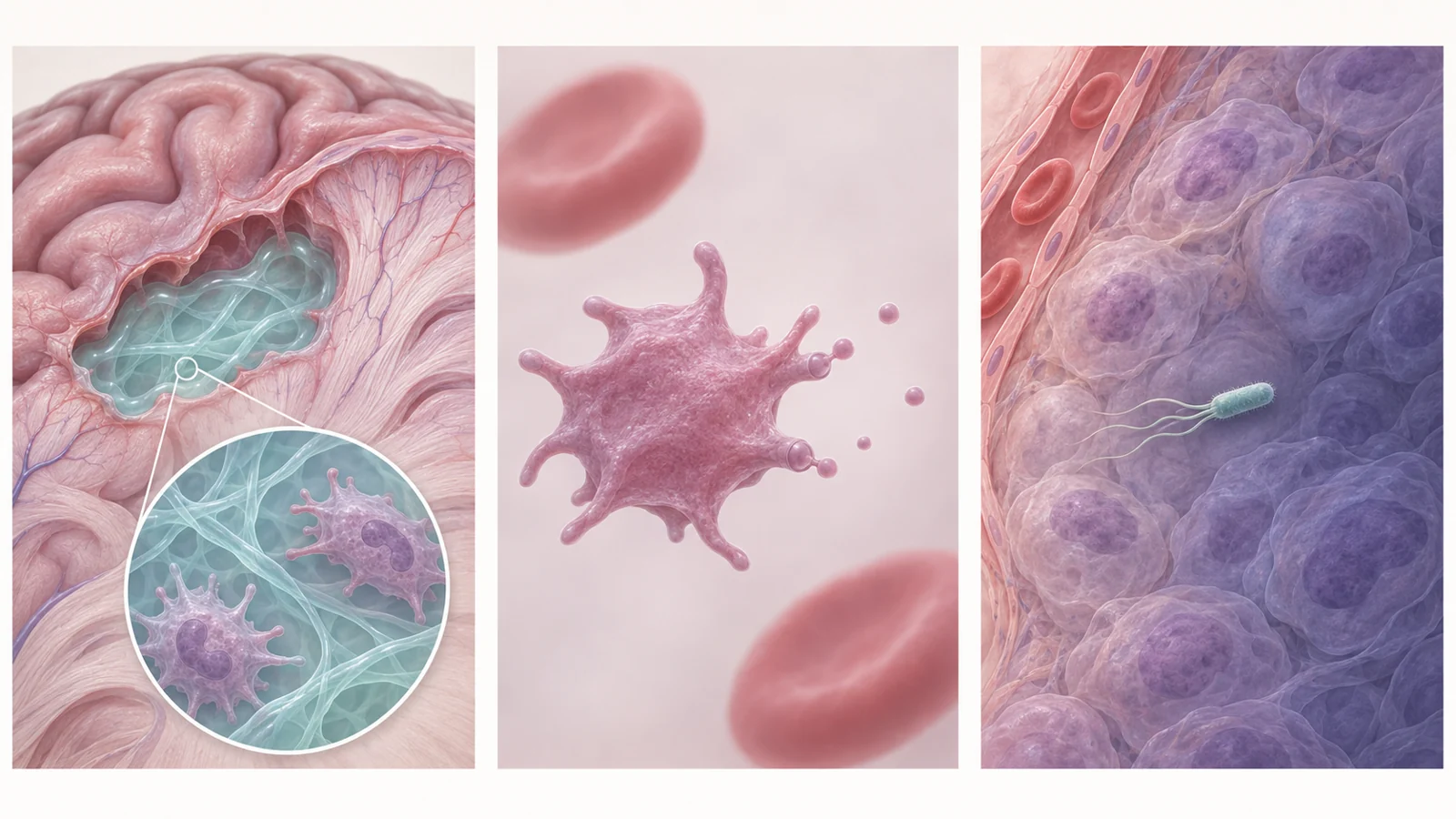
After glioma surgery, the cavity left behind may be a place to deliver treatment locally. The authors describe a hydrogel placed in that space and loaded with nanoparticles carrying plasmids related to a chimeric antigen receptor, or CAR. A CAR is an engineered receptor used to give cells a targeted recognition task. In the reported approach, the nanoparticles were aimed at tumor-associated macrophages, immune cells found in the tumor environment, for gene editing.
The proposed sequence matters. Rather than first removing cells, modifying them in a laboratory and expanding them for return, the hydrogel provides a local delivery route for the genetic instructions. The authors say the approach effectively inhibited tumor recurrence. The abstract available here does not establish the experimental model, size of the effect or how the approach compared with alternatives, so that description cannot be read as evidence of benefit in people.
This in situ strategy changes where some of the engineering work is intended to happen. It may avoid parts of the outside-the-body cell preparation process, but it still depends on getting the intended material to the intended cells and producing a useful, controlled change. Local placement is a design choice, not by itself proof that delivery will be reliable or safe in clinical use.
Platelets and bacteria bring different routes
The platelet example relies on what platelets do when activated at injury sites: release microparticles. The researchers attached antibodies against a target called PD-1 to platelet surfaces as part of an immunotherapy approach. The Account describes this approach as aimed at suppressing postoperative tumor recurrence and providing immunotherapy for inoperable tumors. It is distinct from the glioma-cavity gel: the described therapeutic component is an antibody carried on a platelet surface, not plasmids delivered for gene editing.
Engineered bacteria use another behavior. The authors describe bacteria with an active tendency to move toward sites of inflammation and low oxygen, features associated in their account with tumor locations. They used the bacteria to deliver protein drugs intended to trigger a form of cancer-cell death called pyroptosis and to support immunotherapy. Here, the carrier is a living microorganism and the cargo is a protein drug. The platelet and bacterial examples therefore do not represent interchangeable versions of one delivery system; each starts with a different biological behavior and a different therapeutic payload.
The shared concept is to harness what a living carrier can do, then add a treatment function. That can make a cell or organism more than a passive package, but it also means the design has to account for the carrier itself as well as the drug or genetic instructions it carries.
Translation depends on control as well as manufacture
The practical hurdles sit on both sides of the living-versus-synthetic tradeoff. For living-cell approaches, large-scale production and cost are prominent obstacles identified by the authors. An approach that needs cells to be collected, changed and expanded may be difficult to deliver widely. In situ engineering is presented partly as a way around that laborious sequence, though the supplied account does not establish that it solves manufacturing, cost or clinical delivery challenges overall.
Synthetic bionic cells might offer a different route to production, but the difficulty of reproducing a living cell’s many functions remains. Neither option makes control automatic. A useful therapy would have to deliver its cargo to the relevant cells, perform the intended task, and avoid harmful effects. The examples are research approaches described by the authors; the supplied evidence does not show that they are clinically ready, safer or cheaper, or that patients benefited from them.
Where this research could lead
After glioma surgery, a clinician might one day place a local material in the cavity that gives nearby immune cells a tumor-directed task, without first harvesting and expanding those cells elsewhere. The authors’ hydrogel-to-macrophage approach offers a research bridge to that possible experience. For it to become dependable treatment, delivery control, safety and clinical efficacy would all need to hold up.
A meaningful nearer milestone would be a clearly described, replicated study that measures where the editing occurs, how durable it is, what happens to recurrence and what harms arise. Such evidence could show whether the local delivery idea is controllable enough to justify further development. The Account points toward a possible way of engineering cells in place; it does not yet establish a patient benefit.
Key Sources
- Primary source: Engineering Cells for Cancer Therapy.
DOI or Journal Page · Review or Meta-Analysis · 2024-08-02
Keep exploring